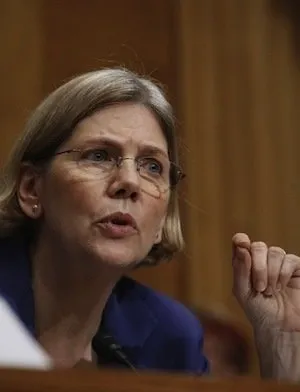
Over the past several weeks, the president and I have had extensive conversations about the vital importance of consumer financial protection.
The president asked me, and I enthusiastically agreed, to serve as an Assistant to the President and Special Advisor to the Secretary of the Treasury on the Consumer Financial Protection Bureau. He has also asked me to take on the job to get the new CFPB started -- right now. The president and I are committed to the same vision on CFPB, and I am confident that I will have the tools I need to get the job done.
President Obama understands the importance of leveling the playing field again for families and creating protections that work not just for the wealthy or connected, but for every American. The new consumer bureau is based on a pretty simple idea: People ought to be able to read their credit card and mortgage contracts and know the deal. They shouldn't learn about an unfair rule or practice only when it bites them -- way too late for them to do anything about it. The new law creates a chance to put a tough cop on the beat and provide real accountability and oversight of the consumer credit market. The time for hiding tricks and traps in the fine print is over. This new bureau is based on the simple idea that if the playing field is level and families can see what's going on, they will have better tools to make better choices.
If the CFPB can succeed at leveling the playing field, we can go a long way toward repairing a gaping hole in the budgets of millions of families. But nobody has ever thought or argued that the consumer bureau can fix everything. Lost jobs, stagnant incomes, rising costs for college, dwindling retirement savings -- there's a lot of work to be done.
When she was 16, my grandmother, Hannie Reed, drove a wagon in the Oklahoma land rush. Her mother had died, so she was up front with her little brothers and sisters bouncing around in the back. When I was growing up, she talked about life on the prairie, about marrying my grandfather and making a living building one-room schoolhouses, about getting wiped out in the Great Depression. She was hit with hard challenges throughout her life, but the moral of her stories was always the same: she would solve her problems one at a time by pulling up her socks and getting to work.
It's time for all of us to pull up our socks and get to work.
Cross-posted from WhiteHouse.gov.
Elizabeth Warren - Wikipedia, the free encyclopedia
Editorial - Elizabeth Warren - NYTimes.com
Elizabeth Warren - The Daily Show with Jon Stewart - 1/26/2010 ...
Please, I really, really want to see folks in very expensive suits handcuffed for their frauds and no longer able to hide behind a corporate entity. Responsibility is personal. Watch a few folks have to trade in $3,000 Italian suits for orange jump suits and the moral climate of Wall Street just may begin to shift.
Best to you/
I also hope your moral ethic would edify the young Geithner somehow, so he joins conscienely the true Americans who work hard to earn rather than side with the snobbish Wall street bankers.
I think I speak for most folks here when I say, "I'm elated that you're aboard."
However, what we've seen so far from this administration is perpetuation of a broken system (I think you recognize it as well.....side-stepping the breaking up "the Goldmans", TARP "if the banks feel up to it - i.e., voluntary inclusion", casino gambling w/derivatives, not to mention main street's bailing out of Wall Street without reciprocity).
We're choking here. We need a hero. To date, we're still awaiting one.
And oh, let us know how we can help you "hurdle" little Timmy. Cuz we know who's pocket he's in.
thanx
What's the most powerful, arrogant and dangerous corporation in the world?
No corporation on the planet comes close to the United States government in sheer magnitude, or unimaginable, unprecedented power.
The nation's top 100 corporations combined still fall far short of the behemoth in Washington, D.C., which conducts extensive operations in agriculture, weapons production, medical care, housing, real estate, education, mail delivery, policing, resource development, banking, the arts, security services, food provision, transportation and much, much more. Within five years, federal spending will consume 25% of every dollar generated by the private economy.
And before you go too far down these free enterprise road, most of the largest so called private companies get most or the largest share of their revenue from the gov.
I wouldn't trust the private sector with anything that remotely should be looked after by the gov. The long list of abuses and failures by the private sector would fill the library of congress 10 times over.
Tyranny comes from government, not corporations.
The object of the classical liberals was to bring about individual liberty in all of its interrelated aspects. In the economy, taxes were to be drastically reduced, controls and regulations eliminated, and human energy, enterprise, and markets set free to create and produce in exchanges that would benefit everyone and the mass of consumers. Entrepreneurs were to be free at last to compete, to develop, to create. The shackles of control were to be lifted from land, labor, and capital alike. Personal freedom and civil liberty were to be guaranteed against the depredations and tyranny of the king or his minions.