iPhone app iPad app Android phone app Android tablet app More

Featuring fresh takes and real-time analysis from HuffPost's signature lineup of contributors
Ellen Brown

GET UPDATES FROM Ellen Brown
 

New State Bank Bills Address Credit and Housing Crises

Posted: 02/27/2012 5:48 pm

Seventeen states have now introduced bills for state-owned banks, and others are in the works. Hawaii's innovative state bank bill addresses the foreclosure mess. County-owned banks are being proposed that would tackle the housing crisis by exercising the right of eminent domain on abandoned and foreclosed properties. Arizona has a bill that would do this for homeowners who are current in their payments but underwater, allowing them to refinance at fair market value.

The long-awaited settlement between 49 state attorneys general and the big five robo-signing banks is proving to be a major disappointment before it has even been signed, sealed and court approved. Critics maintain that the bankers responsible for the housing crisis and the jobs crisis will again be buying their way out of jail, and the curtain will again drop on the scene of the crime.
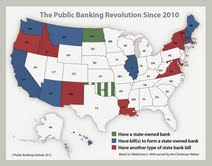

2012-02-26-statebankmap22212.jpg


We may not be able to beat the banks, but we don't have to play their game. We can take our marbles and go home. The Move Your Money campaign has already prompted more than 600,000 consumers to move their funds out of Wall Street banks into local banks, and there are much larger pools that could be pulled out in the form of state revenues. States generally deposit their revenues and invest their capital with large Wall Street banks, which use those hefty sums to speculate, invest abroad, and buy up the local banks that service our communities and local economies. The states receive a modest interest, and Wall Street lends the money back at much higher interest.

Rhode Island is a case in point. In an article titled "Where Are R.I. Revenues Being Invested? Not Locally," Kyle Hence wrote in ecoRI News on January 26th:

According to a December Treasury report, only 10 percent of Rhode Island's short-term investments reside in truly local in-state banks, namely Washington Trust and BankRI. Meanwhile, 40 percent of these investments were placed with foreign-owned banks, including a British-government owned bank under investigation by the European Union.

Further, millions have been invested by Rhode Island in a fund created by a global buyout firm... From 2008 to mid-2010, the fund lost 10 percent of its value -- more than $2 million... Three of four of Rhode Island's representatives in Washington, D.C., count [this fund] amongst their top 25 political campaign donors...

Hence asks:

Are Rhode Islanders and the state economy being served well here? Is it not time for the state to more fully invest directly in Rhode Island, either through local banks more deeply rooted in the community or through the creation of a new state-owned bank?

Hence observes that state-owned banks are "[o]ne emerging solution being widely considered nationwide... Since the onset of the economic collapse about five years ago, 16 states have studied or explored creating state-owned banks, according to a recent Associated Press report."

2012 Additions to the Public Bank Movement

Make that 17 states, including three joining the list of states introducing state bank bills in 2012: Idaho (a bill for a feasibility study), New Hampshire (a bill for a bank), and Vermont (introducing THREE bills--one for a state bank study, one for a state currency, and one for a state voucher/warrant system). With North Dakota, which has had its own bank for nearly a century, that makes 18 states that have introduced bills in one form or another--36% of U.S. states. For states and text of bills, see here.

Other recent state bank developments were in Virginia, Hawaii, Washington State, and California, all of which have upgraded from bills to study the feasibility of a state-owned bank to bills to actually establish a bank. The most recent, California's new bill, was introduced on Friday, February 24th.

All of these bills point to the Bank of North Dakota as their model. Kyle Hence notes that North Dakota has maintained a thriving economy throughout the current recession:

One of the reasons, some say, is the Bank of North Dakota, which was formed in 1919 and is the only state-owned or public bank in the United States. All state revenues flow into the Bank of North Dakota and back out into the state in the form of loans.
Since 2008, while servicing student, agricultural and energy-- including wind -- sector loans within North Dakota, every dollar of profit by the bank, which has added up to tens of millions, flows back into state coffers and directly supports the needs of the state in ways private banks do not.

Publicly-owned Banks and the Housing Crisis

A novel approach is taken in the new Hawaii bill: it proposes a program to deal with the housing crisis and the widespread problem of breaks in the chain of title due to robo-signing, faulty assignments, and MERS. (For more on this problem, see here.) According to a February 10th report on the bill from the Hawaii House Committees on Economic Revitalization and Business & Housing:

The purpose of this measure is to establish the bank of the State of Hawaii in order to develop a program to acquire residential property in situations where the mortgagor is an owner-occupant who has defaulted on a mortgage or been denied a mortgage loan modification and the mortgagee is a securitized trust that cannot adequately demonstrate that it is a holder in due course.

The bill provides that in cases of foreclosure in which the mortgagee cannot prove its right to foreclose or to collect on the mortgage, foreclosure shall be stayed and the bank of the State of Hawaii may offer to buy the property from the owner-occupant for a sum not exceeding 75% of the principal balance due on the mortgage loan. The bank of the State of Hawaii can then rent or sell the property back to the owner-occupant at a fair price on reasonable terms.

Arizona Senate Bill 1451, which just passed the Senate Banking Committee 6 to 0, would do something similar for homeowners who are current on their payments but whose mortgages are underwater (exceeding the property's current fair market value). Martin Andelman calls the bill a "revolutionary approach to revitalizing the state's increasingly water-logged housing market, which has left over 500,000 of Arizona's homeowners in a hopelessly immobile state."

The bill would establish an Arizona Housing Finance Reform Authority to refinance the mortgages of Arizona homeowners who owe more than their homes are currently worth. The existing mortgage would be replaced with a new mortgage from AHFRA in an amount up to 125% of the home's current fair market value. The existing lender would get paid 101% of the home's fair market value, and would get a non-interest-bearing note called a "loss recapture certificate" covering a portion of any underwater amounts, to be paid over time. The capital to refinance the mortgages would come from floating revenue bonds, and payment on the bonds would come solely from monies paid by the homeowner-borrowers. An Arizona Home Insurance Fund would create a cash reserve of up to 20 percent of the bond and would be used to insure against losses. The bill would thus cost the state nothing.

Critics of the Arizona bill maintain that it shifts losses from collapsed property values onto banks and investors, violating the law of contracts; and critics of the Hawaii bill maintain that the state bank could wind up having paid more than market value for a slew of underwater homes. An option that would avoid both of these objections is one suggested by Michael Sauvante of the Commonwealth Group, discussed earlier here: the state or county could exercise its right of eminent domain on blighted, foreclosed and abandoned properties. It could offer to pay fair market value to anyone who could prove title (something that with today's defective title records normally can't be done), then dispose of the property through a publicly-owned land bank as equity and fairness dictates. If a bank or trust could prove title, the claimant would get fair market value, which would be no less than it would have gotten at an auction; and if it could not prove title, it legally would have no claim to the property. Investors who could prove actual monetary damages would still have an unsecured claim in equity against the mortgagors for any sums owed.


Follow Ellen Brown on Twitter: www.twitter.com/ellenhbrown

Seventeen states have now introduced bills for state-owned banks, and others are in the works. Hawaii's innovative state bank bill addresses the foreclosure mess. County-owned banks are being propos...
 
 
  • Comments
  • 15
  • Pending Comments
  • 0
  • View FAQ
Comments are closed for this entry
View All
Favorites
Recency  | 
Popularity
photo
HUFFPOST SUPER USER
A Thomas
02:15 AM on 03/01/2012
California would have the more powerful State Bank in the Nation if not one of the most powerful in the world. We in one motion solve several problems at once with our own bank. Funding for public works projects like 30 in 10 and High Speed Rail - DONE. Additional Schools for the growing population - DONE, Single Payer Health Care, only write ONE check a month - DONE. Return the State Univ to Free Education status - DONE Invest in Alt Energy and Desalination of Sea Water (already underway) - DONE We would bypass the ENTIRE COUNTRY in combined GDP, Commerce and Technology. Also a Gateway to Asia means we would become, what the #3 Economy in GDP???
11:51 AM on 02/28/2012
Prior to 1980 there were two types of financial institutions in a community, commercial banks and savings and loans. The savings and loans were permitted by law to pay higher interest on savings and certificates of deposit but their limit of domain was housing. It was their local speciality and it grew the pursuit of the American Dream, that of home ownership and independence of life. With the deregulation commencing in the Reagan era, we have seen the MBA accountancy drive become profit and this has delivered to us (people) the variations of bust we have observed, the sav & loans crisis 1990 and the subprime mortgage crisis of 2008. The collective speculative thrill of profits is the "evil" doer in each case. In China, for example if you buy a second home, you need 50% downpayment in cash. Those communists actually sound more conservative than our very own Republican high leverage profit mongers.
08:04 AM on 02/28/2012
Government run banks? What businesses should government have control of? Food prices are getting to high, gas prices are getting to high and car prices are getting to high. Should the government take control of all business and natural resources. Is this socialism or maexism. You do like or trust a bank there are other banks, move your money to what ever bank you like. The government motors made 6 billion but look into how. How much money did they get for green energy. Clinton forced bank to loan money to people who could afford the loans, the government caused the problem and now you answer to the problem is the people who caused the problem. Remember glass seagall act that clinton signed, i do not care who introduced it who signed into law.
photo
HUFFPOST SUPER USER
jokelley
Christian Conservative is an oxymoron
09:38 AM on 02/28/2012
I keep asking what law forced banks to lend money to people who couldn't afford the loans. Still have not gotten an answer (because it's not true) but I'll ask you the same. INvestment banks decided to make bad loans and then bet against them. It was very lucrative until the whole thing collapsed. The vast majority of failed mortgages were not under CRA, in case that' what you are thinking. CRA does not apply to investment banks, which made the vaaaaast majority of these bad loans. What would the government have to gain by forcing people into foreclosure, which is what happens when people take out loans they can't afford. The bad loans were often 'No doc" or liar loans which were NOT allowed under any government programs in place then or now. So stop repeating a lie.
photo
HUFFPOST SUPER USER
jokelley
Christian Conservative is an oxymoron
09:39 AM on 02/28/2012
One more question. If banks were only doing what the government was making them do, why are they paying billions in fines for mortgage fraud. They could just say "we were doing what Clinton forced us to do"
photo
Papapaul49
Driver,chief cook and bottle washer, retired LO.
12:44 PM on 02/28/2012
Not quite sure of your point, but as a 25 year veteran of the mortgage biz this notion that government "made" banks do anything is completely false.
The CRA regs incented banks to make more loans to fully credit qualified borrowers who needed more education and support than a standard borrower.
I did hundreds of CRA related loans and everyone had higher requirements and conditions than a standard conforming agency loan.

Even if these loans contributed to the crisis, their numbers were overwhelmed by the
Alt A and subprime crap. Additionally, what govt regulation caused hedge funds to lie about the makeup of a security, bet that it will fail, and take 40 or 50 to 1 leverage?
That's where the problem started.
photo
HUFFPOST SUPER USER
AlanBannacheck
President of the Deep Thoughts Association (DTA)
06:09 AM on 02/28/2012
Having read Web of Debt years ago, you're narrative style (as usual) is brilliant! With 4.44 million mortgages in the U.S. outstanding, which each bring in about 50-80 a month in property taxes (with an average median value of 150,000) what is there to lose?
09:38 PM on 02/27/2012
“Critics maintain that the bankers responsible for the housing crisis and the jobs crisis will be buying their way out of jail, and the curtain will again drop on the scene of the crime.” That pretty much says it all. If we had public banks, none of this would have happened. The politicians make sure the bankers stay in power, get free money and get away with their high crimes; while bankers are the main source of funds for politicians, keeping government corrupt. Talk about a vicious circle! The ying and yang of our economic oppression.
photo
Si1ver1ock
Follow the Woz. Emmigrate to Australia.
08:56 PM on 02/27/2012
It is hard for me to follow all the ins and outs, so it is nice to Ellen Brown do it for us. Go Ellen!
photo
ClassicalGas
Colorado Rocky Mountain Hi!
08:34 PM on 02/27/2012
Come on, Colorado! Let's get moving on this!
photo
HUFFPOST SUPER USER
R A Bows
07:52 PM on 02/27/2012
Great to see so many states becoming aware of how they can take charge of their own economies by moving their money (local tax revenues) out of Wall Street banks and leveraging it in the public interest, just like North Dakota has done so successfully for 93 years. The big banks, of course, are desperately opposed to this freedom from their debt-slavery system and will stop at nothing to discredit public banking and threaten local politicians who support it.
09:02 PM on 02/27/2012
I'm not aware of any desperate resistance of the TBTF banks to public banking on the BND model. What worries them is the flight of depositors and their bad press, seems to me.

The Bank of North Dakota is no threat. Ellen quotes Kyle Hence:"....every dollar of profit by the bank( the BND)........... flows back into state coffers and directly supports the needs of the state in ways private banks do not." This is a misunderstanding of the way the BND operates. Kyle Hence, like many others, hears the term "public banking" and this triggers his repressed socialist inclinations. (The BND was a socialist enterprise back in 1919.)

The fact is that the BND does not loan directly, but "participates" in loans made by private banks. It underwrites the risk and guarantees the profits of these private banks. If the private banks get into trouble, not likely at present, the BND (read "taxpayers") will bail them out, just like the government bailed out these TBTF crooks. It is not a public bank in the way most people understand that term.

I would hope that one of these state proposals would create a public bank that COMPETES with the private sector banks in some areas, such as infrastructure loans,and other public interest undertakings. It is wrong to use state funds to support private banks. The private banking system is not really user friendly.

It is usury friendly. We don't need it.
photo
HUFFPOST SUPER USER
jtenn
11:45 AM on 02/29/2012
Screw'em!