iPhone app iPad app Android phone app Android tablet app More

Featuring fresh takes and real-time analysis from HuffPost's signature lineup of contributors
Ellen Brown

GET UPDATES FROM Ellen Brown

Forget Compromise: The Debt Ceiling Is Unconstitutional

Posted: 08/01/11 06:04 PM ET

The game of Russian roulette that was recently played with the U.S. federal debt has been called a "grotesque political carnival" and political blackmail. The uproar stems from a statute that is unique to the United States and never did make much sense. First passed in 1917 and revised multiple times since, it imposes a dollar limit on the federal debt. What doesn't make sense is that the same Congress that voted on the statute votes on the budget, which periodically exceeds the limit, requiring the statute to be revised. The debt ceiling has been raised 74 times since 1962, 10 of them since 2001. The most recent increase, to $14.294 trillion by H.J.Res.45, was signed into law on Feb. 12, 2010.

Taxes aren't collected until after the annual budget is passed, so Congress can't know in advance whether or how much additional borrowing will be required. Inevitably, there will be some years that the budget pushes the debt over the limit, requiring new legislation. And inevitably, now that this tactic has been discovered, there will be a costly battle over the increase, wasting congressional time, destabilizing markets, and rattling faith in the American financial and political systems. There will be continual blackmail, arm-twisting and concessions. The situation is untenable and cries out for a definitive resolution.

Fortunately, there is one. A bevy of legal scholars are recommending that the issue be eliminated altogether by playing the Constitutional trump card. The Fourteenth Amendment provides at Section 4: "The validity of the public debt of the United States, authorized by law, including debts incurred for payment of pensions and bounties for services in suppressing insurrection or rebellion, shall not be questioned."

Where statute and the Constitution collide, the Constitution prevails. Whether the government should pay the bills it has already incurred is not a matter of negotiation. It is a Constitutional mandate. And those are the bills we are talking about here, as President Obama stressed in his remarks on the issue this past Friday, July 29. He said:

Raising the debt ceiling simply gives our country the ability to pay the bills that Congress has already racked up. I want to emphasize that. The debt ceiling does not determine how much more money we can spend, it simply authorizes us to pay the bills we already have racked up. It gives the United States of America the ability to keep its word.

Raising the debt ceiling on Constitutional grounds would not, as Michele Bachmann declares, make President Obama a "dictator." It would simply mean that he is complying with his Constitutional mandate to pay the government's bills on time and in full.

Social Security Is Not Welfare But A Debt Due And Owing

The president could have had a clean resolution of the issue, but he did not jump at the opportunity. Rather, he allowed Granny to be thrown under the bus with a deal that slashes Social Security, Medicare and Medicaid, all in the name of "compromise."

The Fourteenth Amendment says that debts already incurred shall not be questioned, "including debts incurred for payment of pensions." That includes Social Security, which is an "entitlement" in the true sense of the word: we're entitled to it because we've already paid for it. In fact, the Social Security Act was originally sold to Congress and the nation in 1935 not as a government benefit but as a retirement savings program. Earlier this year, the Urban Institute published a study evaluating the program in this way, concluding that the average worker who retires today will withdraw from Social Security just about the same amount he put in over the years, with a modest 2-percent real interest rate (after inflation).

A deal is a deal. We paid for Social Security, we are owed it, and the U.S. government is good for it. To change the terms of the deal ex post facto is both a breach of contract and a violation of the Constitution.

Where To Get The Money: Ron Paul's Creative Plan

A sovereign nation can always find the money to pay debts owed in its own currency. The U.S. could, if it wished, pay its bills using debt-free U.S. Notes or Greenbacks, just as President Lincoln did to avoid a crippling debt during the Civil War. Alternatively, it could eliminate the deficit with Ron Paul's plan, which amounts to the same thing. As Stephen Gandel explains Paul's solution in Time magazine:

In the last year or two the Fed has been buying up U.S. Treasury bonds in an effort to lower interest rates and boost the economy. The most recent round of that buying has been dubbed QE2, and has come under a good deal of criticism, though most economists agree that it was a generally helpful policy. The result is that the Fed now holds nearly $1.7 trillion in U.S. debt. But that is really phony debt. The Treasury pays the interest on the debt on behalf of the U.S. government to the Fed, which in turn returns 90 percent of the payments it gets back to the Treasury. Nonetheless, that $1.7 trillion in U.S. bonds that the Fed owns, despite the shell game of payments, is still counted in the debt ceiling number, which caps that amount of total federal debt at $14.3 trillion.

Paul's plan: Get the Fed and the Treasury to rip up that debt. It's fake debt anyway. And the Fed is legally allowed to return the debt to the Treasury to be destroyed. A trillion and a half dollars is currently about what spending is expected to exceed tax revenue in 2011.

The biggest drawback to the plan, says Gandel, is just that it "looks bad." It looks as if the government is paying off its debts by printing money. But that is what government-issued money is: a note acknowledging a debt due and owed from the public, good for an equivalent value from the public, traded in the marketplace. A U.S. Note or Greenback and a Federal Reserve Note or dollar bill are both forms of promissory notes. The government can as easily issue a dollar bill as a dollar note or a dollar bond, as Thomas Edison pointed out in the 1920s.

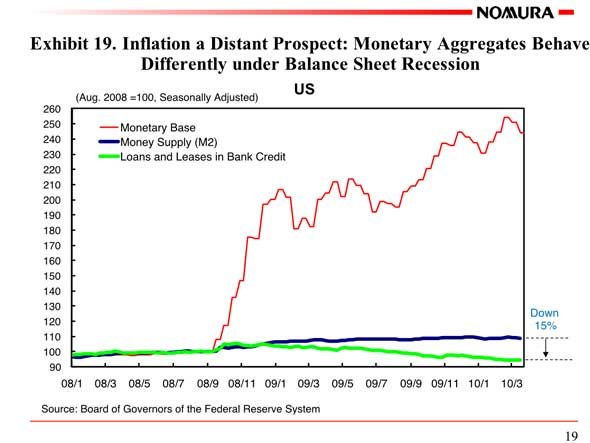
The objection to that solution is that it would be inflationary, but as economist Richard Koo graphically demonstrates, the Fed's quantitative easing has had virtually no inflationary effect on the money supply to date:
2011-07-31-RichardKoos.jpg


Time To Close The Debt Ceiling Loophole

The debt crisis was created not by a social safety net bought and paid for by the taxpayers but by a banking system taken over by Wall Street gamblers. The gamblers lost their bets and were bailed out at the expense of the taxpayers; and if anyone should be held to account, it is these gamblers.

The debt ceiling crisis was a manufactured one, engineered to extort concessions that will lock the middle class in debt peonage for decades to come. Congress is empowered by the Constitution to issue the money it needs to pay its debts. Abraham Lincoln did it; Barack Obama could have done it. He didn't, but he does need to follow his Constitutional mandate to pay the government's bills as and when due. The statute imposing a ceiling on the national debt is trumped by the Fourteenth Amendment, making it redundant and unnecessary. The statute should be repealed.


Follow Ellen Brown on Twitter: www.twitter.com/ellenhbrown

The game of Russian roulette that was recently played with the U.S. federal debt has been called a "grotesque political carnival" and political blackmail. The uproar stems from a statute that is uniq...
 
 
  • Comments
  • 22
  • Pending Comments
  • 0
  • View FAQ
Comments are closed for this entry
View All
Favorites
Recency  | 
Popularity
08:42 AM on 08/05/2011
The FED was established as our central bank with the responsibility of issuing money and the dual-goal of minimizing both inflation and unemployment. One of the reasons for placing the money issuance authority with the FED was to purposely remove that authority from Congress where the political whims of the day coupled with a gross ignorance of economics and finance pose a constant threat of extreme levels of either inflation or deflation.

The FED has failed in its role of minimizing unemployment, but has actually done a decent job in recent decades on its inflation targets. There are those who actually want to now remove the unemployment minimization goal from the FED's responsibility and have the FED focus entirely on controlling inflation.

The only reason we are not seeing higher inflation today is that the dollar is overvalued due to its status as a reserve currency and the comparably poor economic and financial conditions currently affecting the Euro. The fundamental economic conditions in the US, and especially the deficit and debt levels are not supportive of a strong dollar. If the Euro was stable it would be seen as a viable alternative to the dollar, the dollar would fall in value with the Euro replacing the dollar as reserve currency. The drop in dollar value would drive inflation upward. And there is little that the Fed could do to control that.

There are many pieces in this puzzle and we are wandering about in uncharted waters. Anything is possible.
photo
HUFFPOST SUPER USER
R A Bows
11:58 AM on 08/03/2011
As Brown shows, the whole debt issue is a hoax, perpetrated to cut social programs and shift tax revenues to the international banking cartel, which long ago usurped our sovereign currency and credit (as it has for most of the world), and its subsidiary corporations (war profiteers, big oil, big pharma, etc.).
photo
HUFFPOST SUPER USER
politicky
just follow the $$$
12:31 AM on 08/03/2011
Ms Brown,

I am enjoying your book "Web of Debt," and recommending it to anyone who will listen. Thank you for writing it.
05:03 PM on 08/02/2011
Just who owes all that money?
Most of it is owed by the Federal Reserve, a private company. By the looks of it, the Fed is bankrupt. So shut it down and go back to having the Federal Government print money, as it is authorized to do.

People holding "Federal Reserve Notes" might get burned...drug dealers, etc. But it's a small price to pay.

And if the Fed won't roll over and play dead, have the Treasury print money anyway, and see which prevails in the open market.
01:54 PM on 08/02/2011
I would only add that in addition to this being an underhanded way of crushing entitlements,
it also creates a "committee" called Super-Congress. This group's recommendations
can only be voted up or down, no fillibuster or amendments. Once you've got a Super-Congress,
who needs the regular one?

Able to kill entitlements in a single piece of legislation,
more powerful than the constitutional regular congress,
faster than an informed public.
Look! up in D.C.
it's a committee, no it's a governing body, no it's Super-Congress.
This user has chosen to opt out of the Badges program
photo
01:51 PM on 08/02/2011
"...The debt ceiling crisis was a manufactured one, engineered to extort concessions that will lock the middle class in debt peonage for decades to come. Congress is empowered by the Constitution to issue the money it needs to pay its debts. Abraham Lincoln did it; Barack Obama could have done it..."

He didn't do it because he is assuredly well awarer that the fates of Lincoln, McKinley and Kennedy were not merely "coincidental" to their loathing of a national monetary system in the hands of a private banking cartel. And besides, today one does NOT rise to the position of U.S. President without first being "approved" by the powers that be.

Ellen, I just finished reading your book, "Web of Debt". Without a doubt, the best of it's genre I've read so far. It's a Must Read for everyone..... Bravo!

Thanks
11:20 AM on 08/02/2011
Many are suggesting that the solution to the ongoing debt crisis (its not over) is simply “to live within our means” which makes sense on an individual basis but is disastrous to a national economy. To understand the implications of this fallacy we must first identify the limits of our “means.”

It is impossible to exceed our physical means (labor and resources) to produce so that is not a concern other than it is highly desirable to have full employment. If we artificially attempt to limit production the result will be higher unemployment than is necessary, austerity and the loss of social benefits. Surely, the “live within our means” proponents are not suggesting that we limit production – so what are they really suggesting?

I think it is safe to say that they are suggesting that we “live within our financial means” as opposed to reducing our productive capacity. If our national financial system limits production and consumption then there is something wrong with the system as it is limiting our collective potential.

Imagine if you needed to fly to distant destination, and there were plenty of seats available on the flight but you were told you could not board. The reason - they ran out of tickets and could only fill half the plane.

A sovereign government should never borrow money as it may be freely issued instead. Sovereign credit may be used WITHOUT incurring debt.
11:05 AM on 08/02/2011
Bravo! To use this argument, we will need more of the Harry Truman or Theodore Roosevelt attitude in the White House -- someone willing to tell the Tea Party exactly where to put the tea. The legal brief seems pretty clear here.
10:53 AM on 08/02/2011
Sounds like politicians are magicians using slight of hand to live in the world of make believe. Ok, lets make write a make believe check to pay our bills and tell creditors our bills are paided..and see how long that will last..before it hits the fan!! Theyve been maneuvering for so long, and avoiding reality, that any scheme seems good. Oh, for politicians who actually want to make american solvent again!!
photo
Si1ver1ock
the bread of wickedness, the wine of violence
10:23 AM on 08/02/2011
"A U.S. Note or Greenback and a Federal Reserve Note or dollar bill are both forms of promissory notes. The government can as easily issue a dollar bill as a dollar note or a dollar bond, as Thomas Edison pointed out in the 1920s."

Yes!

One of the best articles ever!
This user has chosen to opt out of the Badges program
photo
02:00 PM on 08/02/2011
If you think this article is great, you have to read Ellen's book, "Web of Debt".
A stunning piece of scholarship.
It will 'Blow You Away"
Happy reading
F&F
SeriesSeven
Progressivism is a disease.
09:37 AM on 08/02/2011
It's amazing what lengths progressives will go to read anything they want into the constitution. The 14th amendment means that we can't cut social security? Did you forget the part in the 14th that specifically denotes pensions for services in suppressing insurrection and rebellion? You think that social security recipients earned their payments by supressing insurrection? Seriously?

There is one component of SS that does fall under the 14th. That is the so called "trust fund". the $2.7 trillion or so that was already converted as issued debt by the US Treasury. Without a doubt, this is covered under the 14th because that has already been bonded debt. But the idea that congress is bound to increase the debt limit because of the 14th is preposterous. Debt is a mechanism of funding. Congress has, under its enumerated authority, placed a limit on that funding mechanism. It could likewise place a limit on taxes or spending as well. Congress could also lift the debt limit entirely. But claiming that the President somehow has authority to bypass constitutionally enumerated powers of congress is beyond ridiculous (even the WH lawyers agree). But like most progressives, you fail to read the entire article. Article 5 of the 14th amendment reads:

"The Congress shall have power to enforce, by appropriate legislation, the provisions of this article."

Read that? It says "The Congress"...not the president. And Congress has passed appropriate legislation by issuing a debt limit.
photo
HUFFPOST SUPER USER
joebhed
Greenback Revolutionist
11:52 AM on 08/02/2011
You may be right that the security of social security is not tied to the 14th.
Albeit, that's a small point.
SS should not even be discussed relative to the debt-limit, except as debt instruments relate to the SS fund.

But your claim that Congress has passed appropriate debt-ceiling legislation as relates to the "not to be questioned" language in the 14th seems vacuous, given the debt-ceiling's Liberty Bond history.
We would lose nothing but political brinksmanship were we to follow the author's advice and repeal the debt-ceiling legislation.
Neither here nor there.

The author claims that the money-issuing power of the government is the prevalent construct, and as such the government can issue its deficit balances as real money creation, thus avoiding the issuance and accumulation of any national debt.
This is all that is necessary to avoid what the author describes as this " "grotesque political carnival" and political blackmail" with the debt-ceiling.
This seems the main issue to me.
If she is correct on that point, then the histrionics on the status of our social security obligations is irrelevant.
And, if she is correct on that point, we already have seen legislation proposed by Congressman Dennis Kucinich to so end the issuance of government debt and to fund deficit balances through a public money issuance.
http://kucinich.house.gov/UploadedFiles/NEED_ACT.pdf
The repeal of the debt-ceiling would be automatic under the Kucinich Bill
For the Money System Common.
photo
HUFFPOST SUPER USER
mbbythesea
09:14 AM on 08/02/2011
I wish the US gov't would pay off foreign debt once and for all with treasury bonds purchased by the treasury and then simply cancel the debt. Why not? During the recent hostage taking, it was apparent that the negotiating problems were a result of our faulty election system. Having Tea Party pols purchased by billionaires & most other pols by various corporate sponsors has created a destructive dynamic not conducive to reasonable solutions. Tea Party advocates ignored polls of what 60% of their constituents wanted (i.e. taxes on rich, corps & preservation of Medicare) to follow the mandate of their billionaire sponsors. I support www.fairelectionsnow.org to resolve.
SeriesSeven
Progressivism is a disease.
09:40 AM on 08/02/2011
Brilliant. In a article supposedly exalting the virtues of the 14th amendment debt provision, a progressive suggests that we "cancel the debt". Do you not understand that this is precisely what the 14th amendment says you cannot do? Would you prefer this country to be Rwanda or Zimbabwe. What a childish suggestion.
photo
HUFFPOST SUPER USER
joebhed
Greenback Revolutionist
12:08 PM on 08/02/2011
First of all the article uses noted conservative politico Ron Paul, who copies the writings of several noted Austrian economists, on the feasibility of paying off the national debt using government-created monies.
So, it's not merely a progressive political ploy.
Again, using the Kucinich Bill, the national debt would be paid off when due.
http://kucinich.house.gov/UploadedFiles/NEED_ACT.pdf

Second, the comment states that the national debt held by foreign countries should be paid off. This honors the holders of the debt with the exact thing they want - their money back. The canceling of the debt would be at Treasury, like when your bank cancels out your Promissory Note for your Loan. The 14th Amendment has no bearing whatever on such a move.

If we DID create the payout monies at a $Trillion per year, rather than merely whenever due, that would be like 7 percent of the money supply. Considering the benefits available from liquidating all government debt, and considering that Zimbabwe and Weimar increased their currencies by 150 BILLION TIMES IN ONE YEAR, as opposed to seven percent, which would be a doubling in 10 years, it is your suggestion that is childish here.
06:53 PM on 08/01/2011
Social Security is an obligation to be paid. However, the terms can, must and has been changed. One thing that I believe must change, however, is make it optional. Many younger people are willing to opt-out of the system and fend for themselves. They believe they can better manage their money, and that is a choice that can be made, and they must live with it.

Greenbacks caused inflation, so that is not a good option. However, Ron Paul's plan is not on the same level as Greenback. In fact, ripping up the Fed debt may help ease inflationary concerns. Without that existing debt, the Fed won't be able to liquidate it on the open market like planned. Once that hits the market, there is a greater risk for inflation. To that point, that is why according to your chart, there has not been much inflation due to the QE programs. That monetary base has effectively been insolated from the market.
photo
HUFFPOST BLOGGER
Ellen Brown
author Web of Debt; chrm Public Banking Institute
03:00 AM on 08/02/2011
The Greenbacks did not cause inflation; this is a misconception. I've detailed all that in my book "Web of Debt."

QE has been insulated, and that's why it hasn't helped the economy or the credit situation for small businesses, which generate jobs. Insulating it was a mistake. If it went to the national budget, which goes for the purchase of goods and services, it would have added to "demand," driving an increase in "supply." When supply and demand are in balance, prices remain stable.
photo
HUFFPOST SUPER USER
mbbythesea
09:21 AM on 08/02/2011
Exactly! most of QE money went to patch up the balance sheets of banks--particularly foreign banks with mtg losses. Banks have not reciprocated by increasing lending, so the benefits of QE to the real economy are very limited. I proposed that regulators ease up on their reserve requirements if banks restructure the negative equity portion of underwater mtgs to 0% interest and sponsor exchange mtgs if homes are still unaffordable. Stabilizing homeowners will benefit the real economy--and if decreased reserves become problematic--loans from the Fed discount window can be increased with treasury purchasing the bonds & canceling interest due. At least this way, consumers & communities realize some benefit which will help the real economy.
06:53 PM on 08/01/2011
I first have to commend you on a well written piece. It's rare these days that anyone doesn't get down to name calling and the blame game.

The debt limit statute has become a political scare tactic. I believe it was well intentioned to begin with, but is only used to make the people believe that Congress has to do something or something bad is going to happen, so the people will be glad we are going into more debt.

The whole default debate is over a cash flow problem, not a debt issue. They don't have enough funds to spend to this excessive level. The argument that we must raise the limit to pay bills just means that we have spent too much elsewhere and don't have enough money left to pay the debts.

However, I don't believe it is unconstitutional. Since this was well forcast, the treasury should have not been spending so much knowing that the limit was coming. There is no questioning the validity of the existing debt, it just may be delayed in payment. For example, if you miss your mortgage payment, it doesn't cancel the validity of the debt. So the 14th amendment argument is a non-starter. Plus, the President can't unilaterally try to invoke it regardless, since it states the Section 5 that the Congress is responsible for the implementation on the Article.
photo
HUFFPOST BLOGGER
Ellen Brown
author Web of Debt; chrm Public Banking Institute
02:56 AM on 08/02/2011
He doesn't need to invoke it. He just needs to pay the bills on time and when due, because that's what the Constitution says. It's up to somebody else to challenge him, and I read in a legal treatise that nobody actually has standing to challenge him in court except somebody who is "damaged." The article could only think of hedge funds, which aren't exactly favored litigants these days.