Ed Note: Ellen Kanner will be writing weekly posts with vegetarian recipes for HuffPost Green's new Meatless Monday
CBS News recently spotlighted Chandler, Arizona's Heart Attack Grill, home of the 8,000 calorie quadruple bypass burger. Their motto -- "a taste worth dying for." The Heart Attack is madly popular and the folks running it are just being cheeky, but think about their message -- they're saying to value one meal over your health and the health of the planet. Ain't no burger in the world worth that, ace.
A new National Cancer Institute study links daily meat consumption with heightened mortality risk. Eating meat shortens your life. It doesn't do much for the planet, either. Beef production destroys habitat and boils over with greenhouse gases (cow flatulence equals major methane production). Nobel economist Dr. Rajenda Pachauri, who chairs the United Nations Intergovernmental Panel on Climate Change, says to slow the affects of global warming, go meatless one day a week.
Pachauri's message isn't new. "Nothing will benefit human health and increase chances for survival of life on earth as much as the evolution to a vegetarian diet." So said Albert Einstein back in 1921.
Einstein was no dummy. And neither are you. You know our relationship with food goes beyond a single burger, no matter how big it is. Politics, the environment, your health, our whole future is sitting down at the table with us. That's a crushing lot to think about when all you want is dinner.
Happily, going meatless is one-stop shopping, multitasking at its very best. It's green, as in environmentally responsible and also as in vital and alive. It promotes positive global change, encourages you to eat locally and seasonally, reduces your pesky carbon footprint, saves you money, maybe even saves your life -- we're talking valuable stuff lasting far beyond a single meal.
So do you want to be the change you want to see in the world, or what? I could go all political and PETA on your ass, but bodaciousness beats brow-beating any day. Plant-based cuisine is luscious. Fresh produce entices naturally. A meatless life, or even a meatless Monday is not about deprivation. It is not about a taste worth dying for, it's about a taste worth living for, fresh, fabulous food full of life force.
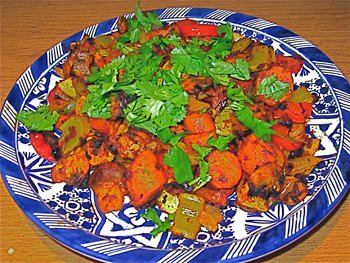
Produce with the life (force) cooked out of it is not nice for you. Nor is it nice for the vegetable. Recipes like this one will redeem the experience of a vegetable done wrong. Bright with lemon and herbs, it features summer's fresh-from-the-farm stand produce (think cheap, think sustainable) and involves roasting, which brings out vegetables' inherent sweetness. Feel free to substitute anything gorgeous you see at the farmers market for the produce here -- yellow squash works instead of zucchini, throw in some green beans or grape tomatoes if the spirit moves you.
Kinda spicy, kinda sexy, very easy, very healthful and your plate will be a meat-free zone. You can take quadruple bypasses off the menu, rack up serious positive personal and global karma and who knows, you might start looking forward to Mondays.
Tunisian Roasted Vegetables
4 cloves garlic, minced
1 red pepper, cut into strips
3 carrots, sliced
1 zucchini, sliced
2 ribs celery, sliced
8 ounces mushrooms, quartered (or halved, if small)
1 large onion sliced
2 tablespoons olive oil
1 tablespoon harissa (Moroccan chili sauce) or chili sauce
2 tablespoons tomato paste
1 teaspoon ground cumin
1 tablespoon lemon juice
a pinch of sea salt
1 bunch cilantro, chopped fine
Slice and chop vegetables. Set aside.
In a large bowl, add olive oil, tomato paste, harissa, cumin and lemon juice. Stir together until it forms a thick, smooth sauce. Add vegetables and minced garlic and toss to coat.
Place vegetables on cookie sheet or shallow roasting pan and roast at 400 for 15 minutes. Give vegetables a stir. Roast for another 15 minutes or until vegetables are tender. Salt to taste and garnish with chopped cilantro. Kinda spicy, kinda festive, very easy, very healthy.
Serve over whole grain couscous, brown rice or quinoa (super-high protein and low in calories). Throw in a salad, some cheese, a loaf of crusty bread and you're good to go.
Serves 4.
Follow Ellen Kanner on Twitter: www.twitter.com/edgyveggie1
Marcus Samuelsson: 10 Unique Vegetarian Recipes
Meatless Monday - Wikipedia, the free encyclopedia
Kathy Freston: Meatless Mondays
Eat Healthy Monday - Meatless Monday for Earth Day | Sustainable Table
Go Meatless On Monday: Even Just One Day a Week Makes a Difference ...
Meatless Monday, a non-profit initiative of The Monday Campaigns ...
Additionally, 'dairy products' would include milk, cream, yogurt, and other foods that contain animal fat, yet are liquid at cold temperatures. These animal-fat-containing-foods will not suddenly seize-up and solidify in a 37C human body, when they are liquid at 4C.
Read what RMankovitz said below.
www.westonaprice.org/soy/soyandbrain.html
I know of no studies showing grass fed meats are damaging to one's health - they are all based on grain fed meat. The nutritional and lipid profiles of grass vs grain fed meat are radically different. The large methane burps from cattle are based on grain feeding. New studies (published on HuffPo) show when you switch them to grass, burping is markedly reduced. As it now stands, worldwide, termites arguably produce more grams of methane than livestock. Per pound of protein, grass-fed buffalo appears to use less environmental resources than annual unsustainable monocrops such as grains or beans.
Because I care about the environment, I do not eat any food containing more than one ingredient, or that requires a plow to produce it, or which cannot be digested without prior human processing.
For background, consult the hundreds of references in "The Vegetarian Myth" by Lierre Keith, "Against the Grain" by Richard Manning, "The Whole Soy Story" by Kaayla Daniel, "Plows, Plagues and Petroleum" by William Ruddiman, and "the Original Diet - The Omnivore's Solution", by me. Ask your librarian for copies.
Roy Mankovitz, Director
www.MontecitoWellness.com
Fortunately, your suggestion addresses both issues. The reason we use factory farms with all their attendant ills has to do with demand. A factory farm is the only way to supply the sheer volume of meat that the American people (among others) want to be eating. I agree with you that we should all be eating, exclusively, meat that is organic, free-range and grass-fed, but that WILL require that we eat far less of it, because there is no way that, acre for acre and pound for pound, a farm like that will be able to produce the amount of animal protein that we've come to take for granted. At least not without utilizing far more land, which I think you'll agree isn't the best solution.
Without firm figures available, I would guess that a 75% reduction in the average person's meat intake would allow for your ideal cattle operations to become the norm, rather than the freaky exception only found at Whole Foods (if anyone here has done the math, feel free to correct me). In addition, we improve our health and dramatically slash both methane and carbon emissions associated with meat production.
Her is another view of the issue, somewhat depressing.
I subscribe to the hypothesis that the current human population far exceeds the planet’s carrying capacity, perhaps by double. Feeding the population is only part of the problem. We seem to be running out of safe places to dump the toxic wastes we generate, and we may well drown in our own effluent.
Ironically, GM Frankenfoods might just solve the world hunger and population problems over the next few generations, but not in the way you would expect. From research on the effects of GM foods on animals (illness and failure to reproduce), it could be just a matter of time until humans will feel the same effects of eating this junk- susceptibility to illnesses (such as pandemics and epidemics) for which there are no cures (perhaps already happening), and low sperm count in men and infertility in women (perhaps already happening).
The resulting increase in death rate and decrease in birth rate could speed up the process used by nature to deal with other species that exceed the carrying capacity of their environment – a path toward sustainability - or extinction. This time, we may have pushed nature too far to fix it. The clock is running, and we are not the timekeeper.