
Brian Kimmel is not meatless. This worried him during our interview. "As a vegan," he asked, "what did you think of the movie?"
The movie he means is the food documentary Ingredients. Kimmel is producer and cinematographer.
"You know that scene on the farm with all those cute lambs?" I said. "I wanted to set them free."
Why, then, would I feature Ingredients and Kimmel in a Meatless Monday post? Because we both believe in bringing conscious food choices to the table, we just have different ways of doing it.
Ingredients, now out on DVD, has been making the rounds at film festivals and for a food documentary, is happier than you'd expect. "We've all seen and read stories about everything that's wrong with food. People like the fact that it's celebrating what's right with food." That has much to do with Kimmel himself, who believes positive change is possible -- starting with himself. This is a guy who grew up eating "food from Safeway. I was the classic kid who wouldn't explore food." Kimmel laughs.
He came to explore food for a living, revealing its beauty and vitality through his camera lens. Kimmel became the darling of chefs during the '90s, that time of wretched excess, when the more expensive and elitist an ingredient was, the further away it came from, the better. "I worked for high profile chefs and was really impressed and awestruck with what these people were doing, but something was missing," he says. "I didn't have the whole story. I was looking at where their food came from. That got me looking at this particular story."
Ingredients is eloquent, edible argument for sustainability and seasonality -- concepts Kimmel had to learn. "I grew up in California, so I wasn't in touch with seasonality." The fact is, when it comes to what we eat, most of us aren't. Blame our Twitter-happy lives, blame the industrial food system, but we've lost out on the gustatory pleasures each season brings. Ingredients brings that all back with interviews with sustainability advocates like Gary Nabhan and Alice Waters and with those in the field -- literally -- farmers like Anthony and Carol Boutard who raise their produce with care and consciousness. They remind you how precious food is.
"Seasonality teaches me awareness," says Kimmel, now based in Portland, Oregon. "I look at things differently. Getting in touch with that cycle has been something new and wonderful."
Granted, it's not so new. "Our grandparents or great grandparents had some connection to the farm, it's only in the last couple generations we've created this nightmare foodwise."
What Kimmel and Ingredients call for is no less than a return to that connection, to valuing -- even growing --q sustainable, seasonal, locally grown food. Sounds big, but "it's a simple thing and really pleasurable," says Kimmel. Join a CSA (community shared agriculture program), go to your local farmers market, cook, grow your own food. Kimmel is. He's planting kale and looking ahead to winter crops like onions, parsnips and turnips. Not bad for a guy who "had no connection whatsoever with what food came from. This is been slow-going revolution for me in terms of awareness," he says with something akin to awe.
A green, sustainable world and enough fresh food to feed us all requires change at every level, from government policy to education, from eating less meat to eating more seasonal produce. Ingredients focuses on the personal and the possible.
"You start to take a look at what's happening politically, economically -- it's out of your control. Food is not," says Kimmel. "If people understand the impact of their purchases, it can create great change. The hopeful side of me is looking at this point in our history as one of beginning -- we'll look at the mistakes we made, correct them and go back to something that's worked for a long time."
As Kimmel says, "There's no way to get around it -- food is the biggest part of our lives. This is something we have to respect and nurture. All the other things -- policy, debates, efficiency versus small family farms -- become sort of irrelevant."
And we both agree change begins with feeding people "a really good meal."
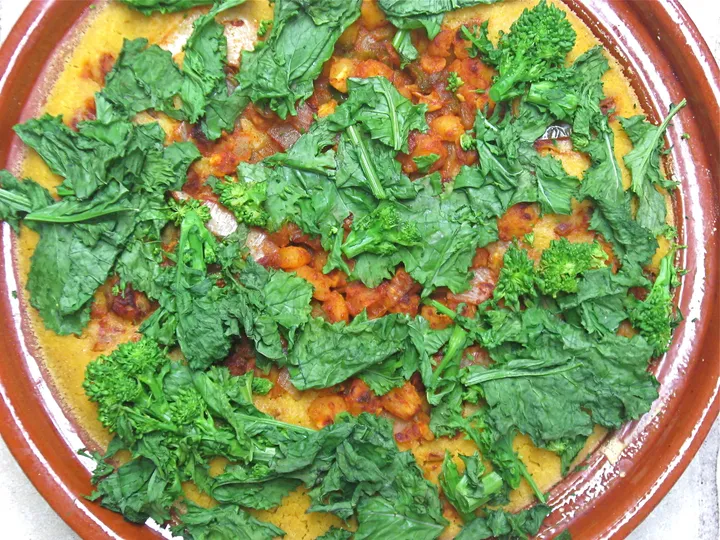
Tamale Pie with Winter Greens
6 tablespoons olive oil, divided use
1 onion, chopped
1 jalapeno, chopped
4 cloves garlic, chopped
2 tablespoons fresh oregano, preferably Mexican, chopped
1 15-ounce can hominy, rinsed and drained (or the kernels cut from from 2 ears of fresh corn, if you still have some in season)
1 tablespoon paprika
2 cups water or vegetable broth
2 cups corn meal
2 teaspoons baking powder
sea salt and pepper to taste
1/2 cup grated cheddar (optional)
2 cups chopped broccoli rabe, kale, chard or other seasonal green
salsa, sour cream and/or guacamole for garnishPreheat oven to 375. Lightly oil 9-inch deep dish pie pan or 8 X 8 ovenproof baking dish.
Set out a generous-sized roasting pan big enough to fit the prepared baking dish. Fill about halfway with water. Place inside oven on oven rack.Heat 1 tablespoon oil in a skillet over medium-high heat. Add chopped onion, jalapeno and garlic, stirring briefly, until the vegetables soften, about 7 minutes.
Add hominy or corn, chopped oregano and paprika, stirring until mixture is well combined. Remove from heat and set aside.
In a large bowl, combine corn meal and baking powder. Pour in water or vegetable broth and the remaining 5 tablespoons olive oil. Using a hand-held mixer, an immersion blender or a big spoon and a little muscle, blend together well for 5 minutes, or until mixture becomes like pancake batter.
Pour into prepared baking dish. Spoon chili and hominy mixture on top. The topping may sink into the corn meal batter. Don't worry. It will rise, phoenix-like, as it bakes.
Cover the pan tightly with foil and place in the larger roasting pan. Bake for 45 minutes.
Remove from oven, careful not to slop hot water onto casserole or yourself. Remove foil. Top tamale pie with chopped greens and optional grated cheddar.
Return to roasting pan and heat, uncovered, for about 10 minutes, until cheese melts and greens just wilt.
Cut into wedges or squares, and serve topped with salsa, sour cream, guacamole, anything you like. Add black beans and a green salad for a hearty autumn meal.
Serves 6.