iPhone app iPad app Android phone app Android tablet app More

Featuring fresh takes and real-time analysis from HuffPost's signature lineup of contributors
Ellen Kanner

GET UPDATES FROM Ellen Kanner
 

Meatless Monday: Cheap Eats For Tough Times

Posted: 07/23/2012 8:00 am

These are challenging days for those of us who eat. Food's expensive now. The drought we're feeling is killing our crops and is going to make things even worse. The House Agriculture Committee's proposed Farm Bill takes a $16 billion chunk out of the Supplemental Nutrition Assistance Program (or SNAP, formerly known as food stamps progam). These are "near draconian cuts," as Wholesome Wave CEO Michel Nischan says. "In its current form the proposal would deny food-assistance to millions of people, many of them children."

"I normally don't consider the price when it comes to food. I buy what I want," says Skinny Bitch's Rory Freedman. Working with the Physicians Committee for Responsible Medicine, Freedman took the SNAP challenge, spending $33 for a week's worth of food for her family. The organic produce she usually gets wasn't an option. Likewise, sweet treats like organic fair-trade chocolate. On a $33 food budget, "there's nothing extra for indulgences." Standing in the checkout line, "holding my breath, wondering, am I going to have enough money for this, or do the walk of shame and put something back on the shelf -- that was an entirely new experience."

According to a new Oxfam America study, 8 out of 10 American women -- the family decision-makers when it comes to meals -- are willing to make changes when they understand what the broader impact is of what they eat. That includes going meatless once a week. Meat production sucks up 8% of our global water supply. Even a single meal where you swap beans for beef saves gallons upon gallons of water.

Going meatless saves money, too. It's why Freedman was able to meet the SNAP challenge. Her grocery bill came in at a tight $32.55. "I eat a lot of whole foods," she says. Her week's worth of groceries consisted of "fruits and vegetables, whole grains like brown rice, whole wheat pasta, beans."

Every culture has a beloved beany dish that feeds people in lean times, be it Cuban black beans and rice or Middle Eastern mjeddrah, lentil and rice pilaf. The processed food that makes up much of what Americans eat, the boxes and cans that clutter our shelves and our diets, the food Tracie McMillan writes about in The American Way of Eating, was not around three and four generations back.  Poverty was, whether it was the Great Depression of the 1930s or the recession of the 1970s.

Much more recently, my husband and I had a weekly food budget of less than $25. Frankly, much of what we ate was not exciting.  We could not afford exciting. A summer corn and tomato stew stands out in fond memory -- cheap, seasonal and local. Otherwise, it was a lot of rice and beans. I still have a real fondness for them. They're comfort foods that come from the earth, not out of a box. They're filling, nourishing, shelf-stable and cheap. They've sustained mankind for eons. They'll come through for us now.

As Freedman says, "We can eat healthy plant-based food on a very limited budget." Being vegan makes things a little easier. So do initiatives like Wholesome Wave's Double Value Coupon Program, doubling the SNAP dollars at local farmers markets so people can get twice as much fresh, local produce. The program is all the more precious now, with potential SNAP cuts looming.

Nischan and Freedman both believe consumer advocacy can help drive policy change and create a healthy, sustainable food system. I hope they're right. But we can't wait for the government's help. "We all need to take personal responsibility," says Freedman. It begins with what we eat.


Mjeddrah

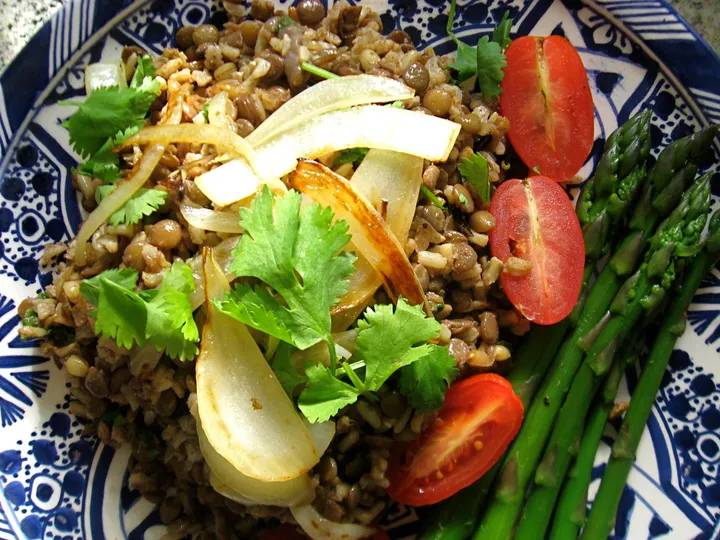
A dish both simple and elemental, the lentils and rice cook together, taking on flavor and qualities greater than themselves. The rice and lentils soak separately before cooking, which brings the tenderness out in the rice and encourages the lentils, which normally require no presoaking, to keep their shape. We should all be so lucky. It's traditionally topped with sauteed onions and makes a meal. Add a few more vegetables, if budget allows.

1 cup brown lentils
1 cup brown rice
4 cups water or vegetable broth
1 bay leaf
2 tablespoons olive oil
1 large onion or two small, sliced thin
1 teaspoon cumin, optional
sea salt and fresh ground pepper to taste

Pour lentils into a small bowl. Cover with cold water. Do the same with the rice, in a separate bowl. Leave 'em to soak for 30 minutes at a minimum, for 2 hours, if you've got the time.
The lentils and rice don't need any fussing with, just let them sit.

Bring water or vegetable broth to boil into a large saucepan. Strain lentils into a sieve. Rinse in cold water. Add to broth. Do the same with the brown rice. Toss in bay leaf. Reduce heat to low and cook, covered, for 30 to 40 minutes, until lentils and rice are soft and fluffy and have soaked up all the liquid. Remove cover, remove from heat and set aside.

Just before serving, heat oil in a large skillet over medium-high heat. Add sliced onion and cook, stirring, for 3 to 5 minutes, until onions start to soften and turn golden and fragrant. Reduce heat to medium, and cook, stirring, another 10 minutes or so, until onions are brown and tender. Season with sea salt and fresh ground pepper.

Stir lentils and rice together gently. Remove bay leaf and season generously with sea salt, fresh ground pepper and optional cumin.

Serve pilaf lavishly topped with onions.

Serves 6 to 8.


Follow Ellen Kanner on Twitter: www.twitter.com/edgyveggie1

FOLLOW GREEN
These are challenging days for those of us who eat. Food's expensive now. The drought we're feeling is killing our crops and is going to make things even worse. The House Agriculture Committee's pr...
 
 
  • Comments
  • 27
  • Pending Comments
  • 0
  • View FAQ
Comments are closed for this entry
View All
Favorites
Recency  | 
Popularity
Page: 1 2  Next ›  Last »  (2 total)
05:24 PM on 07/24/2012
A bowl of lentils is one of my favorite things to have for breakfast.
photo
brooklyncitizen
Soror quaerens lucem
05:00 PM on 07/24/2012
rice and beans.
photo
plantbasedpunk
live from the PHX
02:40 PM on 07/24/2012
Love mujaddara! I like a little squirt of lemon juice on mine.
photo
HUFFPOST SUPER USER
Yam716
For Natural Hair CurlTalk, Visit: lillian-mae
01:12 PM on 07/24/2012
That recipe looks delish!
photo
HUFFPOST SUPER USER
Karl Wilder
Chef Stirring The Pot Harlem
12:52 PM on 07/24/2012
When I was a little boy it was a point of pride for my mother to have meat on the table every day. Now...I eat very little meat. A few anchovies with pasta and veg make a meal for me.
This user has chosen to opt out of the Badges program
05:00 AM on 07/24/2012
" for those of us who eat." I'm normally not picky, but that implies some of us don't have to eat. Just sayin'...........
photo
mlaiuppa
Pres. Sarcasm Society. Like we need your approval.
07:22 PM on 07/23/2012
I go meatless more than once a week. One day meat, one poultry, one fish or pork. That's dinner. The rest of the dinners are meatless. All breakfast is meatless. Lunches are meatless about half the time.

I'm making more soups from scratch; split pea (no ham), tomatoe, broccoli barley, lentil.

I've also found a mac and cheese recipe I like. I want to learn to make spaetzle from scratch and then make kaezespaetzle.

For spaghetti, I poach an egg in sauce instead of having meatballs or sausage.
HUFFPOST SUPER USER
drweh2
an opinionated environmental scientist
06:27 PM on 07/23/2012
Here we have meat approx. 2 or 3 times per month. We're not vegetarians, we just can't afford meat.
photo
HUFFPOST SUPER USER
10YearTeacher
04:27 PM on 07/23/2012
Here's my question:
Why not promote going meatless one meal per day every day. Its actually easier than going meatless for an entire day, and nets more meatless meals per week.

BTW, I am a raging omnivore. But I eat one meatless meal a day on a regular basis to put my money where my mouth is when I say there is nothing wrong with eating meat, there is something wrong with how much meat we eat and how it is raised.
photo
HUFFPOST SUPER USER
theveggiedude
my body is a temple, not a living graveyard
06:12 PM on 07/23/2012
That is a good idea but I disagree about meat being okay to eat. That's like saying a little cocaine now and then is fine too.
photo
HUFFPOST SUPER USER
10YearTeacher
10:24 PM on 07/24/2012
It is ok...you just can't handle your buzz.
photo
HUFFPOST SUPER USER
10YearTeacher
10:24 PM on 07/24/2012
That was a joke.
This user has chosen to opt out of the Badges program
photo
north of 60
Quando Omni Flunkus Moritati
03:19 PM on 07/23/2012
Lentils and rice are a good solid foundation for a wide variety of meals. Use your imagination and you can be a very healthy omnivore.
photo
HUFFPOST SUPER USER
barkingcat
Woof?
09:42 AM on 07/24/2012
Amen!
03:10 PM on 07/23/2012
Buying bulk staples, beans, rice, oats, pasta, olive oil, some nuts, and make those items the basis of your meals. You can order bulk grains, organic even, on line. Or costco, Or shop at an ethnic market, where you will find big bags of interesting dried beans and grains for super good prices. Adding in season fresh fruit and vegies. Easy greens such as chard can be grown in a window box, or indoors under one good grow light. This is a diet that will keep your lipids clean, no cholesterol meds needed, keep your intestines clean, no colonoscopy needed, keep your weight down, no joint pain. If you take a little time to move towards this eating style, as much as you can, with some wiggle room for meat and dairy once in a while, you will gain control over your finances and your health,
and not be slave to the medical industrial and corporate food industrial system.
photo
HUFFPOST SUPER USER
barkingcat
Woof?
09:45 AM on 07/24/2012
Excellent, excellent post -- a dozen nuggets o' wisdom, rolled into one.

(Fanned and faved.)
photo
HUFFPOST SUPER USER
Punks
12:53 PM on 07/23/2012
Don't leave tofu out of the menu.

Cheap, high protein and can be made into a myriad of tasty things from main dishes to smoothies to desserts. Salads too.
02:31 PM on 07/23/2012
i haven't purchased meat regularly in many years, but just recently 'discovered' tofu. i hope the drought doesn't take that out of range too.
photo
HUFFPOST SUPER USER
Punks
03:37 PM on 07/23/2012
Me too.  
photo
plantbasedpunk
live from the PHX
02:38 PM on 07/24/2012
Try the Asian grocery store for your tofu. I can get a block for less than a dollar there.
photo
HUFFPOST SUPER USER
enigma2
Moby..One of these mornings
03:17 PM on 07/23/2012
Tofu in smoothies, wow..you can learn something new every day.
photo
HUFFPOST SUPER USER
theveggiedude
my body is a temple, not a living graveyard
06:14 PM on 07/23/2012
Tofuti is ice cream made with it, so why not in smoothies too?
photo
HUFFPOST SUPER USER
Targetdog
Remembering recent history...
11:16 AM on 07/23/2012
This looks tasty...
10:48 AM on 07/23/2012
Going meatless is cheaper and better for us. We eat very little meat. I love the lentil and brown rice combo. Chop some fresh veggies like carrots, tomatoes or cucumber to top the dish and you've got a great meal full of antioxidants, fiber etc. It's also more filling than fast food, simple carbs etc because of the fiber so you'll feel fuller and you will be full longer. Farmers markets have local produce at good prices this time of year so it's a great time to find deals on local bumper crops. Eating fresh produce and whole foods is better for health http://www.drbaileyskincare.com/blog/the-best-diet-for-healthy-skin-in-2012/ and can be done on a budget. It can even be fast when you prepare enough for leftovers - throw them in a container and you have lunch, that's what I'm eating today, and have eaten everyday for the past 30 years!
I-US
Beware the monsters lurking in word swamps.
10:38 AM on 07/23/2012
One of my favorite dishes: simple, nourishing, wholesome.

The food waste in the West s truly shameful, and honestly, a little stunning considering how historically close we still are to the Depression.