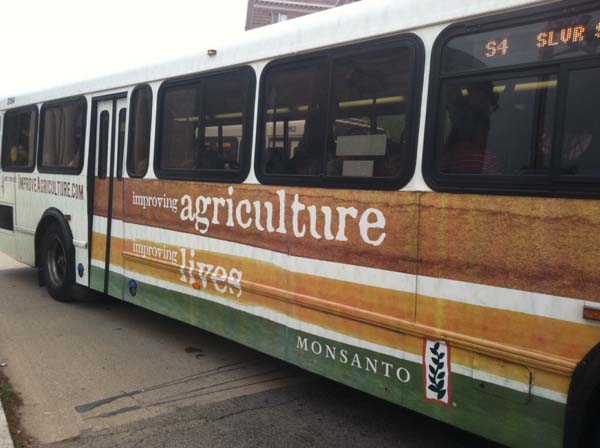
With apologies to Charles Dickens, whose 200th birthday was this week, it's the best of times and the worst of times for Monsanto, the agribusiness giant that is aggressively marketing genetically engineered crops -- and millions of tons of pesticides -- worldwide.
It's the best of times because its stock is soaring. Sure, the St. Louis-based leviathan has been up before -- and down. In 2009, Forbes magazine proclaimed it company of the year. The next year its stock tanked, and Mad Money TV host Jim Cramer proclaimed it the worst of 2010. Now its up again, and last month Forbes was hyperventilating over the fact Monsanto has outperformed most high-tech stocks over the last five years.
But just like the plot in Dickens' Great Expectations, Forbes' rosy scenario is not the whole story.
You may vaguely remember the 19th century novel from high school English. According to a column in last Sunday's Washington Post, its main lesson is: "You will never fully comprehend the most important events in your life while they are happening. Any plans you make will not work out -- and you may grow up to be a jerk. If you are lucky, however, a series of traumatic events will wake you up and show you how insufferable you have become."
If you replace the book's protagonist Pip with Monsanto and look at the company through the prism of science instead of its stock profile, my tortured analogy makes sense. Despite more than 20 years of research and 15 years of marketing, Monsanto's great expectation that genetic engineering would dramatically increase food production and reduce pesticide use has been dashed. Unlike Pip, however, the company has not yet woken up to the fact that its products don't perform as advertised.
That's why it's also the worst of times.
Doug Gurian-Sherman, a molecular biologist with the Union of Concerned Scientists (UCS), has spent quite a bit of time investigating Monsanto's track record. In April 2009, he published "Failure to Yield," the only comprehensive study to date that separates genetic engineering's contribution from other factors that can increase yields. After reviewing two dozen academic studies of corn and soybeans -- the two primary genetically engineered food and feed crops in the United States -- he found that genetically engineered traits in herbicide-tolerant soybeans and herbicide-tolerant corn have not increased yields, and insect-resistant traits have improved corn yields only marginally. The substantial increase in yields for both crops over the previous 13 years was largely due to traditional breeding and better agricultural practices, not genetically engineered traits.
More recently -- just a few days ago, in fact -- Gurian-Sherman and his colleagues in UCS's Food and Environment Program posted a web feature, "Eight Ways Monsanto Fails at Sustainable Agriculture," documenting how Monsanto has broadly failed to deliver on its promise to increase yields, safeguard the environment, and protect farmers' livelihoods over the long run.
"Monsanto talks about 'producing more,' 'conserving more,' and 'improving lives,' but it's a PR fantasy," said Gurian-Sherman. "In reality, the company is doing a great job selling more engineered seeds and herbicide and fattening its bottom line at the expense of the environment. To be sure, there are a lot of farmers who buy Monsanto seed, but they buy it mainly because it's convenient, it saves them time, and it does kill some pests. That doesn't mean that it's better for the environment."
Besides the fact that Monsanto's genetically engineered traits have failed to substantially increase yields, its heavy promotion of crops designed to be impervious to the company's RoundUp herbicide has inadvertently created resistant "super" weeds, UCS experts report. That not only can make farming more difficult and costly, it forces farmers to use even more herbicides, which threatens the environment and public health.
UCS also found that Monsanto's focus on genetic engineering and chemical fixes thwarts research and development of cheaper, more effective solutions, including public sector classical crop breeding and environmentally friendly farming methods.
Given the unvarnished facts, how has Monsanto been able to convince anyone that it is, according to its latest PR effort, "improving agriculture and improving lives"? In large part by spending tens of millions of dollars annually on advertising, lobbying and campaign contributions.
In the fall of 2008, Monsanto launched an advertising campaign that continues to this day. An outgrowth of the company's "sustainable yield initiative," it has targeted opinion leaders and federal policymakers with full-page ads in the Atlantic Monthly, New Yorker, New Republic and other elite publications, as well as with posters in subway stations, on bus shelters, and on the sides of metro buses here in Washington.
Last year, Monsanto spent $100 million on the ad campaign, down slightly from the $120 million it spent in 2010, according to Securities and Exchange Commission figures. The company also spent $6.37 million on lobbying--more than any other agricultural company or trade group--and so far has contributed more than $170,000 to political campaigns in the 2011-2012 election cycle, the third highest in the agricultural sector.
Monsanto's claims in earlier ads were more explicit than ones circulating now. For example, an ad on the New Yorker's back cover that ran the same week Gurian-Sherman released his "Failure to Yield" report back in 2009 stated: "Providing abundant and accessible food means putting the latest science-based tools in farmers' hands, including advanced hybrid and biotech seeds. Monsanto's advanced seeds not only significantly increase crop yields, they use fewer key resources -- like land and fuel -- to do it. That's a win-win for people, and the earth itself."
The company's latest print ads, which all feature the headline "Improving agriculture, improving lives," are toned down by comparison. They insinuate that Monsanto is accomplishing something grand and noble instead of making demonstrably false claims. For example, one ad states: "In the hands of farmers, better seeds can help protect resources and promote biodiversity." Another one states: "In the hands of farmers, better seeds can help meet the needs of our rapidly growing population, while protecting the earth's natural resources." They all wrap up with: "That's improving agriculture. That's improving lives. And that's what Monsanto is all about."
The best response to Monsanto's misleading ad campaign? A well-worn quote from Great Expectations: "Take nothing on its looks; take everything on evidence. There's no better rule."
Elliott Negin is the director of news and commentary at the Union of Concerned Scientists. For information on how to get involved with UCS's effort to set the record straight on Monsanto, click here.
Follow Elliott Negin on Twitter: www.twitter.com/ElliottNegin
:http://www.youtube.com/watch?v=jAP6ZtfP9ZQ&feature=related
http://www.youtube.com/watch?v=EnD-DiDRIJA&feature=related
http://www.youtube.com/watch?v=SJ0Drb0oZwc&feature=related
The will open your eyes to future Obama plans.
Take a look: http://www.youtube.com/watch?v=6V0OTPqgKsU&feature=related
We can only use genetically modified (GM) seeds that the government gives us. These seeds are modified so that they do not produce more seeds for growing - meaning that we have to rely on the government to supply us. Studies have shown that these GM crops have hardly any nutritional value because they have been modified and tainted with poisonous chemicals.
Also, this new law obligates us to use specific pesticides on the crops, which of course will make us sick. They will come to all farms and regulate this in full force by testing our crops to see if we are following these guidelines. Unfortunately, if we do not obey the law the government can either fine us 1 million dollars or seize our properties and we lose everything! Nice hah? My guess, many of these new laws that have been quietly and conveniently passed during election hysteria, will be implemented soon.
Learn more here: http://www.youtube.com/watch?v=9C-QLHmiWjQ&feature=related
Your defensive position in this matter only convinces people, whether college educated or not, that we have a serious problem with the food we consume. The government (FDA and USDA approved) allows these corporations to modify our food, and thanks to S510 that prohibits us to grow an organic garden, you still have a job.
You are the ignorant one in denial of the truth. So you support modifying and poisoning our food, oh on at the "right dose" of course, so that we die slowly not all at once and Big Pharma can cash in on meds too.
Nature is not meant to be manipulated by modern labs for greed because down the road it will have severe consequences like we see happening now. In this modern era, most people have lost a loved one or friends to cancer because we are being robbed of essential micronutrients causing genetic damage and infertility; killing our fish, birds, honey bees, destroying our ecological balance.
We should be fearful and do something good about it!!
The U.S. Department of Agriculture has approved three new kinds of genetically engineered foods -- alfalfa, a type of corn, and sugar beets. And the FDA will likely soon approve GM salmon, which would become the first genetically modified animal to be sold in the U.S., but probably not the last. And the FDA and USDA will not require any of these products, or foods containing them, to be labeled as genetically engineered.
So although the U.S. does not require GMOs to be labeled, you can still find out whether or not your produce is genetically engineered, by looking at its PLU code.
For example:
A conventionally grown product carries a 4-digit PLU code (Ex: conventionally grown banana: 4011)
An organic product carries a 5-digit code, starting with the number 9: (Ex: organic banana: 94011)
A genetically engineered (GE or GMO) product has a 5-digit code, starting with the number 8:
(Ex: GE banana: 84011)
Resource: Dr. Mercola
"If GMOs are indeed responsible for massive sickness and death, then the individual who oversaw the FDA policy that facilitated their introduction holds a uniquely infamous role in human history. That person is Michael Taylor. He had been Monsanto's attorney before becoming policy chief at the FDA. Soon after, he became Monsanto's vice president and chief lobbyist."
But Michael Taylor's mission to allow GM foods into the world food supply pales in comparison to the new mission of the GM food conglomerates -- to have GM foods included as part of "organic" crop labeling.
Because consumers are getting wise to their tricks and are flocking more and more to organic counterparts of GM options, the GM food companies are now lobbying to have GM crops included under the organic banner.
Resource: Dr. Mercola
This guy is your leading spokesman?
He has no scientific training, he is not a farmer, and he thinks he can levitate. See pic:
http://academicsreview.org/reviewed-individuals/jeffrey-smith/
'Yogic Flying and GM Foods:The Wild Theories of Jeffrey Smith"
Genetically modified (GM) food is one of the most pressing dangers facing us as a species. A brand new organism thriving in GM soy and animals given GM animal feed has been identified, and a link between it and high rates of miscarriage and infertility in a number of animals has been established.
The vast majority of US-grown corn, soy, canola, cottonseed oil, and sugarbeets are genetically engineered, which means virtually every processed food you buy that does not bear the "100% USDA Organic" label is likely to contain at least one GM component.
The widespread use of glyphosate, the active ingredient in the herbicide Roundup, is exacerbating the problem. Glyphosate immobilizes certain nutrients, rendering them inaccessible to the plant, which in turn robs you of essential micronutrients you’d normally get from your food. It also cannot be washed off, as it is absorbed systemically through the plant, which means you’re consuming far more herbicide than ever before. Glyphosate is suspected of causing genetic damage, infertility and cancer. It is also acutely toxic to fish and birds and can kill beneficial insects and soil organisms that maintain ecological balance.
Resource: Dr. Mercola
Monsanto can count among its ranks some of the most dangerous products known to man, including Agent Orange, dioxin, and GM seeds.
Virtually all of the claims made for GM crops – increased yields, more food production, controlled pests and weeds, reductions in chemical use in agriculture, drought-tolerant seeds – have not materialized, while serious risks and consequences, including herbicide-resistant super weeds, super pests, uncontrollable cross-contamination and health problems from GM foods, have emerged.
GM foods are patented inventions that are protected under copyright and proprietary information laws. And the corporations controlling the seeds only allow them to be studied under very limited conditions, and rarely (if ever) do they permit them to be studied for safety by anyone but the USDA (who hasn't yet seen the need to conduct rigorous long-term studies).
Resource: Dr. Mercola
http://in.mobile.reuters.com/article/idINDEE81C0FQ20120213?irpc=932
Business
Monsanto guilty of chemical poisoning in France
Mon, Feb 13 19:44 PM IST
By Marion Douet
PARIS (Reuters) - A French court on Monday declared U.S. biotech giant Monsanto(MON.N) guilty of chemical poisoning of a French farmer, a judgment that could lend weight to other health claims against pesticides.
In the first such case heard in court in France, grain grower Paul Francois says he suffered neurological problems including memory loss, headaches and stammering after inhaling Monsanto's (MON.N) Lasso weedkiller in 2004.
He blames the agri-business giant for not providing adequate warnings on the product label.
The ruling was given by a court in Lyon, southeast France, which ordered an expert opinion of Francois's losses to establish the sum of damages.
Lawyers for Monsanto could not immediately be reached for comment.
The EPA has described the following effects when exposed to levels above the maximum contaminant level (MCL): slight skin and eye irritation; at lifetime exposure to levels above the MCL: potential damage to liver, kidney, spleen; lining of nose and eyelids; cancer.
Since 2006, use of alachlor as a herbicide is banned in the European Union.
Monsanto isn't nice but their product saves oil and make food cheaper and that allows you to drive thru and eat a cheap burger.
That's what everyone wants isn't it?