iPhone app iPad app Android phone app Android tablet app More

Featuring fresh takes and real-time analysis from HuffPost's signature lineup of contributors
Elliott Negin

GET UPDATES FROM Elliott Negin
 

Wasting Time With Nuclear Waste

Posted: 06/22/2012 1:44 pm

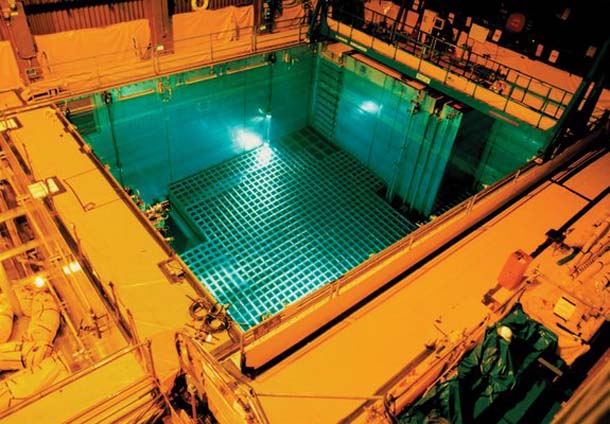
2012-06-22-spentfuelpool.jpg
Some spent fuel pools hold five times the amount they were originally designed to accommodate. (NRC)


Haste makes waste--unless you're talking about nuclear power.

In that case, delay makes waste--tens of thousands of tons of it.

The waste--used, or spent, fuel--is dangerously radioactive and has to be sequestered from the environment for tens of thousands, if not hundreds of thousands, of years. And even though nuclear power is more than 50 years old, no one has figured out just where to put it. Right now that waste is piling up at nuclear power plants across the country, and most of it is sitting in congested, relatively unprotected cooling pools.

This problem received some media attention earlier this year when President Obama's Blue Ribbon Commission on America's Nuclear Future issued a report recommending what to do with the waste. One of the blue ribbon commission participants, geologist Allison Macfarlane, was approved by a Senate committee yesterday to become the new chair of the Nuclear Regulatory Commission (NRC).

The blue ribbon commission recommended building one or more interim storage facilities and reopening the search for a suitable permanent geologic repository site, given the Obama administration nixed plans to finish building one in Nevada. But the commission didn't offer any recommendations to strengthen on-site spent fuel management, and Congress hasn't addressed it, either--although there are signs that some lawmakers are beginning to snap to attention.

Trouble with a capital T that rhymes with P and stands for pool. Spent fuel consists of fuel rods that, after four to six years in a reactor, no longer produce energy efficiently. They still emit high levels of radiation and heat, however, so they have to be placed immediately in deep water pools to cool them. Initially the plan was for plant owners to cool spent fuel in pools for a relatively short period of time, and then ship it off to be reprocessed for reuse. But during the Carter administration, the government abandoned this ill-advised idea because it would have been more expensive than using fresh uranium, it wouldn't significantly reduce the amount of waste, and the reprocessed material could be used in bombs.

"When the plants were originally designed, plant owners thought that the spent fuel would remain on site only two or three months," said Dave Lochbaum, director of the Nuclear Safety Project at the Union of Concerned Scientists (UCS). "When those plans changed, plant owners just filled the pools up to capacity without ever rethinking whether they should provide more safety and better barriers."

Some pools now hold as much as five times the amount they were originally designed to accommodate, according to UCS. That's not good. If a malfunction, natural disaster or terrorist attack triggered a leak or shut down the pool's cooling system, the rods would heat the remaining water in the pool, eventually boiling it off. If plant workers couldn't replace that leaking or evaporating water, the pool's water level would drop, exposing the fuel rods. And once those fuel rods are exposed to the air, the heat could damage their zirconium cladding, enabling radioactive gases to escape into the environment.

Spent fuel pools are located outside the primary reactor containment building and, according to Lochbaum, "are often housed in buildings with sheet metal siding like that in a Sears storage shed." In other words, spent fuel pools are a lot more vulnerable to a natural disaster or a terrorist attack than a reactor core.

Continuing to add spent fuel to the pools compounds the risk by increasing the amount of radioactive material that could be released into the environment. A large radioactive release from a spent fuel pool could result in thousands of cancer deaths and hundreds of billions of dollars in decontamination costs and economic damage, according to 2004 study in Science and Global Security, a journal published by Princeton University.

Everybody out of the pool. Even under the best-case scenario, a national interim storage facility -- let alone a permanent repository -- is decades away. And even if a disposal repository opened today, it still would take more than 30 years to ship the spent fuel from nuclear plant sites, according to a 2008 Department of Energy (DOE) estimate. That means that large quantities of spent fuel will continue to build up at reactor sites for many years to come. Today, approximately 74,000 tons of spent fuel is stored in 77 locations in 35 states. Of that, more than 54,000 tons -- 73 percent -- is sitting in wet pools, according to a May Congressional Research Service report.

Fortunately there is a way to reduce the safety and security risks associated with spent fuel pools: transfer the spent fuel to dry casks after it has cooled sufficiently, which generally takes five years. That was the conclusion of a 2006 report by the National Academy of Sciences, which determined that "[d]ry cask storage has inherent security advantages over spent fuel pool storage...."

UCS maintains that the waste can sit safely on site in dry casks for at least 50 years. A 2010 report by the nuclear industry's trade association, the Nuclear Energy Institute, was even more confident, stating that "existing dry cask storage technology, coupled with aging management programs already in place, is sufficient to sustain dry cask storage for at least 100 years at reactors and central interim storage."

In any case, plant owners eventually will have to transfer spent fuel to dry casks to ship it via rail or truck to an interim or permanent repository, so it makes the most sense to accelerate the transfer to the less vulnerable dry casks. Some plant owners have transferred some waste when their pools became too packed to add any more rods. Even so, only 25 percent of the spent fuel in the United States is now in dry casks, according to the Congressional Research Service.

Suing the DOE for damages. Plant owners aren't in a hurry to transfer spent fuel to casks for two reasons. First: the cost. According to a 2003 study by expected-to-be NRC chair Allison Macfarlane, UCS Senior Scientist Edwin Lyman and other nuclear experts, it would cost $3.5 billion to $7 billion to transfer all the spent fuel that has been in pools for more than five years to dry casks. Second: The NRC has not required plant owners to transfer the spent fuel because it maintains pool safety risks are not serious enough to warrant the expense. The agency points to the fact that, after the 9/11 terrorist attacks, it required plant owners to disperse hotter fuel throughout the cooling pools to reduce the potential for a fire. But according to a blog Lyman posted earlier this week, declassified NRC documents cast doubt on whether this measure actually fixed the problem.

Meanwhile, approximately $26.7 billion is sitting in a nuclear waste fund established in 1982 by the Nuclear Waste Policy Act, which set an apparently unrealistic timetable for constructing a permanent underground geologic repository by the mid-1990s. That law required plant owners to make annual payments--now pegged at $750 million--into the fund to cover the cost of a permanent repository. That money can't be used to pay for transferring spent fuel to dry casks. Senate Majority Leader Harry Reid (D-Nev.) introduced a bill in 2007 to amend the law so the fund could be used for interim waste storage. It died in committee.

Plant owners have filed dozens of lawsuits against the DOE, charging that the agency breached its contracts to accept spent fuel by 1998. Since 2000, the DOE has paid out approximately $1 billion in damage claims to cover costs incurred by plant owners "to construct dry storage facilities or additional wet storage racks, ... purchase and load casks and canisters, and [pay] utility personnel necessary to design, license and maintain these storage facilities," according to the Congressional Research Service.

Congress needs to act. Unfortunately there are no cheap or easy answers. Despite the Nuclear Waste Policy Act's restrictions, the courts are forcing the DOE to subsidize plant owners to transfer spent fuel, and the agency estimates that new lawsuits and other costs could eventually amount to a $16-billion legal liability. To stem those suits, Congress could pass a bill like Sen. Reid's. But that would raid the Nuclear Waste Fund to pay for spent fuel transfer, and drain the reserves needed to construct a permanent repository.

Congress needs to do something, and its primary consideration should be public safety. There is currently a bipartisan effort in the Senate led by Jeff Bingaman (D-N.M.), Lamar Alexander (R-Tenn.), Dianne Feinstein (D-Calif.) and Lisa Murkowski (R-Alaska) to incorporate the blue ribbon commission's findings into a bill. That's heartening, but any bill they draft must go beyond the commission's recommendations to include language requiring plant owners to expedite the transfer of spent fuel to dry casks. If they fail on that score, the 120 million Americans who live within 50 miles of a nuclear reactor will remain at risk.

Elliott Negin is the director of news and commentary at the Union of Concerned Scientists.

 
FOLLOW GREEN
 
 
  • Comments
  • 381
  • Pending Comments
  • 0
  • View FAQ
Comments are closed for this entry
View All
Favorites
Highlights
Recency  | 
Popularity
Page: 1 2 3  Next ›  Last »  (3 total)
10:37 AM on 07/11/2012
Even with fast reactors (which remain to be developed on a commercial and fit for service basis), there is no solution to the waste problem.

http://www.thebulletin.org/web-edition/features/managing-nuclear-spent-fuel-policy-lessons-10-country-study

"Reprocessing does not eliminate the requirement for a repository, however, or even reduce its size much. This is because, in effect, reprocessing merely exchanges the problem of managing light-water-reactor spent fuel for the problem of managing not only spent MOX fuel but also the high-level waste from reprocessing, plutonium waste from MOX-fuel fabrication, and eventually the waste from decommissioned reprocessing and MOX-fuel fabrication facilities."

http://www.fissilematerials.org/ipfm/site_down/ipfm-spent-fuel-overview-june-2011.pdf

"According to a comprehensive study by the U.S. National Research Council published in 1996, however, even with repeated recycle in fast-neutron reactors, it “would take about two centuries...to reduce the inventory of the [transuranics] to about 1% of the inventory of the reference LWR once-through fuel cycle”. The study also concluded that this would be extraordinarily costly … Countries that reprocess produce wastes that require about the same size geological repository as would direct disposal of the unreprocessed spent fuel" (p. 9 - 10)
photo
HUFFPOST SUPER USER
Atoms4Peace1
Applying the atom peacefully since 1978
12:09 PM on 07/11/2012
pyroprocessing is not "reprocessing". Different process all together.
05:01 PM on 07/11/2012
You might want to look at pyroprocessing a little closer.

Another technology at pilot scale, available at zero locations, and with significant technological challenges remaining to be solved. Process is highly volatile, inefficient (making effective re-processing to scale a challenge), and can only be used on high burnup fuel (which we don't have because fast reactors are costly and have significant technological hurdles remaining to be solved).

http://www.oecd-nea.org/science/docs/pubs/nea5427-pyrochemical.pdf

So yes … a faith based alternative to be sure, but very little in terms of feasible, cost-effective, or near-term commercial benefit. "Pyrochemical processing of commercial LWR irradiated oxide fuel may be technically feasible, but its application on an industrial scale has not been proven and its ability to yield products with sufficient decontamination of unwanted radionuclides has not been verified" (p. 140).
12:58 PM on 06/26/2012
This is a must read....
"The Energy Department is also the main source of funding for radiation health research. That’s like having the tobacco industry determine if smoking is bad for your health."
http://www.counterpunch.org/2012/06/25/radioactive-conflicts-of-interest/
07:40 PM on 06/27/2012
It's more like the NIH funding research on vaccines.
11:30 PM on 06/25/2012
Dry casks are no solution. Shut down the reactors, it's the only solution. Where do you put something that mustn't catch fire, no matter what? New spent fuel pools would cost about half a billion dollars to build, plus maintenance. Dry casks are vastly cheaper. THAT is what is driving the push to dry casks -- NOT "safety". What is anyone going to do if/WHEN a dry cask catches fire (shall I list two ways that can happen? Terrorism and accidental airplane strikes, but there are plenty of others....)? Just say no to nuclear power. www.acehoffman.org
This user has chosen to opt out of the Badges program
photo
09:38 PM on 06/25/2012
Industry regulating itself is a laughable concept, considering industry's primary goals are never measured in terms of centuries, let alone millennia.
Industry doesn't have any workable solutions for waste storage anymore than the government. if they did we wouldn't be discussing this issue.
This user has chosen to opt out of the Badges program
photo
09:27 PM on 06/25/2012
Atoms for peace - an out dated propaganda phrase if ever there was one, considering there are cheaper alternative technologies out there. The down side I suppose is that you can't make anti tank weapons from windmills and solar plants.
photo
HUFFPOST SUPER USER
Steve Moyer
Philosopher, Politician and Programmer.
08:19 AM on 06/27/2012
Good line! "You can't make anti-tank weapons from wind and solar farms." You also can't make nuclear weapons. Remember, Nuclear power concentrates power in the hands of the few ... the centralized government authorities responsible for nuclear matters.
09:09 AM on 06/28/2012
Try thinking a little more creatively. With small modular reactors in the works, regular citizens could setup a nuke-coop and purchase one of the smaller designs (gen4 power at 25 MWe). Ten thousand households at $10k each.
This user has chosen to opt out of the Badges program
photo
09:08 PM on 06/25/2012
Deregulation!? Why, we should each do our patriotic duty an store the waste in our basements. We should be building schools with the stuff. Panzies and your dry storage casks.
Everyone knows nucular power is safe, so long as industry is allowed to build and manage their plants without government oversight. Just ask anyone in Japan, they know that businesses never cut corners to boost their profits.
12:02 AM on 06/26/2012
Heard most of that pronukers want small modular reactors under high schools. That way they can contaminate them when the are most vulnerable. Just ask the atomic banana.
03:45 PM on 06/25/2012
The way I see it, all of the pro-nuke commentators, whom preach to everyone about how safe and harmless nuclear waste is, should voluteer their backyards for storage, and help america out of this dilemma. After all if there's nothing to worry about, then why not step up to the plate? That way if you haven't died of cancer in 12 years, you can say you were right, and there won't be anymore controversy. So what'ya say guys? Help us out.
06:47 PM on 06/25/2012
Ok but you guys need to put in a tailing pond from the rare earth mines in China.

Just think of it as a cool water feature in the backyard, you can even have a little boy peeing statue with a solar powered pump!
12:08 AM on 06/26/2012
Do I use a acid or basic leach? purify, and sell? Or purify and bury or do I get paid both ways?
Can do either, what crystal do you want?

God you really have no clue what the industry is fixin' to do.
10:29 AM on 07/11/2012
"Ok but you guys need to put in a tailing pond from the rare earth mines in China."

Wind turbines work perfectly fine without rare earths.

http://www.enercon.de/en-en/1337.htm

The company ("Enercon") is the pioneer of direct drive turbine, has the largest turbine in production today (at 7.5 MW), and is the most visible turbine in Europe. Enercon was prevented from selling turbines in the US because of a patent dispute. If we don't want to make these turbines in the US, perhaps we should just stop buying from China, and do all our business with the Europeans.
photo
RemyC
Indian Point, not worth the risk!
03:06 PM on 06/25/2012
Nuclear waste isn't waste! It's wonderful woopie doopie gooey stuff the pro-nukers want to store in their own backyard so they can use it over and over again till every tree, every blade of grass, every ant, is contaminated and collapses into a pool of uncoagulated jelly.
This user has chosen to opt out of the Badges program
photo
01:23 PM on 06/25/2012
Nuclear fuel rods need to be replaced when just 5% of the fuel is consumed. The rods can be replenished in the MOX fuel fabrication facility while the waste is shipped to New Mexico to be permently stored in a salt dome that exists and is running today.
09:26 PM on 06/25/2012
Why are tens of thousands of tons of nuclear waste stored on site at NPPs across the US?
This user has chosen to opt out of the Badges program
photo
12:06 AM on 06/26/2012
MOX is being built
07:45 PM on 06/27/2012
Because the law says NPP owners can't do anything else with it.
photo
HUFFPOST SUPER USER
Michael Mann
Nuclear Educator
06:50 AM on 06/25/2012
from Phys.Org
Nuclear fuel recycling could offer plentiful energy

June 25, 2012

Imagine the mess if we mined one ton of coal, burned five percent of it for energy, and then threw away the rest.

That is what happens with uranium for nuclear fuel today. Currently, only about five percent of the uranium in a fuel rod gets fissioned for energy; after that, the rods are taken out of the reactor and put into permanent storage.

There is a way, however, to use almost all of the uranium in a fuel rod. Recycling used nuclear fuel could produce hundreds of years of energy from just the uranium we’ve already mined, all of it carbon-free. Problems with older technology put a halt to recycling used nuclear fuel in the United States, but new techniques developed by scientists at the U.S. Department of Energy’s (DOE) Argonne National Laboratory address many of those issues.
http://phys.org/news/2012-06-nuclear-fuel-recycling-plentiful-energy_1.html
HUFFPOST SUPER USER
alvdh1
03:24 PM on 06/25/2012
Especially if you are an acclaimed nuclear non-educator, such as Michael Mann, who doesn't give a rats as$ about the history of reprocessing disasters, leaks and worker exposures.
The type of nuclear education Michael would like for you to have is to ignore all of the hazards, bury your head in the sand and let the technocrats create nuclear dead zones, contaminate the oceans, land and air with radioactive poisons in order to get a few hundred more years of energy.

Here is how the French do it by dumping waste into the English Channel and the atmosphere or the dirty little reprocessing secrets Michael Mann will never share with you while he is asking you to bury your head in the sand.

http://www.alternet.org/world/132852/the_french_nuclear_industry_is_bad_enough_in_france%3B_let's_not_expand_it_to_the_u.s./

Here is how the British do it by dumping it into the North Sea and contaminating the land around the plant.

http://www.guardian.co.uk/environment/2009/apr/19/sellafield-nuclear-plant-cumbria-hazards

Here is how Japan does it.

http://www-bcf.usc.edu/~meshkati/tefall99/toki.html

Here is how America attempted to do it.

http://www.ucsusa.org/nuclear_power/nuclear_power_risk/nuclear_proliferation_and_terrorism/a-brief-history-of.html

http://concernedcitizens.homestead.com/maplink_westvalley.html
photo
HUFFPOST SUPER USER
Michael Mann
Nuclear Educator
05:27 PM on 06/25/2012
Alvin,
You really should be more respectful if you wish to get respect. I doubt you even read the link I posted, you were too busy making personal attacks. here is more information about recycling once used nuclear fuel.
http://www.world-nuclear.org/info/inf69.html
I believe an even better method is to use a molten salt reactor like the Liquid Fluoride Thorium Reactor (LFTR) to make energy while disposing of the existing once used fuel.
http://www.youtube.com/watch?v=P9M__yYbsZ4&feature=relmfu
photo
HUFFPOST SUPER USER
Michael Mann
Nuclear Educator
01:52 PM on 06/26/2012
Interesting post, since I AM a nuclear worker and I do care about my co-workers and my dose much more than someone who never sets foot inside a nuclear power plant (Alvin) Your false concern for my exposure is touching and I will give it the consideration it deserves. You've got no clue, yet you feel the need to share your nonsense and create anxiety, which may actually hurt people.
This user has chosen to opt out of the Badges program
photo
01:07 AM on 06/26/2012
Hey Hey Hey MM, before we start talking about what doesn't exist let's get back to real life. Even Japanese politicians are admitting decon is myth until the technology is developed. Let's focus on this where lives are at stake instead of selling pipe dreams. You cannot have it both ways.
professor
Correkt the Spelling and Pick on the Moniker
02:08 PM on 06/24/2012
kNotzi tro always always always refuses to directly address my point. Because it can't. Because I am right.

I say the rich who make the profit from nuclear power forced it on us. They should be forced to pay for the "repository." But instead, they pass the cost along to us. As always. That is a crime. It always has. Rich people forcing the rest of us to pay for their mistakes. This tro, paid by rich people, thinks that is alright. It is not alright. Even it knows that that is not alright. But it has to say what it is told to say, no matter how stpd.
HUFFPOST SUPER USER
Harley 2
04:58 PM on 06/24/2012
Nicely said, nuke is a high profit industry for the direct participants as the still unknown costs are passed on to the general public.
photo
HUFFPOST SUPER USER
Atoms4Peace1
Applying the atom peacefully since 1978
02:16 PM on 06/25/2012
There are many middle class workers in the nuclear enterprise. We pay mortgages, put our kids through orthodontics and college, save for retirement, lead decent, uneventful lives. I dont see a lot of people living high on the hog.
photo
HUFFPOST SUPER USER
Michael Mann
Nuclear Educator
02:41 PM on 06/25/2012
I haven't seen any posts from "kNotzi tro" have they all been deleted? very confusing...
12:46 PM on 06/24/2012
All these very smart nuclear scientists and engineers, and they fail to see the one obvious fact... That the reason we don't have a safe place to store this stuff is because, in the final analysis, there is no place that is "safe". We have redefined the word in the name of energy policy expediency, in order to build the reactors... Ask Japan how that is going. But we have diluted ourselves, if we believe engineering has advanced to the point where we can create a safe place for a Hiroshima with a half life of 10,000 years.
HUFFPOST SUPER USER
Harley 2
04:59 PM on 06/24/2012
The sexy science fools them into thinking they are doing something "good", indeed the greed for cheap power is a tragedy.
07:36 PM on 06/24/2012
Hiroshima is a city. Not sure if it makes sense to discuss the half life of a city.
11:42 AM on 06/24/2012
Plant operators don't want to transfer the spent fuel into dry cask because of the cost, but are suing because there is no waste repository. The spent fuel has to be in dry cask to be transported and is much safer stored that way once properly cooled than in the pools. So, if it is safer and has to be done regardless, get it in the dry cask.
professor
Correkt the Spelling and Pick on the Moniker
01:27 AM on 06/24/2012
O, I like that one. So the Nuclear Waste Fund is paid for by taking it out of our hides whether we like it or not. But the rich guys who make all the profit out of skering us into nuclear energy don't have to pay one red cent.

I don't like that. I want the rich guys to pay. Not us. They make the profit. Cough it up, theves.
photo
HUFFPOST SUPER USER
Michael Mann
Nuclear Educator
09:47 AM on 06/24/2012
How do you figure? The waste fund is paid per kilowatt produced, everyone pays, rich, poor, whomever used the power. Trying to make this into some kind of class struggle is ridiculous, people should be smarter than to fall for that ploy. You can make the same argument for any business, so I guess you advocate communism? I think they tried that and it didn't work...
HUFFPOST SUPER USER
Elliott Negin
UCS Director of News & Commentary
12:14 PM on 06/24/2012
In fact, the nuclear power industry would not be viable without government subsidies, so if you want an example of where an industry privatizes the profits and socializes the risk, this would be the one. For more information on federal subsidies to nuclear power, read this 2011 Union of Concerned Scientists report: http://www.ucsusa.org/nuclear_power/nuclear_power_and_global_warming/nuclear-power-subsidies-report.html.
photo
HUFFPOST SUPER USER
jimpager
10:39 PM on 06/23/2012
So we spend a trillion dollars to fight terrorism to keep WMD away from our shores and then construct 100 dirty bombs disguised as nuclear reactors near our biggest cities. Germany has withdrawn from nuclear, no doubt Japan will too. Wnen will America learn? Will it take a meltdown like Fukishima or can we learn from their mistakes rather than commit them ourselves?
01:57 AM on 06/24/2012
I'm pretty sure the nuclear power plants were constructed before the war on terror started. I also know that constructing a dirty bomb out of spent fuel is pretty difficult to do. Much easier to use industrial or medical radioactive sources. The lesson from Japan is that the forces that cause the meltdown killed more people than the meltdown.
photo
HUFFPOST SUPER USER
Atoms4Peace1
Applying the atom peacefully since 1978
03:15 PM on 06/25/2012
How do you figure 100 dirty bombs if 1) a reactor doesnt go off like a bomb and 2) in our country at least, there are no credible Fukushima type scenarios that would lead to a breach in containment.

People have to realize Fukushima was an outlier, the design was different than US Mark 1 plants, the accident scenario likelihoods are different.

There is a tremendous amount of "What ifs" on this forum and these scenarios should be vetted to ascertain likelihoods.

Risk = likelihood * consequence and not just consequences alone.
photo
HUFFPOST SUPER USER
jimpager
04:37 PM on 06/25/2012
They are spending my tax money on nuclear. I don't have to vett that. I live about equidistant between two nuclear plants that, were either to leak substantially, would wreck my life forever. No thank you. Please shut down the nukes.