The following events took place in April 2009, when I was privileged enough to be invited
by Oxfam America to learn about their programs abroad. Focusing primarily on the rampant
Cholera epidemic, but also on the importance of sanitation systems and crumbling economies, the
diary feels especially timely now, given the Haiti earthquake disaster. Now more than ever, Oxfam
and other humanitarian organizations need regular folks' help to keep the victims of these disasters safe
from disease and death. -- Emile Hirsch
Photographs by Nabil Elderkin
Day 1
Still hung over from an endlessly long yet surprisingly fun Coachella
experience, I swill down Diet Coke and resist the burning desire to have a
cigarette--all the while my foot is pressing harder and harder on the gas pedal. In
thirty minutes I will have returned from the massive California rock concert outside
of Palm Springs to my loft in Venice Beach. In thirty hours I'll be setting foot in
Zimbabwe.
After a restless night of tossing and turning in my sheets I can't believe we
are already at the Washington Dulles Airport, waiting in the Admirals Club Lounge.
By "we," I mean Nabil Elderkin--a young 27‐year‐old raging bull of a photographer,
all testosterone, passion and energy--and Lyndsay Cruz, the cute, sharp as a whip
beach blonde hair Oxfam Public Figures Liaison, and myself. We all went into the
Congo in June of 2008 together, and had eye-opening and memorable experiences
while we learned about the rampant poverty, political instability, and quiet
determination in that beleaguered country. I originally got involved with Oxfam
after portraying Chris McCandless in the film Into The Wild. Chris had given his life
savings of 24,500 dollars and sixty‐eight cents to Oxfam before departing on a cross-country
spiritual odyssey. Chris was a remarkable individual, with a hard to
understand idealism‐-yet the beauty he saw in the world made me want to live in it
to the fullest--so when Oxfam first called me to see if I wanted to be
involved, I felt Chris tapping me on the shoulder.
Zimbabwe, formerly Northern and Southern Rhodesia until granted
independence from the United Kingdom in 1980, is a landlocked country in
Southern Africa. Now under the leadership of longtime President Robert Mugabe,
and, in a new, positive sharing of power with onetime serious political rival and now
Prime Minister Morgan Tsvangirai, what was once a bloody, murderous political
climate by many accounts has apparently cooled down quite a few degrees.
Meaning just really hot, instead of boiling. Controversy over the fairness of the
Zimbabwe presidential elections was the talk of much of world in 2008. But now,
with these two powerful leaders joined up, one can only hope there will be a
renewed vigor of focus for Zimbabwe's biggest ailment--its collapsed infrastructure
and economy.
Anybody who wants to really see that being a "billionaire" isn't all it's
cracked up to be need only visit Zimbabwe. Because the hyperinflation of their
economy has gotten so incredibly out of hand (independent economists say the
inflation rate ran into the quadrillions of percent), four trillion dollars won't even
buy you a bottle of water. Political turmoil and civil unrest have resulted in the
weakening of the farming and export industries, as many white farmers had their
lands stripped from them, rendering far fewer crops than anticipated. And as a
result of this collapsed infrastructure, basic services and utilities that most humans
take for granted, such as running water and proper sanitation systems, coupled with
parching droughts throughout the country, have created a deadly nest for a deadly
bacteria--cholera.
Cholera is a water-borne disease that is primarily contracted through human
ingestion of contaminated feces. Meaning, if there is a lack of food and people are
forced to grow their primary crop (corn) in the street, yet also forced to defecate in
back streets and alleys because the sewage system is not working, then there is
going to be a high risk of a cholera outbreak. 90,000 Zimbabweans have already
been infected due to the 2008 cholera outbreak, with over 4,000 deaths. My eyes
grow wide as I read how cholera kills you--diarrhea and dehydration. The insane
part of all this is that weeks before, on an early online conference call I did with
Oxfam doctors in Boston, I learned the cure for cholera is simple: sugar, water, and
salt.
On the plane trapped in seat 26A my mind is racing. I'm fidgety. Pressing
down on the screen in front of me attached to the seat, I scroll through all the
movies South African Airlines provides. One of them grabs my attention--Senator
Obama Goes To Africa. The engaging documentary follows the then Senator Obama
on a trip back to Kenya, where he is given a superstars' greeting, to Chad, visiting
refugee camps and then to Cape Town South Africa. In Cape Town he gets a tour of
where Nelson Mandela was held prisoner, always telling the younger prisoners who
joined him in captivity at Robben Island to stop concentrating on fighting and
killing, and to concentrate on studying instead. Throughout watching the program I just continuously catch
myself with a huge smile on my face. President Obama exudes such empathy for the
Africans--I'm happy he's our leader right now. For Africa and the issues like HIV
and poverty, violence against women--having President Obama leading the way gives me hope that he is going to inspire a massive
revolution of peace and prosperity.
After thirty hours of flying and transferring flights, my feet hit the surface of
Harare, Zimbabwe's capital. I feel as if I'm in some sort of jet‐lagged dream. At
customs, the Zimbabwean man asks how long I will be staying before he stamps my
visa. "7 days,'' I reply.
"7 days is more than enough," he says. Hmm, I think to myself. Was it just me, or
did that sound slightly ominous?
At baggage claim, we meet a Zimbabwean man who sticks out a big, meaty
paw. "Ransam," he says. His full name is Ransam Mariga, and he's worked for
Oxfam for the past seven years. His voice is deep, and each word isn't spoken so
much as echoed up from his belly, all in a very controlled, matter of fact way. He
reminds me of Arnold Schwarzenegger in T2, but looks more like George Foreman
with professor spectacles. He leads Lyndsay, Nabil, and I outside to where his car is
parked. 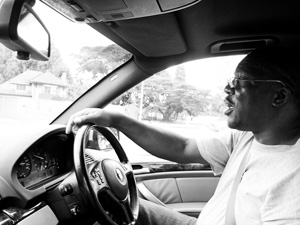
"Smell that?" Nabil says. I do. A burning wood, campfire smell. "Smells like
Africa" he says.
Unlike the Congo, where we had official trucks with massive radio antennas
attached to them, all sporting big Oxfam logos across them, Ransam is driving a SUV
Silver BMW X5. "Ransam, I didn't know you rolled like that," Nabil cracks.
Driving on the roads my heart pounds, not just because I'm in a New
World now, but also because Ransam hauls serious ass while driving. With two lane
long stretches of dark highway lit primarily by the night stars above, the area feels
quiet and empty, and the peace is broken with occasional clusters of lights coming
from houses or businesses.
"Ransam, you think I can get some of those big bills?" Nabil asks, referring to
the standard fifty trillion dollar bill.
"Yes, I have them." Ransam replies.
"Well, we can do a trade off," Nabil says.
"That won't be necessary. You can have them," Ransam says.
"Why?" Nabil asks.
"Because they're useless." Ransam says. 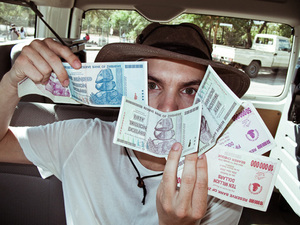
And the Zim dollars are now, in fact, worth less than the paper they're
printed on. Ransam explains that three weeks ago, in an effort to resuscitate a dying
economy, President Mugabe let the people officially trade in foreign currency,
primarily US dollars, rendering Zimbabwe into a totally cash economy, and leaving
Zimbabwe dollars obsolete. Ransam begins talking about the now dilapidated state
of the country, and reminisces back on the Harare that used to be just little more
than a decade ago--once one of the most beautiful cities in the world, Ransam says.
Lyndsay asks Ransam if he has a family. Ransam says he has a wife and four
children, plus another ten children that live with him that are two of his wife's
sibling's children. Her siblings died of of AIDS and Ransam and his wife decided to
raise them. Fourteen children, and three of them, he says, have HIV themselves.
The antiviral medicine makes it so you practically cannot even tell by looking at
them they are sick. The poor, he says, are not so lucky when it comes to affording
expensive medicine. The government reports 18% of the population is HIV positive
here, Ransam says it's "more like 25%."
DAY 2
Morning? I'm not sure. It's still dark. A few roosters came to and started
squawking, so I took my cue and followed suit, turning on my bedside lamp. For all
the crazy jet lag, the hurtling of your body in a man made machine through time and
space across Earth‐‐I slept like a stone. I sleep well in Africa.
Joining us in the morning at breakfast is Ransam's program support officer
Verith Masa, a young, bright woman with enough bling in her teeth and ba donk a
donk to be Missy Elliot's long lost sister. As we drive through the easternmost side
of Harare, groups of men barely hang off the back of flatbed trucks, and Musasa
trees pepper the side of the roads. Again, corn is growing on every shred of spare
land--this is a new phenomenon in Zimbabwe, caused by the economy. Ian
Mashingaidze, Director of Oxfam Southern Africa office, with strong features and a
uproarious laugh, says about all the corn "Give a Zimbabwean corn porridge three
bowls a day three hundred and sixty five days a year, he is a happy man." We pass
by the Presidents' office, where many men in army camouflage with yellow berets
and guns wait. And just across the street is the Central Reserve Bank, an elegant
aquamarine colored building that is the tallest in all of Zimbabwe. Pulling up to the
Oxfam headquarters, we meet Sefelipelo Bhebhe (what's up baybay:) a public health
coordinator for Oxfam. Squeaky clean efficient, she quickly explains to our group
that today we will be visiting the city of Kadoma, and hour and a half Southwest
from Harare. There we will see what Oxfam, in association with their regional
partner Practical Action, have being doing to help improve the water sanitation
systems and treat cholera. Kadoma, it also turns out, is Ransam's hometown, and he
would soon find himself experiencing an orgy of flashbacks. But more about that
later.
As we pass farm after farm at Mach 5 with Ransam at the wheel, the endless
fields of yellow corn and green swirling together to form a candy cane I wouldn't
eat, Ransam explains that the farmland is largely responsible for the hobbled
economy. In 2000, he says, Mugabe tried to pass a referendum that expanded
executive power and granted him power to move lands as he saw fit. The voting
public rejected the bill, yet much of the proposals of the referendum were
nevertheless carried out. Much of the farmland that was redistributed was given to
owners who lacked any vested interest or knowhow to farm it. And seeing land
being stripped from people forced the international community, including the US,
Britain, and the EU, to pull out any support they had been giving to Zimbabwe--
further causing any foreign investors interested in Zimbabwe to run for the hills.
And since 40% of Zimbabwe's economy was directly dependent on farming--it only
spiraled down further out of control.
The cholera outbreak is only the tip of the iceberg for the many challenges
Zimbabwe faces. With only one doctor per 12,000 people, medical attention is
scarce and difficult to come by. Largely because of the financial crisis, more than 4
million professionals have already left, a "brain crisis" as Ransam puts it. These are
hard times, and Ransam calls them how he sees them. With a beard and rectangular
professorial spectacles, and standing well over six feet, Ransam cuts quite a figure.
And he has a notorious temper amongst some of the Oxfam staff--"You need to be
there, yesterday" a young Oxfam worker recounts him sharply telling her. But the
passion and even anger Ransam experiences are understandable and in many ways
to me seem the fate of a man with true conscience; he is fully aware people's lives
depend on him doing his job to the best of his abilities, and no matter how well one
does their job, there will always be people whose lives can't be saved.
Approaching Kadoma, I roll down the window and close my eyes,
letting the '70s Zimbabwean Afro Jazz Ransam has put on the CD player soak into
my mind. As I open them I see a grimy green bus loaded to the tippy top with
luggage tied down by ropes, whizz by, spitting enormous plumes of black smog out
of its exhaust and leaving a little jet‐like trail behind it. There's no way that thing
passed its smog check, I think to myself. But right now I've got other things on my
mind--like my life. Ransam drives like Kurt Russell did in Death Wish.

Cruising into Kadoma, people mill about with the soft buzz of
commerce. A yellow Labrador lazily walks out of the blazing sun to join a few other
dogs. Inside the Practical Action headquarters we meet several workers, among
them Alexio (legitimate T.I. identical twin) and Tendai, a nice young woman. They
brief us before we go into the field about their water and sewage systems. As Alexio
speaks I have to really struggle to contain my ADD because he looks so much like T.I.
I just want him to bust into a freestyle. But instead he goes into mind-numbing
detail about the reticulation systems they've developed with their boreholes, or
drilled pumps. By constantly circulating the water, they keep it fresh and don't
allow it to stagnate or grow bacteria like cholera. Tendai chimes in about how it's
important to train communities themselves to learn how to not only fix their
boreholes, but also how to keep sharp eyes out for any symptoms of cholera. Many
of the townspeople, it turns out, were highly suspicious of the Practical Action staff
when they began going door to door teach the people about these methods, and
many of them even kicked them out of their houses, and warned all their neighbors
to not listen to them. But when the outbreak went into full force, people changed
their minds and quickly invited them back in. As a result, many of the 92,000 people
of Kadoma are much more savvy about cholera, and very few cases are reported as
of this moment.
A young girl with a tattered blue skirt skeptically looks me up and
down as I step out of the SUV on one of the rocky dirt roads. We are visiting the
lavatories for the town--due to condensed homes, sewage for each individual home
is no longer available, and one large lavatory is now being built by a crew of about
12 men and women, all wearing white t‐shirts and long blue pants with big black
rubber boots. Soon, they say, this new lavatory system will be available to use. But
only thirty yards away, there is one of the already in-use public toilets. As I walked
up to the concrete house‐like building, I notice a squishy, dark, dampness on the
ground surrounding it for 15 feet in all directions. Bile started to creep up in my
throat as my nostrils caught the smell of rotting feces and stagnated urine--the
dampness was sewage. The moisture reflected the shimmering sun in some of the
puddle like area, and it looked like it was moving. It was moving. All around the
toilets were a sea of little white maggots, growing and wriggling around in the poop.
I began to quietly gag, and couldn't believe that these were the sewage conditions
that the people of Kadoma live in. Cholera could very well be living in any of that
sewage--and it could only take a dog walking by, or a toddler wandering around, or
a careless adult, to step in it and spread it, easily causing another outbreak.
"Can you feel the stench of the sewage in the air?" Ransam asks sadly.
He then leans to me and puts his hand on my back and conspiratorially whispers,
"This is where I lost my virginity." I look at the leaking sewage and maggots on the
ground, and pray he used a condom.
A borehole (I always thought it was boar hole, until corrected) is a
well that has been drilled into the ground, with either a hand or mechanical pump
attached at the top. Children, elderly, and women collect water from Kadoma's main
borehole--a large bronze fountainhead. Two large 5,000 liter tanks are erected
behind it for storage. Different colored buckets of green and white and yellow
surround the gushing faucet, and the sounds of splashing water is refreshing to the
ears. Everybody literally comes alive when they are around this life spring, with
smiles and laughter flowing freely as the water.
Visiting and emptied out yet still operational cholera center later on in the
day, massive green tents stand side by side. Sister Kathy, a spunky Zimbabwean
woman in a solid green dress, guides the tour. Sister Kathy points to one of the
tents, which sports a large Unicef logo across the front flap. The male and female
acutely dehydrated could be placed in one tent, because, Sister Kathy says, they are
too ill to "do anything." Chuckles abound from all the Africans in our group, and
once from me once Ian translates the joke from Shona to English for me. Over in the
corner around a patch of brittle, dry, brown weeds is a quiet black tent. It is the
makeshift mortuary for people killed by cholera.
Next door to the clinic is a primary school, which Ransam says is the one he
attended as a child. Josephat, a young and jumpy Practical Action worker, urges
Ransam to come back and speak to the students about the value of education
because many children "don't think it pays to go to school anymore."
"When they see me driving in an X5, where do they think I got it from?"
Ransam says. Ransam is such a baller right now all I want to do is be his bitch in
some way, get him some coffee, or light a cigarette or something. He is the poster
man for making education a real man's job.
On the way back to Harare, Ransam's obsession with speed catches up to
him, when he blows out the turbo on the engine and massive clouds of diesel shoot
out the back of our car like Chinese fireworks. Ransam gets on the phone and starts
making calls, pacing impatiently at the front of the car‐ it isn't Ransam's fault, it
turns out, the turbo was already on its last legs. 50 yards behind us there has been
a serious car accident, and a crowd has formed around what must be an injured
person. These two lane roads were originally supposed to be separated, but due to
corruption, only one was built.
DAY 3
Jimi Hendrix permeates the radio waves, as I sit shotgun in a full car on its
way to the Mudzi district, a dry, drought‐afflicted area hit hardest by the cholera
outbreak. In the back seat is a new American member of our group, Miriam
Aschkenasy. At 5'1'' she's a feisty tiger of a woman, armed with a nose piercing and a
strong passion for yoga, this part‐time Harvard Humanitarian Institute teacher and
Cambridge ER doctor, full time Oxfam Public Health Specialist, has flown over from
Boston to be with us. Ransam and Miriam work together keeping all of the
programs on track, and much of their work they do, such as using Bio‐Sand filters to
treat water in people's homes (almost like a massive Brita filter) is cutting edge.
Miriam educates me on a new process of epidemiological surveillance that
gauges how the diarrhea situation is impacting the district. The survey, conducted
by Spouse‐Net (Single Parents Widow Support Network) measures 15 households
every 2 weeks. Bridget Masareuri, a strong Zimbabwean woman with kind, honest
eyes, is the director of Spouse‐Net. We meet her once we've arrived at the Pumpkin
Hotel in the small city of Kotwa. Trained as a social scientist, Bridget employs many
ingenious techniques to educate the people on the danger of cholera. We are about
to go and see one of them.
Two hundred and fifty people are in front of us now, divided naturally into
men on one side, women on the other. All eyes are glued to the "stage," where
actors from the village perform a short play about a woman who is cooking some
stew, but stops to change a baby's diaper and then goes back to cooking, thereby
infecting everyone in the family. The performance is presented as a comedy, with
many of the actors really hamming it up in hysterical ways once they get infected.
After the performance ends, a chorus of women begin singing a song about cholera
in their native Shona language.
Miriam explains how the songs are incredibly affective at spreading
information, and finding myself bobbing my head and tapping my foot to the tune, I
can easily see why. Many people from several different villages have gathered here
today to give thanks to Spouse‐Net and Oxfam for all the work they have done for
the community. Bridget and Ransam's teams are presented with gifts of fine,
handcrafted basket weaving, all done by a blind black man. With white cloudy
cataracts in his eyes and a long white and black beard, he may not have sight, but
certainly not a lack of vision.
After thanking the people for coming to greet us, we walk down a dirt path to
their recently fixed borehole. They insist I pump the large steel handle, and as soon
as I do clear, clean water pours out of the faucet like a gushing hose. A young man
takes me aside to me afterwards and tells me of the horrors of the outbreak. "It was
just terrible" he said, "One village had 33 people that died in it, so many children
became orphans."
Nabil plays with some of those orphans later on, giving them fist
pounds (more common now in the villages now than handshakes, which spread
cholera). They delight and giggle. As we leave, Nabil and I hop on the back of the
pick‐up truck that brought us in a 6 Km on the rocky dirt path and stand up, riding
the truck Ben‐Hur style. After getting smacked by a few thorny branches, we
quickly learn the art of ducking, and go for a wild ride. We pick up a young man of
20 on his way to Harare, and he jumps in the back with us and we all stand there,
riding the wind in a beautiful African Sunset, stoked. Ox‐drawn carts pass us by, as
that's the main form of transportation here, and I'm reminded of what Miriam told
me about how many people would have to travel miles on Ox‐drawn carts to receive
any medical treatment at all, and how agonizing that would be while vomiting and
suffering from unimaginable diarrhea.
At dinner everybody is dead tired, and there's more than a few sets of
glazed over eyes, and little if any conversation. As we sit having a beer, a drunken
man comes up to us and begins a long, intoxicated monologue. Turns out he's a
well‐known police officer around here. Eventually he leaves, getting into his car
completely hammered, and after his engine dies several times, zipping off.
In the middle of the night my eyes open, disoriented. There is not a single
photon of light in the room, its utterly pitch black. Only problem is, I can't
remember where I am, which rarely happens to me upon awaking, even when I'm
doing lots of traveling. After flailing about panicked in my waterbed from the
eighties for a few moments, I realize it's so dark because there's no electricity at
night at the Pumpkin Hotel when you're in Kotwa in the Mudzi district of Zimbabwe.
Duh.
DAY 4
A nun from the "Ministry of Feces" stands before a crowd of two thousand
people, all in rapt attention. She tells them she is here to convert them to her
Church--part of the education program to get the people to focus on what cholera is
and how the disease is spread. Its as hilarious as it is informing, and is meant to be
so--singing some of the "church songs,"--"Father, you know where you produced
your feces, go and cover them up"--and "All of us know where we dumped our feces
yesterday, go and cover them up." Sitting with our group in front of the stage,
Ransam leans over translating. If they were to produce an album of all the cholera
songs, Ransam says, it would be one obscene album.
Drums are brought in now, and hands hitting the stretched out leather gets
everybody in a trance, bobbing their heads about. Earlier in the day, Miriam had
told stories of her dancing on the last trip to Zimbabwe, and how she fully intended
to dance today. "Now's your chance'' I whisper to her. I can see the wheels spinning
in her eyes for a second, before she pops up jumps into the dance circle, joining the
five other female dancers. The roar from the crowd was the first time I'd ever heard
a collective scream occur so simultaneously. Miriam starts what looks to me like
bona‐fide Crunking and the entire 2000 people all push in closer, creating quite a
claustrophobic atmosphere.
What follows Miriam is another performance piece about cholera--about a
male Apostolic, one of the religious sects of people who do not believe in
administering medicine of any kind, as part of their religious beliefs. In the play he
gets and gives cholera to many, before getting fatally sick and renouncing his
religion that would have him killed. The lead actor portraying the Apostolic is
riveting; he reminds me quite a bit of one of my favorite actors, Japanese actor
Toshiro Mifune. What also strikes me is how hard everybody laughs when one of
the characters gets sick, squats, and makes extremely exaggerated farting sounds.
The audience howls. I lean over to Miriam and ask how they can laugh so hard when
many of them probably know people that in fact died from the very thing they laugh
about.
"It's a coping mechanism," she says. I also think that once people realize that
improper sanitation is to be laughed at, everyone will avoid becoming the butt of the
joke. Pun intended.
Some cholera patients were recently checked into the CTC (cholera
Treatment Center) clinic, so we take the two hour off road drive to get there, passing
a baboon on the side of the rocky dirt road that I could have sworn was hitchhiking.
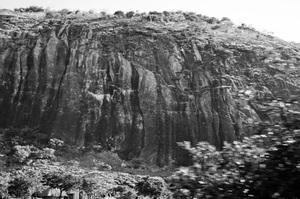
Massive round mountains made of granite are everywhere, with big individual
boulders and trees on the tops. "Black Mambas are up there," Ransam says,
referring to one of the world's most deadly snakes.
Barbara Samanga, an attractive, doe eyed Zimbabwean nurse with short
curly hair greets us. She runs the clinic by herself, which when it gets full, means
she's taking care of up to 50 patients at a time. There are 3 patients with cholera
that are just up the path in the quarantine room. Walking up the path, I catch Nabil
photographing what could be the cutest baby of all time (if my niece Atabey hadn't
already filled the spot) that a mother of about 16, holds.
Inside the quarantine room are an old man, an old woman, and a young
woman. They are on cots that have holes cut out where the rectum is, so the
patients may diarrhea while lying down. But the two women are sitting up now,
happy to have some visitors amid such gloomy circumstances. The young woman,
Tendai Chamanga, a deceiving 36, isn't sure how she contracted cholera but
suspects it was from some of the water that was given to her at the Church on
Sunday. The older woman, Margaret Chazma, who spontaneously forgot her age
when asked, got cholera from taking care of one of her close relatives who was ill
with it. Both of the women seen in good spirits, given the circumstances, generously
giving us pleasant smiles, and abundant laughter.
The 66‐year‐old man, Chiremba Zuze, doesn't have the energy to smile right
now as he lies on his cot, clutching his blanket to his chest. Chiremba has a bright
white beard and is wearing a blue suit, his open shirt exposing a chest covered in
tinea corpous, or ringworm. Never having attended a public health meeting before,
he was a sitting duck waiting to get cholera. I step closer to him now and stop,
because the stench of the vomit and the feces is so strong I'm literally stopped, as if I
ran into an invisible wall. All of these patients will most likely be brought back to
health, Barbara summarizes. Unfortunately many are not so lucky.
DAY 5
In the morning, while our group is packing into our vehicles on our way to
the local Mudzi government run hospital in Kotwa, I can see something is bothering
Ransam. After some silence on the road, Ransam tells us that just last night 19 new
cases were reported. All the cases were people who were members of apostolic
sect, and all the infections occurred at a local funeral, burying the dead. There's
frustration etched on Ransam's face as he explains the quagmire of trying to help a
people who not only refuse it but also condemn it and push it away. The only way to
get them to take the medicine is to convince them that they aren't taking medicine--
just a bit of salt and sugar. Some of the humanitarian workers have even started
referring the Apostolic as "the killers" because of how many innocent people are
infected by their ignorance‐that's why they create so many of the plays about them.
The doctor of the hospital is a young jokester of a man in his thirties
named Dr. Mudariki. He's one of only two doctors at the hospital, which services
33,000 households, figuring four people per household, that's 132,000 people. As he
elaborates on the nature of the 19 cases reported, I'm continuously distracted by his
t‐shirt, which has a large AK‐47 embroidered on it. And the back of his jeans has
several multi‐colored locks on them--he looks more like Kanye West than Dr. Phil.
When I press him on the meaning of the shirt, he assures me he just thought it
looked cool.
The good news is that Oxfam's early community response education is
working--over the course of the night, all 19 people were identified, taken out of
their homes, and brought to treatment centers. This is a great sign, and also will no
doubt save lives. Dr. Mudariki dismisses his team of fifteen assistants and gives us a
solo tour of the hospital.
As we pass by the non‐operational X‐Ray building (they don't have the
chemicals) I see a trio of motorcycles parked in the hallway. Pretty cool, I say.
Miriam looks at me and calls them "donor cycles." She's seen some pretty awful
things working in that ER, that's for sure.
Rounding out the last corner of the tour I'm delighted by the serendipitous
occasion of running into Augustine Mutizee--the man who played the Apostolic
with such verve and bravado in the play the day before. He's visiting the hospital
today to treat cuts and wounds to his arms and face, after five men jumped him in
his village that thought he was too much of a "show off." Ah, fucking actors don't
know when to let up no matter where in the world we are.
After that we stop by a village and are given a tour of the agricultural
development programs that have been implemented recently, such as seed and
propagation programs. Nabil and I squat down on a field and shell fresh groundnut,
or peanuts, which have been harvested and left to dry out in the sun. Cow peas and
corn crops are also everywhere, and in front of a large group of a hundred or so
villagers a man giving us a presentation on the progress they have been making
informs us that the newly harvested generation of seeds are now called "Mai
Masraure" which means "Mother Masarare." They named the seeds after Bridget
because of how much she has helped all of them. Bridget blushes shyly. The man
then says that they would name the new harvest after Ransam, but he is too tall to
represent such a small seed--but I am short, so they will name it after me.
Uncontrollable laughter follows, and Ransam translates it back to me while taking
off his glasses to wipe the tears from his eyes from laughing so hard.
We're racing the sun now to get back to Harare and Ransam won't say it, but I
know why because Miriam had told me in private earlier: its extremely dangerous--
livestock, civilians, and oncoming cars pose serious hazards once the sun sets. As
I'm sucked back into my seat as we shoot up the next hill, I'm pretty sure now what
Ransam is trying to do: break the sound barrier.
"The cars that don't turn their high beams off when they go by, they are
usually the drunk drivers." Ransam says. "The economic situation has caused many
people to drink to escape their problems." I take note of that, but am not comforted
when half the cars that pass us by leave their high beams on.
Back at the hotel Pandarhi in Harare, I lay on my bed clenching my
abdominal muscles in pain. I've had violent diarrhea now for the past day, and the
burning pain in my stomach isn't getting any better. Tired, nauseous and dizzy, I
stumble to dinner and ask Miriam if there's anything wrong with me--like, did I get
cholera? Not even close, she says, if I had cholera, I wouldn't even be able to walk.
DAY 6
I stare into The Devils Cataract with sheer awe--it is no doubt one of the
most incredible sights I have seen in my 24 years. Victoria Falls in eastern
Zimbabwe, sporting the largest single curtain of falling water on Earth, blows
Niagara Falls, well, out of the water. Unending columns of water crash over 100
meters down into deafening explosions below, shooting billowing spray so high into
the air that it looks like clouds are above. This bonus trip to the Falls today, our
group's chance to see one of the Seven Natural Wonders Of The World, is a treat
we're grateful for. My drenched sneakers struggle to keep control as I walk to the
edge of the aptly named Danger Point, an unfenced edge of rocks over the falls, the
cliffs below holding the violent, frequently whirl pooling torrent of the "Mighty
Zambezi" river in place, unmoving and unconcerned with mankind.
On a nearby well kept lawn next to the Falls, a group of wart hogs run around
casually at a nice patch of grass before we get onto a ferry on the Zambezi. The wart
hogs chase each other, making sounds exactly like Harley Davidson's--I shit you not.
I finally understand the meaning of the title to the film Wild Hogs. Little did I
know I would be eating barbeque warthog within hours. I summon my nerve and
approach one of the hogs munching on some grass. Getting a bit to close for his
comfort, he perks his head up makes a move to charge. I bolt--but the hog was only
bluffing. I look back with shame and he's still eating grass.
After leaving the falls, we visit what is listed on our itinerary as a Nature
"Sanctuary," which really should be nature "cemetery." Crocodile hides, bags, and
stuffed crocs are all available in the gift shop of the Crocodile farm, which raises the
baby crocs from birth before stun gunning them at the right age and skinning them.
perimeter, named Simba. Simba the lion lies on the ground, tired. Nabil walks up to
the fence and makes rather annoying sounds to Simba, taunting him to get good
photos. Simba goes from being stock still to charging the fence, swiping at it with a
sledgehammer paw and giving a mighty roar--and knocks Nabil on his ass,
chastening him. The staff of the "sanctuary" brings in a massive slab of elephant
meat which Simba drags off, tired. Our host, a leathered skin old man explains
Simba's sister and brother died two years ago, and he's been alone since.
On the way back from dinner at the "dress‐up" Africa restaurant for us
gringos called Boma, we encounter two elephants on the road, illuminated by the
headlights. They are giants. Moving slowly across the road, unconcerned with the
tourist bus in front of them. These ancient creatures are captivating, and Nabil is so
taken with them our driver has to scold him to stop him from jumping out of the car
to photograph them. It doesn't work. Nabil fearfully gets out of the car, and begins
snapping pictures. Inside the car I'm laughing, and thinking this is a different side to
Africa, separated from the humanitarian crisis I've mostly been exposed to on this
continent so far. It is a place of wildlife and beauty and magic.
DAY 7
Perusing the local roadside set up shops back in Harare, Lyndsay, Nabil and I
buy up gifts for our friends and families. My mother has a love of elephants, so for
ten dollars I buy her a beautiful green stoned elephant cut out in an abstract and
compelling design. Going to and from the layout blankets, we are constantly being
lured by the vendor's to buy their sculptures, their stones. The economic hardships
couldn't be more obvious than right now--the desperation in the shopkeeper's
voices is disturbing. An old, white man in a tattered black-and-white striped t‐shirt
with torn and battered jeans and sad, deep blue eyes, hovers around me. The
shopkeepers shoo him away tersely, worried he will bother me, the customer. It's a
strange sight to see a homeless white man here, Nabil says.
After spending close to 100 US dollars I'm walking to the car and the old
white man with blue eyes is waiting for me. I have no money left, I lie to him. I get
into the car and close the door. He puts his hands gently on the glass of my window
and taps.
"What about me? What about me?" he says. I don't look at him, just forward and
talk to Lyndsay. She wonders whether he was in one of the farmer families that got
their land taken away from them and redistributed. Eventually he stops tapping.
"What about mercy?" he says. We drive away.
Back at my room at the hotel I start furiously washing my hands, but stop and
am overcome with a wave of guilt. In my mind's eye I see the old man stumbling
down the road. No amount of washing can make these hands clean today.
DAY 8
Ransam Mariga shakes my hand goodbye. It's a strong, firm handshake, one I
would only expect from one of the more heroic men I've met. "We are on our way to
recovery, I think. In two years, I believe we will be a much different country."
Ransam says. He speaks with the kind of noble authority that makes me believe
him. I express my gratitude to him for his guidance and help showing us around
here, and am given comfort knowing there's people like Ransam Mariga who work
their hearts out day in day out to save lives.
Zimbabwe's people, despite being dimly perceived by the world, are a
buoyant, friendly people, living under a weight of oppression. Despite all the
political insanity, hardships, a collapsed infrastructure, rampant outbreaks and a
severe lack of resources, I've honestly never met a friendlier group of people.
Change is coming to Zimbabwe, I think, because the infrastructure is already there--the
paved roads, sanitation systems, and farms--they just need to be given a leg up
again. Hopefully soon the political situation will calm and foreign investors, other
foreign countries such as the United States, and a large tourism industry can boom
once again. In the meantime, Oxfam is an invaluable, life saving resource for the
Zimbabwe people.
Back on the plane, all the laughter from the crowds of villagers as they
watched the comedy plays on cholera echoes in my mind. The people simply look a
fierce an agonizing killer in the face and laugh at it--you can never lose your
laughter, they say, then you've lost everything. And yet, don't be fooled by the
laughter. It hides things, however elegantly, that are tragic and true. The most
honest performance of all came from a young village woman in a choir in Makaha,
who sang, with an endless abyss of sadness in her voice: "Ndikarangaria hama
dzangu dzakafa, ndinochema." "If I remember all of my relatives who have died of
cholera, I just cry."
Epilogue:
Since my trip to Zimbabwe, I was asked by musician Kenna to participate Summit On The Summit,
a project he developed where a group of artists and educators would together climb Mount Kilimanjaro,
with the goal to raise money for the global clean water crisis. Having been previously to Congo, and now
Zimbabwe, I felt inspired to go and drag myself up that mass of rock. Out of forty five of our climbers on the
mountain, all forty five made it to the summit--a feat our dumbfounded guides said was extremely rare. On a climb of
twelve climbers, nine making it up is considered a success. I believe we all made it to the top together because we all
believed in the cause ; bringing attention to those in need. I had a whole bunch of issues on my way up
that would cause most sane people to lose their appetites, but that's another story...
Photographs by Nabil Elderkin