iPhone app iPad app Android phone app Android tablet app More

Featuring fresh takes and real-time analysis from HuffPost's signature lineup of contributors
Emma Gray

GET UPDATES FROM Emma Gray
 

"Iron Lady Effect": Are Women Lowering Their Voices to Sound Like Margaret Thatcher?

Posted: 01/10/2012 3:17 pm

First women were supposedly trying desperately to sound like Britney Spears and Ke$ha. Now, according to a new survey, there's a new female vocal role model: Margaret Thatcher.

The Daily Mail reported that nearly half of women use a "more masculine tone" of voice at work, while 56.7 percent of women dress more conservatively. Both of these measures supposedly boost women's careers, according to a survey conducted by One Poll for Business Environment, a company I couldn't find on Google.

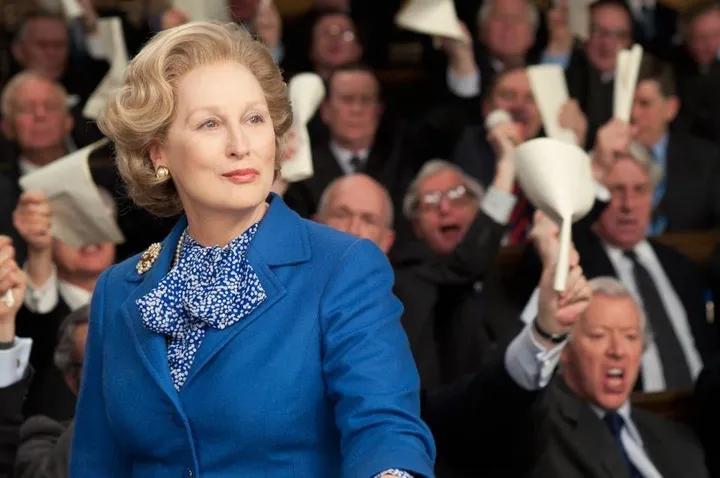
The Mail dubbed the behavioral trends these findings allegedly expose "The Iron Lady Effect" after former British Prime Minister Margaret Thatcher's own image transformation. She took elocution lessons to combat her own "too-feminine" voice and kicked her love of hats altogether after meeting with various image consultants (although she refused to give up her signature pearls). "The Iron Lady," the biopic of the PM released at the end of December, starring Meryl Streep, has set off a new wave of women idolizing Thatcher, according to the CEO of One Poll for Business Environment, David Saul.

Saul told The Daily Mail:

As the first major female leader of our times, it's not completely unexpected that today's women should want to emulate [Thatcher] in various ways -- intentionally or not. Whilst it is still widely reported that women still have some way to go in terms of boardroom equality, evidence suggests they are well on their way to the dizzy heights of 'Thatcherdom' once again.

But let's recall that Thatcher was never all that popular among women -- and didn't really strive to be. "I owe nothing to Women's Lib," she famously said. Although she certainly broke through the glass ceiling to become Britain's first female prime minister, her policies generally ran counter to the interests of 1970's feminism. As author Linda Grant recounted to The Guardian in 2005:

Margaret Thatcher became leader of the Conservative party at the height of the women's movement, yet she was completely apart from our campaigns, our passions and our identity. She was the middle-aged woman with the hats, the pearls ... and the policies which had nothing to do with equal pay for work of equal value.

Perhaps women do strive to emulate Thatcher's drive and accomplishments -- or will, now that "The Iron Lady" has put her back in the spotlight. Still, it strikes me that there are many more reasons women might decide to dress conservatively at work -- not wanting to draw attention to one's sexuality at work, complying with an office dress code -- that come way ahead of mastering PM chic, or even the power associated with it.

And as for the supposed voice-lowering phenomenon, since Thatcher was in office from 1979 to '90, many young working women probably aren't aware of how low her voice was, much less that she put effort into making it that way. But the larger question I think, is who are these women who are intentionally lowering their voices at work? Do people really do that? If you've witnessed it, please chime in in the comments. (I suspect that if I tried to lower my voice, I would end up sounding more like a phone sex operator than a boardroom professional.)

For me, this survey seems like another example of the way women are consistently given mixed messages about how to dress, speak and act in the office -- capitalize on your sexuality but don't sleep around, wear makeup but not too much makeup, dress conservatively but not in a way that looks masculine.

Instead of trying to follow all of those directives, your best bet is probably to dress and conduct yourself in a way that feels comfortable for you and fits into your company's culture. It's definitely easier than dropping your voice an octave.


Follow Emma Gray on Twitter: www.twitter.com/emmaladyrose

First women were supposedly trying desperately to sound like Britney Spears and Ke$ha. Now, according to a new survey, there's a new female vocal role model: Margaret Thatcher. ...
 
 
  • Comments
  • 37
  • Pending Comments
  • 0
  • View FAQ
Comments are closed for this entry
View All
Favorites
Recency  | 
Popularity
Page: 1 2  Next ›  Last »  (2 total)
08:43 AM on 01/16/2012
Lets talk about how MEN use speech! Why do women have to be broken down and dissected piece by piece? This is a ridiculous article and just spews more prejudice from men towards women. How women, dress, how women speak,what women do, what women shouldn't do...I'm really sick of it.
photo
HUFFPOST SUPER USER
Vanderbil Covington
It is better to be wise than just knowledgeable
01:42 AM on 01/16/2012
There are distinct differences in the way women use speech. Not only affected by region, but also age, race and associations. Most white women from the North and West coast tend to speak higher in the throat, giving the voice a higher nasally pitch. They also tend to speak at a faster word rate. Those from the East and South normally have a lower pitch by a full octave. Black women vocalize lower in the throat which produces a lower pitch but higher intensity due to breath directly from the lungs. I site these examples only as high percentages and representitive of all women
08:40 AM on 01/16/2012
Wow, thats quite an observation. So, how do MEN use speech?
photo
HUFFPOST SUPER USER
Vanderbil Covington
It is better to be wise than just knowledgeable
11:55 AM on 01/16/2012
Men seem to be affected only by regional dialects, not discernable differences in speech patterns. One other observation, Whites in close proximity to each other, tend to speak in a quieter voice than Blacks. This is a cultural thing based on tradition where Blacks speaking in low voice or whispers were suspected of intrigue
photo
HUFFPOST SUPER USER
Vanderbil Covington
It is better to be wise than just knowledgeable
11:44 AM on 01/16/2012
Correction: Should have read; "...and NOT representitive of all women"
photo
zmfts
Whatever doesn't kill you makes you walk funny.
01:34 AM on 01/16/2012
I honestly have never thought to myself, "Hmm, I would really think this woman was a professional if her voice weren't so high-pitched." Seriously, it's not something I ever think about. Don't we have more important things to worry about?
01:34 AM on 01/16/2012
i like cindy lauper's voice. also kate bush, diana ross, karen carpenter and aretha franklin's voice.
12:57 AM on 01/16/2012
I'm not. XD

Sometimes, I try to sound like Lust (from FMA), but that's just for fun. Laura Bailey is awesome, her Lust voice is BORDERLINE GOD.
12:29 AM on 01/16/2012
A more masculine tone? OMG, what a ridiculous term. Women compete and are quite successful in sports, they also participate in community, local, city, state, and national politics. If you really believe a "more masculine tone", then you are really out of touch. "Valley Girl" speech patterns? Seriously? No woman took that seriously. I met Margaret Thatcher and she had a very shrill side, too. Three octaves, more on the sharp side, but the serious side was alto, not reserved for males
photo
HUFFPOST SUPER USER
Joy Zocco
Retired systems analyst
11:57 PM on 01/15/2012
It may be that some women's voices deepen when they get a little older - remember Lucille Ball? If it really is a fad/trend, it probably won't last very long.
11:05 PM on 01/13/2012
"Valley Girl" speech patterns and other verbal ticks can be hazardous to your career, your networking endeavors, and your social life. Talking deeper could be a step in the right direction but it's really about what you say and how you say it.
03:41 PM on 01/13/2012
In recent years, many women have adopted a new vocal range. If you listen to a lot of 20-40 year old women, you will notice them ending each sentence by trailing the words in a deep croak. As if to speak in as low a range as possible. Not sure why. You can hear great examples of this on This American Life when female contributors are telling their stories. Also Melissa Block on NPR is the queen of the "wry croak." But this is not limited to entertainment/news personalities. My daughters' friends and even my nieces have adopted this "end with a croak" delivery. I would love to know where it came from. The Margaret Thatcher movie is definitely not the source. Watch any movie up until the year 2000, and you will notice women speak in a different register than now. Maybe it does imply more power, as someone said, but many times the subject matter can be very light, yet the sentences end this way. In my career as a music producer, I have spent many hours with singers and voiceover performers, and am attuned to vocal quality, register, etc. So I don't believe I'm imagining this. Love to hear other thoughts. Maybe you yourself are a croaker! Write in!
08:45 AM on 01/16/2012
"croak'? What? Totally imagined by YOU. So what "new vocal range" have men adopted?
12:27 PM on 01/13/2012
I don't know if they are or not, but I know one thing.....a deeper voice commands more respect from both men and women than a high pitched one.
photo
HUFFPOST SUPER USER
BlackYowe
I am a classical- liberal woman and a Jeweler.
02:26 AM on 01/13/2012
Just wait, menopause will do it for you, LOL.
07:37 AM on 01/12/2012
You know, if it's true, it would be the first celebrity trend I applaud. I've noticed young women becoming increasingly squeaky and baby voiced. Now if emulating Ms. Thatcher could result in removing the question mark from every single sentence, we'd really be on to something! www.HereSheIsBoys.com
05:55 AM on 01/12/2012
Lots of British women's voices are naturally low, really. Definitley seem lower compared to American women's voices, for some reason.
This user has chosen to opt out of the Badges program
photo
shortguy54
Short, balding, brilliant... (well, maybe not so)
04:09 AM on 01/12/2012
I high woman's voice speaking loudly can easily sound screechy, strident or scolding. Images of nagging mothers, wives and daughters come unbidden to the mind. A definite turn-off in a professional setting! My wife has been in politics for 20 years now and always strives to keep her voice low when speaking in public. It seems to work well.
02:25 AM on 01/12/2012
No.