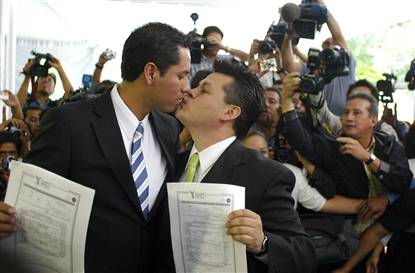
A Federal Court Judge in California has ruled that Proposition 8 violates the due process and equal protection clauses of the Fourteenth Amendment. The decision is important not only because it reaffirms the fact that marriage discrimination is illegal, but it does so under the Federal Constitution.
Seems like a no brainer after years of state decisions supporting gay marriage, but the struggle to bring a Federal Constitutional challenge to marriage discrimination has been long and hard.
As a movement, the LGBT community has always seen legal strategies as a central part of the march towards equality. Many organizations, including Lambda Legal, have spent decades building positive precedents on gay issues in State and Federal courts around the country. But their strategy has been one of incremental change: move individual laws towards equal protection and eventually, real equal protection will be a winnable issue. This is why, for example, state cases were brought in places like Iowa, rather than an across the board challenge against LGBT legal discrimination.
So imagine the uproar when two star lawyers, both straight white men, marched into the Proposition 8 controversy with little prior experience with LGBT struggles and announces a federal challenge to marriage discrimination. They were going after the holy grail: equal rights for LGBT people under the fourteenth amendment, and they were going after it, with or without the LGBT movement's approval.
What resulted was an internal struggle between incremental change and bold gestures for equality.
Today, bold gestures certainly seems to be winning the struggle.
The Federal Court not only found that discriminating against gays and lesbians was unconstitutional because it denies them due process, it found that discriminating against gays and lesbians was legally equivalent to discriminating on the basis of sex -- a constitutional no-no from way back. It found that there was no credible evidence suggesting that marriage discrimination served any legitimate state interest and that the only plausible intent behind Prop 8 was pure hatred and discrimination. Piece by piece, the 138 page decision tears apart the logic of the traditional marriage movement and exposes it as the offensive and homophobic club it really is.
The case will be appealed and a stay issued by the judge will likely avoid a marriage flood in California before the case gets to the Ninth Circuit Appeals Court. The appeal, a step before the Supreme Court, will be a very important indicator regarding the success of this strategy. But with one win under their belt, even a loss in the Appeals Court could pave the way to success in the Supreme Court.
The slow build strategy adopted by the LGBT movement has been highly effective. Without it, there is little chance that the bold federal challenge to Prop 8 would have seen any success. But the fear that a Supreme Court case will create a bad federal constitutional precedent if brought too early still paralyzes many LGBT legal strategists.
I'm not sure they're wrong.
What I do know is something that was articulated well by the Federal Court today:
Plaintiffs presented evidence at trial sufficient to rebut any claim that marriage for same-sex couples amounts to a sweeping social change. Instead, the evidence shows beyond debate that allowing same-sex couples to marry has at least a neutral, if not a positive, effect on the institution of marriage and that same-sex couples' marriages would benefit the state. Moreover, the evidence shows that the rights of those opposed to homosexuality or same-sex couples will remain unaffected if the state ceases to enforce Proposition 8 (pp. 125-126).
Gay rights are no longer an outlandish concept that stretches the boundaries of community standards. Sure, the majority of Californians were, at one time, against same-sex marriage. But permitting marriages in spite of their objections will not "rock their world." Instead, their world will continue spinning with the same velocity and tenor as before.
This fact, and this fact alone, might save the bold legal strategy launched in this federal challenge. The Supreme Court likely does not have a majority of judges who believe in gay rights. It might, however, have a majority of judges who understand that ruling explicitly against the rights of LGBT people in America is so antithetical to the current political and social climate, it is simply not worth the heroics required to reason discrimination into the Constitution.
Let's hope this is true. Because whether you support an incremental or bold strategy for achieving equality in America, the bold train has left the station, and it is certainly gathering steam.
Follow Emma Ruby-Sachs on Twitter: www.twitter.com/EmmaRubySachs
Rabbi Michael Lerner: Why Jews Should Rejoice at the Overturning of Prop 8
The rights of homosexuals are supported by an overwhelming majority of the American Jewish community. That support is not only based on a memory of shared victimhood, but also on the core values of our own Jewish tradition.
Despite the angry protests of many anti-gay Christian groups, I believe that Judge Walker's ruling is actually rooted in a profound theological truth articulated by St. Paul in Romans 13: "the one who loves another has fulfilled the law."
.
Wrong. The constitutional "no-no" with regards to discriminating based on gender means this: laws that discriminate based on gender are subject to "intermediate scrutiny". That means that if a law is challenged on the basis that it discriminates between the genders, the government has the burden to show that the law is substantially related to an important government purpose.
.
Judge Walker declined to make his decision based on intermediate scrutiny, or the even more rigorous strict scrutiny test.
.
Instead he applied "rational basis review" in which the person challenging the law has the burden to show that the law is not rationally related to a legitimate government purpose. Rational basis review for the purposes of the Equal Protection Clause applies to any group except those based on race, national origin, or alienage (strict scrutiny), or those based on gender or legitimacy of birth (intermediate scrutiny).
.
Judge Walker said that sexual orientation COULD be considered a suspect class, but that is what we call "dicta", which is not binding, because he didn't actually make his ruling on that basis.
We let latte-sipping, tree-hugging, organic-gardening, atheist lefties get married.
Used car salesmen, bank robbers and pedo.philes can get married.
Couples who don't want or can't have children get to enjoy wedded bliss.
Good grief, even swingers and cuckolds can tie the knot.
Several thousand gay and lesbian couples joining the parade really isn't going to screw anything up. Truly.
Oh - and fanned!
This is a little too profound for the anti-gay crowd who can only think, or actually have thoughts, in a linear, reptilian, simplistic way.
The answer to that would likely be as varied as the reasons given by the heterosexual community for reasonable qualifications for divorce.
I am aware that those that promote acceptance of "homosexuality" believe that they don't have a choice in how they feel. But it doesn't appear that God would countenance that attitude...at least there appears no evidence that Christ taught acceptance of that lifestyle as he represented his Father in the work of his mission. There is a difference between being tolerant of a behavior and implementing the concept of that behavior in one's life. The behavior is the thing that cannot be accepted...not the individual.
In His Care
When it comes to laws, we should be following our constitution and the founding documents of this country---not the Bible, not the Koran, not the Book of Mormon or any other religious texts (there are countries where they do that, Saudi Arabia, Vatican City, Iran), and per our consititution, according to the most recent decision, marriage is a civil right and it cannot be denied to gays and lesbians.
They are in a quandary. How do they justify removing all restrictions to marriage without admitting that qualifications are not discriminatory? Prop 8 sought to clarify the qualifications for marriage. The homosexual judge that said it was unconstitutional was obviously biased and incorrect.
In His grace
In His Care
I am here to tell you that you know nothing. You only believe these things to be true because it feels safe to have "all the answers" and because that's what other people have told you to believe.
But what do you really know? If you can learn to be honest with yourself and ask yourself some hard questions, then you may begin to understand that you don't have all the answers. Once you figure that out, you may be able to actually learn something real.
Right now, all your beliefs are imaginary.
I'm a bit more optimistic about the supremes. Even when they decide incorrectly they still base it on some aspect of the law (however thin). Problem is here, there are quite literally no legal arguments advanced in support of Prop 8. None. Check out the trial transcripts if you doubt me. I suspect will get five of them to rule in our favor.
This was a comment posted at ABC website. Thought it was well said ~ couldn't agree more.
In all the talk, I haven't heard the definition of marriage come up.
Here's how your conservative friends could respond: Gay marriage won't affect me personally, but it changes what society is in a fundamental way, and I don't like the new definition of society. Maybe that's what they're thinking without verbalizing it.
And while one will still be able to hold that belief in their heart until their last breath, one simply will no longer have the weight of the government endorsing their delusions of grandeur.
People who love can create loving environments and raise children who are not abused.
When we get over our old fashioned, religious based thinking, we all we be better.
The anchor baby issue is not a moral issue at all, but more a matter of an interpretation of the amendment. Immigration control is a necessary role for any government. The prevailing interpretation of granting citizenship to the child of a foriegn invader seems incongruent with the "jurisdiction" clause, and undeniably perpetuates the illegal immigration problem. Maintaining the status quo is unduly burdening our social services, and contributing to getting American citizens killed, while simply realigning the policy with the clause is a painless method for curtailing the larger problem. A new amendment is unecessary.