
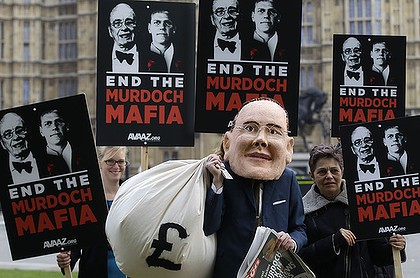
For the last eleven months, as we have watched the Arab Spring topple dictators across the Middle East, we have also witnessed a challenge to entrenched power no less remarkable, and much closer to home. Yesterday, James Murdoch appeared before the UK Parliament for the second time in four months to explain his role in the phone-hacking scandal at the News of the World tabloid.
Just this week, new revelations indicate that a private investigator hired by News International was following and covertly filming the solicitors and their families representing victims of phone hacking, attempting to cover up dirt with dirt. As if it were needed, it is yet more evidence of a media company working at best on the fringes of legality, and with an endemic culture of malpractice that looks to have reached right to the top.
As its executive chairman, James Murdoch must bear personal responsibility for the failings and practices at News International. Parliament will confront him with evidence that he knew the malpractice at News was far more widespread than he has earlier admitted. With hacking, bribery and bullying as endemic at the company as we now know it was, denial of knowledge is no longer an excuse that holds water.
Cool-headed investors have already acknowledged James Murdoch's culpability, with an unprecedented two thirds of independent shareholders, including several large and influential pension funds, voting against his re-appointment to the News Corp board at the company's Annual General Meeting in Los Angeles last month. Investors are already moving ahead of BSkyB's AGM later this month, and the meeting is sure to see a significant vote against his re-election as the company's chairman.
In a way, though, the corporate movements are a sideshow. Public demands for James Murdoch to go are growing by the day, and it is to the public that a person in a position of such trust and influence must ultimately be accountable to.
Each new revelation of the practices of News International under James Murdoch's leadership makes it increasingly clear that he does not meet the 'fit and proper person' test required under British law to hold a broadcasting license. The idea that he is an appropriate person to control two of the most influential daily newspapers, The Times and The Sun, is equally absurd.
People are justifiably outraged and are increasingly channeling that outrage into concrete actions and demands. Since launching our campaign one year ago, the members of global campaigning organization Avaaz have participated in one million online actions, sent 250,000 messages to official consultations, commissioned two public opinion polls, initiated legal challenges and made thousands of phone calls to our leaders -- helping to force Murdoch to abandon his bid for BSkyB. Avaaz's 700,000 members in the UK are now joining with the 10 million Avaaz members internationally to challenge damaging media empires more broadly in the UK and wherever they appear.
While the Murdochs are a key part of the problem, the issue is much bigger than them. The issue is instead the profound threat to democracy that the accumulation of so much media power in the hands of any one person represents.
The solution is clear and well tested -- stronger legal limits to media ownership. A 20 percent ownership limit across all media would prevent the building of media empires in Britain and safeguard our democracy and existing media diversity. Existing laws in the UK and internationally already regulate media ownership on a market-share basis. While the limits they impose are currently too weak to prevent dangerous accumulations of power, they can readily be adapted to institute a stronger 20 percent ownership cap across all sectors that helps protect our media for good.
Australia provides a clear example of what can happen without such limits. There, Murdoch controls a full 70 percent of the newspaper market. Instead of holding the government to account, he is able to hold them hostage. And yet even in Australia, a growing public movement is rising to the challenge. Australia's own media inquiry has been set up in response to these public concerns, and is currently considering options for how ownership concentration and poor press standards can be addressed.
Despite the damage they have caused, the Murdochs have proven useful to show us the deep danger to democracy posed by excessively concentrated media power. It's time to take action, not only against the Murdochs, but against the broken system that allows their kind to rise and flourish.