
We have been hearing a lot about big oil lately and the dismal attempt by the Obama administration to hold BP accountable for its damage indicates that big oil is going to continue to be a big bully. Some have been calling for legal remedies. But a case of oil pollution that has over fifteen years of "experience" might make us nervous about any attempt to hold BP accountable in the courts.
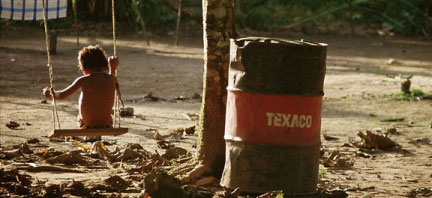
A section of the Amazon larger than the entire state of Rhode Island has been decimated by pollution from the oil industry. The indigenous population in the polluted area suffers from astronomical cancer rates, low birth rates and water quality related death and disease. From 1964 until 1992, Texaco, now Chevron, developed and exploited this oil-rich area. Today, a legal team representing the indigenous Ecuadorian population is trying to hold Chevron accountable.
The legal battle, started in 1993, has been through three different court systems without success. This struggle between residents and big oil illustrates how international investment and the agreements that facilitate it, undermine the principles of justice creating a system where wealth dictates legal success.
When residents of the Oriente, Ecuador launched their class action law suit, they did so in the United States under a special legislative measure called the Alien Tort Claims Act that allows international litigation to occur in American courts under special circumstances. Chevron argued that the case should be heard in Ecuador - the location of the conflict - and the U.S. courts agreed. But then the government changed in Ecuador and the new regime was much less likely to bend over backwards to please big oil, so Chevron came back to the U.S. to gain permission to transfer the case to arbitration. Their reasons: the Ecuadorian court they loved so much in the first case was now part of a corrupt justice system that failed to abide by the rule of law when dealing with Chevron.
The U.S., again, found that Ecuador was competent to hear the case and suspended the arbitration. So, in 2009, Chevron decided to enter into a different arbitration proceeding under the bilateral investment treaty between Ecuador and the United States, claiming that a fraudulent "clean up" effort in 1990 of a small subsection of the polluted Amazon area should release it from all tort claims under the terms of the investment treaty. This arbitration, as well as the proceeding in Ecuador, is ongoing.
Fifteen years of litigation has taught the legal community some important lessons.
The first is that endless litigation drains the resources of plaintiffs in David-Goliath type cases - those kinds of cases it is most important to see in the courts where the principles of justice can protect weak parties and meet out remedies fitting to the crime and damages caused. Chevron has an endless pocket. It made 25 billion dollars of profit last year alone. And it surely intends to use its economic advantage to draw out litigation until the plaintiffs' resources dry up. Plaintiff's lawyer Steven Donzinger collected Chevron statements that indicate that it will mete out "a lifetime of litigation" if the indigenous groups persisted in their claim. Chevron's general counsel stated that he expected to lose the case, but would "fight until hell freezes over and then skate it out on the ice."
The second is that international arbitration, in particular, presents a situation where money dictates justice. Many arbitration proceedings, included in investment treaties and complex contracts and the default forum for conflict, happen behind closed doors. Parties are predetermined and groups, like the indigenous people in Ecuador who live in the area polluted by Chevron, are not granted standing. Their case is never heard. There is no legal aid, no public assistance for those parties to the dispute who do not have sufficient funds to gain adequate representation (even the World Trade Organization's Dispute Settlement Body has a few lawyers and resources set aside for least developed nations). The terms of the contract provide the only legal reference and there are no precedents, no right of appeal, no legal system in the traditional sense that provides checks and balances on individual arbitrators.
But these arbitration decisions have real consequences. If Chevron is permitted to continue its case under the bilateral investment treaty and receives a favorable ruling, Ecuador is bound by that ruling. Violating it leads to serious trade sanctions and damages - sanctions the country can't afford.
Meanwhile, the Amazon residents languish in serious peril. As Donzinger observes, the affected area looks like a dump site: "old Texaco barrels mired in hundreds of giant, unlined, open-air pits of oily sludge that leach their contents via pipes built by the oil company into nearby streams and rivers. Carcasses of cows and birds can often be seen floating in the oil muck at well sites built, operated, and closed -- but never cleaned -- by Texaco."
•Resources include Steven Donzinger with Laura Garr and Aaron Marr Page, "Rainforest Chernobyl Revisited. The Clash of Human Rights and BIT Investor Claims: Chevron's Abusive Litigation in Ecuador's Amazon." Human Rights Brief (2010), pp.8 - 14.