It's bad enough that the federal government has decided that the Don't Ask Don't Tell repeal must be preceded by a year-long study. It will take twelve months for a group of policy wonks to figure out that letting already gay soldiers tell their comrades they are gay without risking their jobs will not irreparably harm troop functionality.
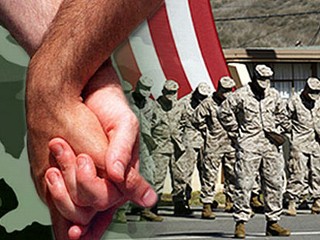
But, now, the wonks in charge of this study are actually employees of a private think tank, the RAND Corporation. That means that tax dollars are being funneled out of government so that a high priced team of private employees can figure out that troop integration -- a phenomenon practiced all over the world including in Israel and Canada and the United Kingdom -- won't lose any wars.
Privatization has many costs. When governments cede control over core functions, accountability is lost, oversight often can't keep up with the private actors and the provision of quality services, whether military, international or domestic, slowly disappears. Blackwater's actions in Iraq and New Orleans provide a perfect example of this lesson.
Blackwater also taught us that paying for private contractors to fulfill government obligations often requires a larger piece of public resources than if the government maintained control of its own core functions. That means that outsourcing actually costs more money, dollar for dollar, than having the government do its job.
Part of being a representative is being able to make decisions, based on empirical evidence in an efficient manner. Spending a year waiting for a study that could cost the taxpayers hundreds of thousands of dollars in order to discover what the rest of the world already knows is not making decisions in an efficient manner.
Not to mention the fact that the RAND Corporation spearheaded the long-held American policy of backing military dictatorships in East Asia. It also came up with the brilliant idea to escalate the bombing of civilian targets in the Vietnam War. They have been proponents of escalating nuclear arms production (they came up with the idea of mutually assured destruction) and were the creators of the then most advanced nuclear weapons delivery system in the world.
The DADT repeal is an important step on the road to equality in the United States. It is something to celebrate and a moment, when it comes, to feel proud of the tolerance and respect Americans have slowly cultivated. It should not be an opportunity to funnel taxpayer money the deeply debt ridden government doesn't have to a conservative private think tank in order to facilitate a smooth transition to a policy the majority of Americans already support.
Follow Emma Ruby-Sachs on Twitter: www.twitter.com/EmmaRubySachs
I have reservations about a private think tank undertaking this study—but would we be better off turning it over to a bunch of (older) career military officers who are not in touch with the younger military personnel serving under them?
One issue that is not touched on is that it is long past time to review the UCMJ (Uniform Code of Military Justice). It still penalizes sodomy (oral sex between consenting adults) and adultery.
I wish every homophobe concerned about the conduct of gays in showers would show just as much concern for the high incidence of rape against female soldiers conducted by their male soldiers.
How is the military fundamentally different that gays cannot function within the confines of the rules and regulations and expectations levied against their heterosexual peers who would also be wearing the same uniform? What's SO bad about gays that they are not wanted/permitted in the military? Is the problem even larger than just the military, is it societal, do gays have a 'place' somewhere near the back of the line, discrimination, that kind of thing, are they evil, what's the whole story, here?
Scrap the think tank and get rid of the policy.
And I'm usually not one for privvatization.
That said, it's important that the government pick either a think tank with a reputation for being empirical and non-ideological or multiple think tanks of differing biases. There's trade-off: it's cheaper to use just one, but since bias is unavoidable the latter may be more thorough.
As far as I know, the RAND corporation is not an ideological think-tank. So this seems like a decent move, particularly in an environment of government distrust and budget worries.
I'm very glad you are publicizing the problems with government outsourcing, but I think you've chosen the wrong target. First, the "neutrality" of a non-governmental entity may help legitimate a decision that many Americans think should be made on the basis of sound policy, not politics.
Second, at a time when government outsourcing has arguably caused us to lose the war in Iraq by delegating tasks to free-wheeling companies who reenforced the Arab world's perceptions of Americans as bullies, crying wolf when the government outsources a study on gays in the military seems a little silly. Not because excluding gays from equal citizenship is insignificant or silly--it is decidedly a critical moral issue--but because the likely harm from outsourcing this study is so much less significant than the harm caused by outsourcing key military and diplomatic functions, like protecting Iraqi officials or encouraging the reinvigoration of civil society in Iraq. The massive human toll of our failures on those fronts seems to dwarf the accountability and transparency concerns you raise here.
Whatever makes you think that empirical evidence has anything, whatsoever, to do with public policy?
Empirical evidence is used only, solely, to oppose something. No empirical evidence whatsoever is needed to do anything. If you have any doubt, take another look at the last Bush administration and the work of Congress during that period.