

Campinas, Brazil
In a democracy that developed technology to protect the integrity of the popular vote and the social contract linked to it globalists aligned with the business-to-business values of the elitist World Economic Forum have added a sense of drama to Brazilian politics by seeking to influence the outcome of the October 31st presidential election.
Similar efforts to work around social contract democracy are also an issue in the United States where president Barack Obama recently commented on foreign influence in the run up to next month's mid-term elections.
Brazil is a long way from London but The Economist has endorsed US-style neoconservative Jose Serra of the Brazilian Party of Social Democracy over Workers Party candidate Dilma Rousseff, arguing that Serra, who learned his "Chicago school" economics in Chile during the dictatorship of General Augusto Pinochet, would make a better president, and that president Lula's Workers Party is monolithic and corrupt. This from a publication that failed to fully investigate the activities of Jack and Mark Thatcher during the government of Iron Lady Margaret Thatcher because doing so would have been bad for business.
An item in The New York Review of Books has called into question Brazil's obligatory voting system that gives blacks and indigenous people an opportunity to have an equal voice with the nation's wealthy political class. And in Washington the once militant French socialist Dominique Strauss-Kahn, now preaching the gospel of free markets as managing director of the International Monetary Fund (IMF), has editorialized that Brazil faces a gloomy economic scenario if the government fails to open the banking system and privatize state companies... never mind that France hasn't done too badly running an economy in which half the nation's major banking institutions have been government owned since the days of president Georges Pompidou. In spite of its uneven income distribution, Brazil's economy has been outperforming the United States and all the Euro zone nations, which is why it is attracting investment from so many globalist companies and speculators.
Brazilian economist Paul Singer has pointed out that Brazil was less affected by the 2007-08 crisis and impending economic collapse precisely because around half the banking sector is government operated. As a result, Singer suggests, management from this perspective is focused on avoiding market turbulence and high risk speculation that led to the free market collapse of institutions like Fannie Mae, Freddie Mac, and even Lehman Brothers.
Skewed media coverage of the Brazil election also carries a made in USA tag. CNN and Fox continue to demonize Dilma as an anti-business ex-urban guerrilla while ignoring the fact that Alfredo Sirkys, Green Party leader and handler of failed Green presidential candidate Marina Silva, is a former revolutionary who kidnapped more diplomats than anybody in Latin America outside the FARC. Although the Greens are supporting Serra in spite of his lackluster environmental record Sirkys has already entered Marina as a candidate in the 2014 presidential election.
Marina has also become a propaganda asset for evangelical groups with globalist agendas. A member of the US-headquarted Assemblies of God church whose high profile influencers include retired US Army general Stanley McChrystal, she is no stranger to Washington. She visited with leading anti-abortion activists on Capitol Hill prior to kicking off her presidential campaign in Brazil. And because she uses her "green" issues as a cover for her broader faith-based agenda she continues to get equal time and prime time coverage from the media as if she was still a candidate. Just twelve hours after last Sunday's presidential debate she was amping up her anti-abortion views -- which view a woman's right to choose as a crime worse than homosexuality -- on a morning women's talk show broadcast by the same network that hosted the debate.
There's yet another disquieting dimension to the "Marina factor" that could create moral consternation in the world's largest Catholic country. As the standard bearer of the Green Party Marina's anti-abortion views are supported by international elements of the US-based Verbo Baptist Church who are active in Brazil. Verbo's top anti-abortion spokesperson in Latin America is former Guatemalan strongman and free market advocate Efrain Rios Montt. According to Nobel Laureate Rigoberta Menchu, Rios-Montt supervised a mini-Holocaust in Guatemala that took the right to life away from more than 60,000 Mayans, mostly Catholics.
In a mature republic like France, socialist presidential hopefuls Martine Aubry, Segolene Royal and conservative finance minister Christine Lagarde can focus on reconciling social contract issues and economic restructuring because citizens have put a woman's right to choose into perspective among the core values that project French national identity.
In Brazil, however, US-based religious organizations supporting Marina's anti-abortion crusade have made the issue denying women the right to choose another manifestation of the psychopathology of underdevelopment that keeps the role of most women -- even the sexy samba dancing cariocas -- reduced to that of second class citizens. Most evangelical Christian bookstores sell books that promote the concept of the man as lider (leader) of a Christian family unit, reinforcing the concept of the submissive alpha female and turning a blind eye to equal rights for women.
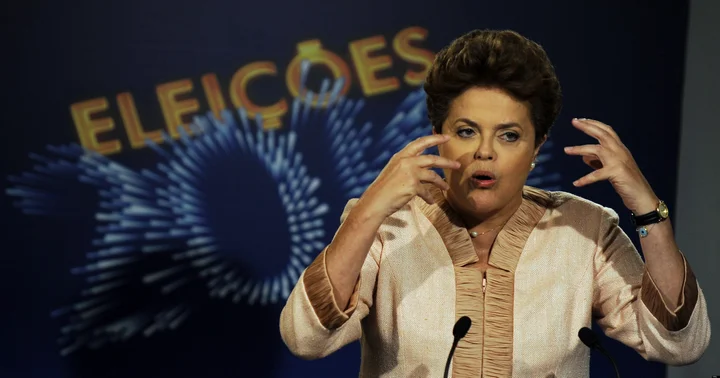
Over 19 million citizens supported Marina in the first round, and polling now indicates that Dilma, not Serra, is starting to pick up a majority of those Marina votes. Polls indicate that even female evangelical voters see Dilma as a leader who can battle to improve the status of all women in Brazil's male dominated society. In spite of Serra crying foul, all three major polling organizations predict that Dilma will become Brazil's first woman president on October 31st. The only other big October surprise could come in the form of a cybersecurity issue that impacts the integrity of Brazil's vote tabulating system much as a system problem caused large sections of the national power grid to shut down last November.
Globalists are interfering in the internal politics of Brazil because the stakes are high. Brazil's economic model, which features a strong government infrastructure to regulate the disruptive effects that free markets can have on social institutions, is a post-Bretton Woods system hybrid that features strategic alliances with France and China that countervail turbulent free market influences that have been the hallmark of more than 80 years of having the US as its major trade partner. And this, like its policy of using ethanol to offset costly oil imports, causes discomfort among the clubby, ensconced world economic order.
Average consumer credit card interest rates in Brazil run 44 percent annually and foreign banks want a bigger share of that lucrative action. Serra's backers want to privatize Petrobras, the huge national energy firm, a move that could turn the giant into the Enron of South America. And software companies like Microsoft, SAP and Oracle want government and business in Brazil's economically disadvantaged Northeast to buy more of their high end products instead of shareware and Linux-based systems while tending to work around Brazil's affirmative action policies that seek to provide high wage jobs that blacks and indigenous people need to be included in national life.
One big wild card remains, notably the 28 million voters who the Federal Electoral Court says abstained, voted blank, or had their ballots nullified. Pollsters have a difficult time tracking the motives of this type of prospective voter, especially in a nation where voting is obligatory and respondents are known to lie to protect the privacy of their choice. Still, IBOPE and Datafolha, two of the large political polling firms, claim to have factored in the intentions of these voters and in this demolition derby -- which Lula says has been the dirtiest campaign he's seen since Brazil returned to democracy -- predict that the winner will be the name at the top of the #13 ticket, Dilma.