
- BIG NEWS:
- The Fed
- |
- Holiday Sales
- |
- Banks
- |
- Personal Finance
- |
As President Obama packs for China, I thought I'd show him a picture of how China is manipulating its currency.
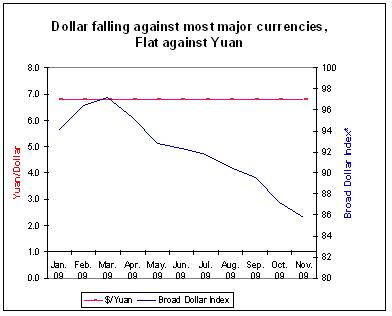
Source: Federal Reserve: Yuan, Broad dollar index. Graphic idea compliments of AAM.
The dollar stays flat against the Chinese Yuan, even as it loses value against other major currencies. The dollar is down to $1.50 per Euro, compared to $1.27 at this time last year (sorry to folks daydreaming about summer in Italy). It's down against the Canadian dollar, the Japanese yen and the entire "broad dollar index" tracked by the Federal Reserve. But the dollar is unchanged against the Chinese Yuan (unless one considers 6.836 to 6.827 a drop).
Everyone knows this is happening. Treasury Secretary Timothy Geithner even used the word "manipulating" with the Senate Finance Committee mere hours before it voted to recommend his confirmation.
The dollar exchange with China "defies the laws of monetary physics." During this U.S.-led global recession, dollars aren't worth as much as they once were. The natural physics of exchange makes U.S. goods relatively less expensive for others to buy, but makes foreign goods more expensive for Americans to buy. In a free market for currency, that would help bring accounts back into balance.
But China treats those laws as optional. China's deliberate policy of pegging the Yuan to the dollar makes American imports of Chinese goods artificially cheap and gives American companies opening factories in China an artificial subsidy. That's good for China but bad for America, and helps explain our soaring trade imbalance with China. An extraordinary 83 percent of America's non-oil trade deficit is with China. During the downturn, our trade deficit with other countries has been shrinking -- but not with China.
The wheels of change are starting to turn. The Obama administration stood up to China when it imposed tariffs on Chinese tires and pipes dumped in the U.S. markets. The chattering class called it a trade war, but it's not. It's just applying the same rules of free trade that other countries respect, and that China agreed to when it entered the G-20 and was granted permanent normal trade relations with the US. Obama just blew the whistle.
The G-20 summit in Pittsburgh in September concluded with a joint statement to seek "more balanced growth as part of the global economic reconstruction." The entire G-20 signed on -- including China -- but China's name was in bold in the quest for "balance," and everyone knew it.
Now America's high level trip to Asia opens with a joint op-ed written by our own Timothy Geithner along with the finance ministers of Indonesia and Singapore. They repeat the goal of "strong and balanced growth" and expressly state that "Market-oriented exchange rates in line with economic fundamentals will be essential."
China seems to be paying attention. In its third-quarter monetary policy report, the People's Bank of China suggested that it might consider other major currencies, not just the dollar, in guiding the exchange rate. That's not quite a free market float, but it's better than the dollar peg.
In the American heartland the issue isn't exchange rates, of course. The issue is jobs. American workers can compete dollar for dollar against Chinese workers. They can't compete dollars against manipulated Yuans.
America's economic future is intimately tied to China's. Let's hope Barack Obama remembers who he's working for.
-----------
This post originally appeared at the Campaign for America's Future.
Want to reply to a comment? Hint: Click "Reply" at the bottom of the comment; after being approved your comment will appear directly underneath the comment you replied to
The USA gets itself in a mess and then blames the Chinese! Wow! If our companies choose to go there for their cheap labor then tax the imports from there! I just bought a rubber water bucket for outside and I looked at the MADE IN PORTUGAL label. We don't even make buckets here?
I think we should only trade what we can't make. Seems our politicians and their bad decisions
is at fault here, not the Chinese. We can't even bargain with the Chinese anymore since they own us.
And how dare Obama speaks of human rights when we have the worst case scenario with Guantanamo and Iraq/Afghani Prisons. It is all in the perception I guess.
A couple of points.
First this,
"China's deliberate policy of pegging the Yuan to the dollar makes American imports of Chinese goods artificially cheap and gives American companies opening factories in China an artificial subsidy."
It would be nice if American companies showed some patriotism and decided to fore go the subsidy and keep the jobs in America. But that would mean they would have to reject their god- $$.
Second, maybe we should play tit for tat and peg the dollar to the yuan.
Funny thing is, Obama (well, his adminsitration) is standing up against the Chinese on an extremely important issue. The Bush administration consistently backed down when faced against the Chinese.
Yet the tin foil hat baggers and the fright wing continue to proclaim lack of leadership...
I am curious. When did balanced trade become protectionism?
The exchange rate isn't the only factor. One of America's oldest manufacturing businesses spells it out for anyone who will pay attention:
http://www.reverecopper.com/pdf/TownHall.pdf
Today, any investment by any American firm using private or federal funds should be stopped.
If you do not know this; the growth of China was in a large part funded with your tax dollar used like the Marshall plan after WW2. Low to no interest loans or grants of American tax money being repaid by cheap merchandise sold to Americans at under what it could be made in America but with a profit of a hundred or five hundred percent to the Chinese government and American business man--tax free of course.
Think about a shirt from any departmentstore, It is sold at $18.00 to $25.00 in the USA. Labor to make it was a dollar in China or Viet Nam. Material and cutting two dollars. Added on for supplies and building plus profit at factory, three dollars. At best this shirt would have cost them Seven dollars, real time this is half the amount. That means from eleven to seventeen per shirt in markup and profit in the USA. The same shirt could have been made in America for ten dollars a shirt. Sold for eighteen to thirty with Americans making a fair wage and the taxes on profit here in America. But your government has decided to impoverish you to make the world better.
middleamerican2010
Casey
The point is, why does it costs so muck to make that shirt in US? That same shirt could be made elsewhere say in the Phillipines or one of the Asean country or even in South America for maybe slightly more. The economy depression is not caused by China, people nowadays cannot even afford a place to stay and did you read last week how many children are on food stem? There are poor people now in the US and the numbers are growing. Where is the buying power now? It is always good to buy local but can people afford it? You should consider that the huge profit made from selling China made goods here goes into US pockets. It is always easy to go for a witch hunt and balme others but it require your own real effort to work your way through.
If you want people to buy local then bring down the costs of production but again can it be done without retrenchment? The shops closing here is because people cannot afford it anymore. People just cannot afford it anymore.
The prices for middle end and low end consumer goods are extremely low and very affordable for the very poorest Americans. The erosion of nominal incomes from inflation has come mainly from housing because of loose lending standards and low interest rates, as well as from gasoline prices, education, and health care costs; although low income folks in urban areas often don't have cars and when they do don't drive very much, low income folks in general either don't go to college or tech school or get it heavily subsidized by the govt (often for free), and health care is often free for the lower class via Medicaid, Medicare (poor retirees), or emergency room services. But for things like shirts, they are extremely cheap at any Walmart or Target.
We have no buying power since we were not paid living wages. Our wages were stagnant and we were deceived by bringing in cheap stuff from overseas, that and easy credit was made available so you had the perception that we can keep up with the rest of the industrialized nations until the bubble burst.
If the shirts were made in the US, profit margins for retailers would be much lower. Thus retailers wouldn't have expanded so much over the past two decades, meaning less retails jobs and less commercial construction and construction jobs as far fewer buildings would be built for stores. Less construction for retail stores means less carpet and drywall for the stores, less cement, less steel, fewer computers, less office furniture, fewer cash registers, etc. etc. So it's not like keeping production in the US is a cure all. It's clearly not.
so I take it you are in favor of the model in place during the bush admin. export dollars and debt and balance that with selling us consumer and govt debt abroad? after all the consumption and expansion of retail "jobs" and commercial real estate (which is in drastic trouble) was fueled by consumer debt. home equity gains. and those were a bubble. by your postings you dont believe in balanced economic growth, you believe in bubblenomics.
A ctearer picture. US products other than military hardware are too expensive to compete in the open market. Even computer giants competing in Asia have their products manufactured and assembled in Asian countries. US automotive giant GM once compete through S. Korea Hyundai. Now agricultural equipments are being produced in India and China to cater to both local and Asian market. Simply put, made in US products are too expensive for the Asian market. The Asian market with limited manufacturing base is the best place to sell your products. Exception being Japan and emerging S. Korea both countries reaching Industrialized Nation status. Europe and UK certainly do not need what they already have and it would be difficult for the US to sell there.
US products mainly cater to local market with the strong consumer buying power. If not for the economy downturn there is no hurry sell to foreigners. But years of neglecting the Asian market had allowed Japan to capture the market without much competition. Now in every Asian country you can find made in Japan products. The only way for US to be competitive is to reduce overheads which can be done through automation or produce it in Third World countries( both not good for the job market ) or drastically deflate the US dollar.
The dollar would not have to be drastically devalues had the intervention and manipulation been stopped much much sooner. a huge mistake by Rubin. China is not more productive than the US. never have been. They simply employ more workers instead of more capital investment. The yuans's valuation does not affect many import prices either. the govt does. here in the US, regardless of the source of the commodity be it oil, ore, wheat, steel etc. the market is set by futures markets. these prices are controlled in china.
The price of steel and ore are not set on a futures market. The prices are not "controlled" by China, although China has had the greatest demand for ore and steel over the last decade and their demand has had the most influence on their price.
The author makes a massive over-sight. He uses the March to November timeframe and completely ignores the September 2008 thru March 2009 timeframe.
From zerohedge:
His "observation is correct if one only focuses on the developments in the past 4-5 months. However, before I answer your question, I also would like to present a chart (see Exhibit 2). This chart shows the change in the exchange rates of the same set of EM economies between September 2008 – when the global financial crisis broke out – and March 2009 when the global economic and financial situation started to stabilize. This chart shows that the renminbi was the strongest EM currency, because it was the only EM currency that did not depreciate against the US dollar in the wake of the global financial turmoil.
I recall that, back then, many market observers predicted that the renminbi would depreciate against the USD by following the footsteps of other EM currencies. I believe that, had China allowed renminbi depreciation, the depreciation pressures on other EM currencies would have been even stronger.
Your observation that the renminbi is the weakest EM currency is valid only as far as the past 6-7 months is concerned. If we take a slightly longer view, examining the cumulative performance since the crisis (i.e., August 2008), the renminbi is still stronger than most other EM currencies."
I'd also like to point out that the US has been the biggest currency manipulator this year. Is it not clear to everyone that the Federal Reserve and Treasury have been intentionally weakening the dollar? And this is been to the detriment of the Europeans and Japanese, who are none too happy about this.
Also about the yuan, most people think if its value went up 20% or so against the dollar that some manufacturing would come back to the US. That idea is simply false. If there was any movement of production out of China, it would go to places like Vietnam or Bangladesh. People should also realize that the US dollar depreciated from $1.15 per euro in early 2006 to $1.6 per euro by mid-2008 as well as depreciated substantially vs many other currencies (Brazilian real appreciated 100%, Austrailian and Canadian dollars, Mexican peso, etc) and the total US trade deficit stayed at the same levels as they were in early 2006. The biggest reason for this was the increase in the price of oil. The deficit ex-oil went down dramatically, but oil kept going up as the dollar weakened, the fed pushed rates to zero, and global growth was strong relative to the US. The solution for the deficit has to begin with oil IMO.
the rise in oil prices has little to do with dollar devaluation. global demand has fallen. The same force that cause oil to rise to 150 a brl are in place today. the same is trueof iron ore, coking coal etc. its speculation and flash trading in the futures markets. thier purpose is to allow for planning of future production. not create bubbles.
the rest of the post is total nonsense. China print yuan buy dollars and then US debt which drive the long end of the yield curve down. along with it mortgage rates (in a normal market) and other forms of municipal debt. it did in fact infalte the housing bubble.
on your US currency manipulation. I beleive you are writing of "monetary easing" There is no current model in the world that suggests it causes inflation.... Japan...no....China ....no.
Why should the Chinese adjust their currency, they had nothing to do with this mess created by the USA and a few other countries which they drug down! China kept right on trucking and they were careful to do everything right. Now we want to blame them for our mess? How dare!
I have yet to hear anyone from our politicians apologize for the mess they had created, ergo that means they keep on doing it. Have they addressed the derivatives yet, the hedge funds, the Commodities Futures Modernization Plan which is the cause for our high oil prices? Nope, nothing, nada! Where are our highway tax dollars going and the bridges need attention - how many more bridges will have to collapse and people killed before they put the money they collect where it belongs. This is most disturbing. Vote all of them out of office and then hold the new crop to their 4 year term limit.
The question is: would the dollar fall even more if China un-pegged their currency?
The answer is no, that move (alone) would strengthen the dollar.
.
not likely. A rising yuan will depreciate the dollar even more, but the question is, will it effect changes that help the US re-grow its devastated manufacturing sector. Most observers say the yuan should rise by some 30%. If so, instead of a six yuan to a dollar, there would be close to eight to a dollar, or a twelve cent yuan. The two cent difference will still not close the gap between Chinese and American labor costs, nor is it likely to spur growth re-growth of US manufacturing. The hope now is tied to developing green energy and services as part of a new industrial revolution. But it is still only a hope, and many people are skeptical that the green revolution will rebound to the US benefit more than it will to Asia.
Yes. China's currency is relatively stronger than the US's at the current, fixed, exchange.
The USD would fall from a de-pegging.
I fail to see the manipulation. Isn't currency manipulation, in this case alleged by the chinese govt, where that govt takes actions to increase or reduce the value of its currency relative to another? i.e. change/ manipulate. Isn't china's action the exact OPPOSITE of manipulation- they have a standing policy, known by all, to PEG their currency to ours. Not move it up or down. No secrets, sudden changes, or bank interventions.
The USA should realize the situation for what it is and act accordingly, complaining does the American citizen no good. Want to see real currency manipulation? just look at the fed as they destroy the USD
It _is_ manipulating its value vs others - by pegging it when its value should have dropped.
.
Ah, yes, i see now. By having a pegged, or fixed exchange rate, one in which you do not manipulate it, you ARE actually manipulating it. i was thrown off by 'old school' definitions.
http://en.wikipedia.org/wiki/Fixed_exchange_rate
From the article: a fixed exchange rate prevents a government from using domestic monetary policy in order to achieve macroeconomic stability.
As in- a nation gives up its own monetary policy ( largely) when it pegs to another, which means any changes are a result of the other party's actions (like say the fed)
2009 America = Nineteen EIghty-Four (the novel)
war is peace, freedom is slavery
See Eric Lotke's Profile
Regarding the parallel between Orwell's 1984 and today:
I wrote a whole book about it:
2044: the problem isn't Big Brother; it's Big Brother, inc.
www.2044thenovel.com
The Chinese are the only country that can give America some of its own medicine. Every other country has to buy American dollars to try to shore it up so that their currency doesn't rise to the level that causes their exports to be too expensive to sell. America cannot bring China to heel. Usually they start a war with uncooperative countries (you listening Chavez?) but I don't think that is in the cards this time. America is going to have find another way other than economic, political or military bullying.
Here`s my guess.
Just like the Federal Reserve`s except to a positive balance instead of a mountain of crushing debt.
That country has cash, this country has nothing but debt and not enough to cover it except the generosity and greed from other nations that choose to help America perpetuate(for now) it`s monetary death loop of debt since 1913.
But it`s just a guess.
Well let's see, the Hong Kong Dollar has been trading at 7.75 per US for the past several months, the Saudi Riyal has been trading at 3.75 per dollar for years and the UAE Dirham has been trading at 3.67 per Dollar for ever and a day. Are they currency manipulators? And when the US is printing up massive paper in order to devalue our Dollar, isn't that currency manipulation? (Sorry for the double post, corrected for typos).
There are articles citing the dangers of artificially high Chinese and Japanese currencies, and then there are articles bewailing the falling value of the dollar.
We are asked to be concerned about asian currencies that are valued too low, because it hurts our exports, and we are asked to be concerned about a low dollar, because it hurts our imports.
I guess we should just learn to be afraid of everything.
Well on our way to being afraid of everything.
You must be logged in to comment. Log in or connect with