
The role of government in our lives is now the subject of pitched debate inWashington and throughout the country. But no matter your view on this contentiousissue, nobody questions the profound responsibility of public institutions, here andabroad, to safeguard basic rights against discrimination, to equal justice and to politicalparticipation.
Sadly, those rights are denied to some 12 million people around the worldwho have been denied citizenship -- rendered stateless -- often by discriminatory nationalpolicies that exclude minorities even when they have lived in a country for decades orcenturies and have well-established ties to both the land and culture of their places ofresidence.
From the Roma in Europe, to Dominicans of Haitian descent, to Bidoon inKuwait and other countries, stateless communities suffer from marginalization andneglect. Most lack identity documents and cannot register a marriage, death, or birthof a child. Without documentation, many stateless people cannot open a bank account,own property, find legal employment, access public health services or enroll in school.And because they have nowhere else to go, they -- and their children, and their children'schildren -- live in a state of permanent uncertainty.
This year marks the 50th anniversary of the UN Convention on the Reductionof Statelessness, and it is a fitting time to consider the current dimensions of this terribleproblem, which first gained international attention when the Nazis systematicallydenationalized German Jews. In its own effort to focus attention on the issue in thisanniversary year, the United Nations hosted a photo exhibit on statelessness at itsheadquarters in New York this summer, which graphically depicted the dimensions of theproblem and offered powerful contemporary stories of stateless people in Nepal, Kenya,the former Soviet Union and elsewhere.
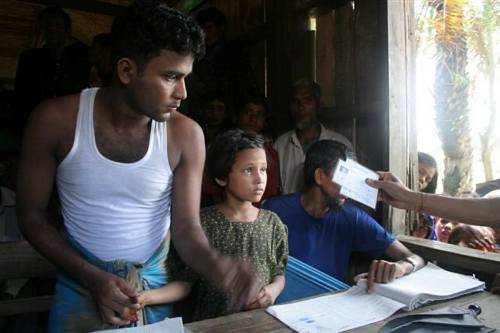
A young Muslim girl (Rohingya) picks up her identity document provided with UNHCR assistance in Burma's N. Rakhine State. (Photo courtesy of UNCHR)
Among the most egregious stories are those of the Rohingya, a Muslimminority from Burma's Northern Rakhine State who have lived in Burma for centuries,but were excluded from the country's 1982 citizenship law and continue to sufferpersecution, including forced labor, confiscation of property, rape, and other forms ofviolence. While approximately 750,000 Rohingya remain in Burma, an estimated threemillion Rohingya have fled to Bangladesh, Thailand, Malaysia, India, Saudi Arabia, andother countries in the region. Although some have been recognized as refugees, manyothers lack documentation and are at risk of arbitrary arrest and detention, deportationback to Burma, human trafficking, and other abuses. The Obama Administrationis working with other donor governments, international and non-governmentalorganizations, and affected countries in the region to provide assistance to the Rohingyaand identify durable, humane, and comprehensive solutions for their plight.
Globally, the U.S. government is concerned about statelessness as a humanrights and humanitarian issue that impacts prospects for democratization, economicdevelopment, and regional stability. U.S. diplomats around the world are working topersuade other governments to amend nationality laws that discriminate against womenand minorities and cause statelessness, provide documentation to stateless persons,protect them from abuse, and ensure they have access to basic services. And we are thesingle largest donor to the Office of the UN High Commissioner for Refugees (UNHCR),the agency mandated to protect stateless people, contributing over $700 million last year.
Happily, the laws of the United States do not contribute to the problem ofstatelessness; we grant citizenship through birth in the United States, birth abroad to aU.S. parent if statutory requirements are met, and through naturalization. To be sure,certain provisions of the 1961 Convention would make it difficult for the United Statesto move toward ratification -- for example, the Convention limits voluntary renunciationof nationality in ways that would conflict with the right to voluntary expatriation thatis recognized under U.S. law. Nonetheless, we support the objectives and principlesof the 1961 Convention as well as the 1954 Convention relating to the Status ofStateless Persons, and we believe other governments should consider accession andimplementation as a means to minimize statelessness.
Preventing and reducing statelessness requires first that governments, civilsociety groups, and international and regional organizations recognize the problem,its causes, and the suffering and indignities it inflicts on millions of people around theworld. But recognition is not enough -- governments around the world must be pressed totake strong action to address this eminently solvable problem and ensure a brighter futurefor millions of disenfranchised and vulnerable people.
Eric P. Schwartz is U.S. Assistant Secretary of State for Population, Refugees, andMigration.