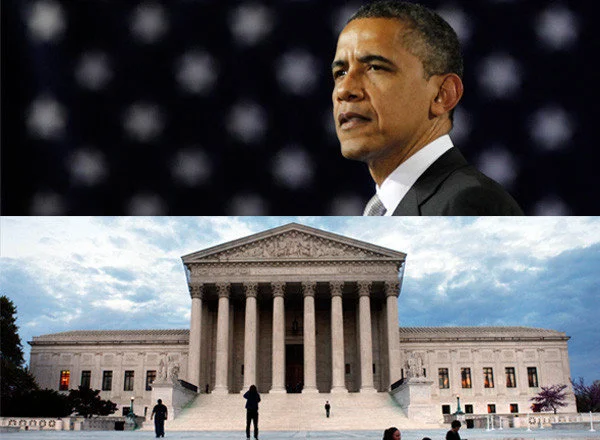
The president has been criticized by some for his alleged attacks on the Supreme Court, and he was ordered to explain his remarks by the Fifth Circuit Court of Appeals. The president's remarks weren't entirely accurate, though the reaction has been vastly overblown. Contrary to what conservatives are saying, President Obama did not go far enough. Here is what he should have said:
My fellow Americans:
The United States Constitution expressly gives Congress the authority, in Article I, to regulate commerce "among the several states." As far back as 1824, the Supreme Court held that the Congress has full power regulate commerce "that concerns more states than one." Almost 200 years later, Justice Scalia wrote that the Congress has the power to regulate "even noneconomic local activity if that regulation is a necessary part of a more general regulation of interstate commerce." In the years between 1824, and 2005, with very few exceptions, the Supreme Court consistently deferred to Congress when the legislative branch tried to solve national economic problems. These precedents are not mine, nor did they come from prior presidents or prior Congresses, but from the Supreme Court itself.
I do not deny that the Supreme Court has the power to overturn acts of Congress that the Court believes are unconstitutional. That the Court has this power, however, does not mean that it always exercises it wisely or in conformity with the Constitution. It is my job as president, and Congress' job as the nation's lawmaker, to also act in accordance with the Constitution. No Supreme Court case has ever said that the Court has a monopoly on the power to interpret the Constitution.
The Affordable Care Act undoubtedly is a law regulating economic activities that affect more states than one. Decisions by Americans whether to buy health insurance or not, for how much and under what conditions, substantially affect the American economy. People may reasonably disagree over whether the mandate is a good or bad idea (I think it is good), but the Court's job is not to decide the best health care policy but to rule on whether a law enacted by Congress violates the text of the Constitution. Although Congress is not allowed to regulate commerce by enacting laws that abridge freedom of speech or religion, or any other textual limitation actually in the Constitution, there is simply nothing in the Constitution preventing Congress from using mandates when exercising the commerce power. If the Court makes up that limitation out of thin air, it will be engaging in an improper exercise of the power of judicial review.
Prior cases by the Supreme Court, most of them unanimously joined by Justices appointed by both Republican and Democratic presidents, clearly support the constitutionality of the ACA. The Court has allowed Congress, among many other examples, to regulate the amount of wheat a farmer may grow on his farm for personal purposes, the types of customers small restaurants are obligated to serve, loan sharking by small time hoods, and the private growing of marijuana never bought or sold and permissible under state law. You might not agree that Congress should have passed all of these laws, but it is Congress, not the Court, that gets to regulate commerce. After all, members of Congress can be voted out of office but the Justices serve for life.
No one believes more than I do that the Court must at times exercise the power of judicial review and strike down laws that violate the Constitution. But that does not mean that I can't suggest that the exercise of that power in a given instance would be a grave mistake for our country. Challenging the wisdom of judicial interference is not the same thing as challenging the core idea of judicial review.
The problems raised by health care in this country are complex and not easy to solve. We certainly have more work to do. The individual mandate (which makes possible other important aspects of the Affordable Care Act), represents the elected branches' best effort to begin to tackle this national crisis. If you don't agree with that response, that is what elections are for.
The Supreme Court's job is to determine whether Congress' efforts to regulate health care satisfy the grant of power in the Constitution to regulate commerce "among the several states." The answer from prior cases and constitutional text should be obvious. A Court decision to overturn the mandate would be inconsistent with precedent dating all the way back to 1824, and would represent an effort by the Justices to inject themselves into the political and policy debates surrounding our health care problems. For the sake of all Americans, I hope the Court resists that temptation.
Follow Eric Segall on Twitter: www.twitter.com/espinsegall
Trump: President Obama's comments on Supreme Court's pending decision on ...
He spoke to the American people, hopefully contemporaneously because he bungled it so badly he was backtracking within 24 hours.
Seagall makes good points. But one was missing:
"We promise to force all Americans to buy private health insurance in 2014, because we know what's best. And the following year, we'll force you all to buy a fitness center membership, because WE know what's best. And the following year, yes, broccoli, because the American people and the free market cannot be trusted to buy, or eat, or live, what's in their own best interest.
Once the government has the power (unfettered by a measly Supreme Court) to compel commercial activity, and to force all breathing humans to buy whatever we tell them to, you can trust us to provide that utopia we always promised: a filet mignon on every plate (at your expense, but don't worry it's healthy tofu), an American-made GM car in every driveway (but not a Chrysler - they got bought by Fiat, and not a Ford - because we NEVER owned them).
Oh, just trust us...with unlimited power and the death of the Constitution, the federal government will finally be able to operate freely, as the finely tuned machine of progress we always dreamed of.
You people will thank us...eventually."
They clearly didn't think that was unconstitutional, and they were the people who wrote the Constitution.
Act of 1792 was never enforced, let alone challenged in federal court to establish its Constitutionality.
But you are correct, enough founding fathers believed it Constitutional to pass it.
Keep in mind, they also passed the Alien and Sedition Acts. Never challenged in the Supreme Court, those Acts become the club to bludgeon the free speech of political opponents, and even to justify the internment of Japaneses Americans during WWII. Would you defend the founding fathers as infallible and passing the Alein and Sedition Acts, which became known in the Court as "The Alien and Sedition Laws constituted one of our sorriest chapters."
But you are right, limits have been tested before.
The legal contention is that everyone at some point will use health care, whether they buy insurance or not. We also agree that hospitals can't turn people away. It's a logic error. The expense gets transferred to everyone else as we're paying for people that don't have insurance; not to mention the expense becomes inflated as the ER shouldn't be used as a primary care visit. If this is another 5-4 ruling against, this court will lose all credibility. Half the public already believes it's as political as congress which is rather sad. You would like to think there was a fair secular body that would weigh purely on evidence and law. Perhaps I was naive. :(
Never before in all the years you reference has the Commerce Clause been used to justify a federal law requiring individuals to engage in commercial activity (buy something that they don't want from someone they don't care to do business with) under the guise of regulating commerce. Let me repeat, that has NEVER been done, as I am sure you well know but fail to mention. And to do so in a cavalier manner is a classic boot-strap argument that is fair game for constitutional examination. This is a case of first impression.
Now it is unknown how the Court will rule on this issue. And it is premature to lecture the Court, particularly as did Obama with half truths and mischaracterizations of past Court rulings.
Therein lies the problem with and the objection to Obama's premature attack on the Court.
It is a choice to not buy a car. It is not a choice to never need the healthcare system.
If someone does not have car insurance and wrecks their car, they are held liable, both criminally and punitively.
If someone gets sick without any health insurance, I pay for them...as does everyone else with health insurance. I guess we should just make it a criminal law to get sick and not have health insurance. That would make a lot of conservatives happy, huh?
Yes. I hope more people who have this notion that only the Supreme Court can interpret the Constitution read this carefully. The Supreme Court (or any court) ends up doing it the most simply because courts usually have the last word. But Congress and the President can - and must - interpret and follow the Constitution as they see fit as part of their jobs.
The progressive left needs to turn the tables on this "judicial activism" nonsense that conservatives are forever spewing-- in recent decades, it's been conservatives that are legislating from the bench and fundamentally undermining democracy in ways that no liberal justices ever did. If anything, liberal courts have expanded rights and constitutional liberties whereas conservative courts are now ruling in favor of corporations and the power elite--in decidedly activist ways!