
Looking back, I can see that I was spoiled growing up, though my family wasn't rich by American standards.
I had a cold, clean river bubbling past my house that contained fish bigger than me. Even when I traveled to Haiti at 13 years old, I didn't comprehend how lucky I was.
In the mountains just outside Port-au-Prince, people bathed in streams so polluted and foul, I couldn't fathom how it would facilitate cleanliness.
Only as an adult, whom the Klamath River called back home, did the truth finally wash over me: without people and communities to speak for stable mountainsides, adequate supplies of clean, free-flowing water, and a diversity of wild fish runs, we could easily have rivers like the ones I saw in Haiti.
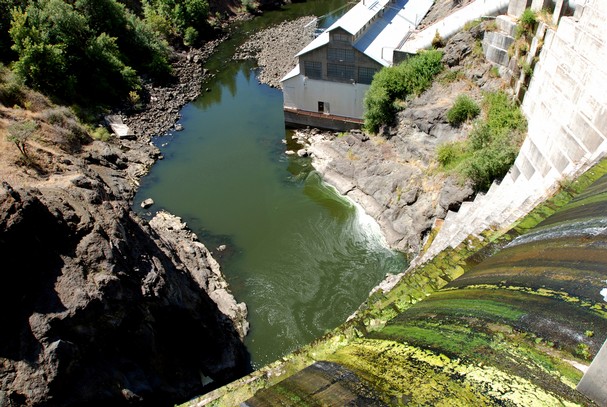
My childhood also taught me that we need to fish, swim and raft our rivers to appreciate their magnificence and remember how to protect them.
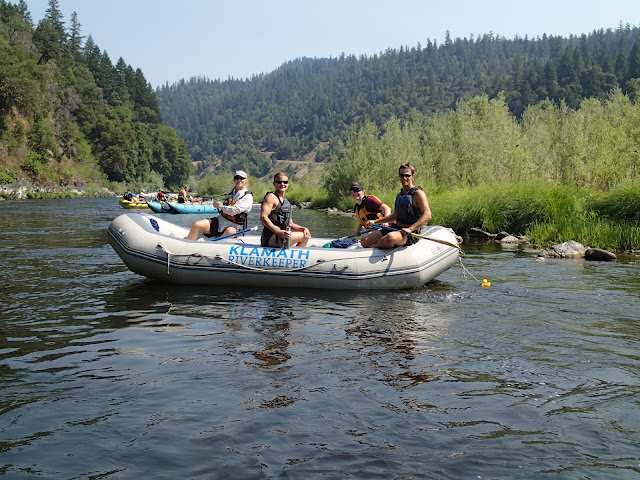
That's why Klamath Riverkeeper, the nonprofit organization I represent, led 50 children, tribal members, anglers and other community members on a paddle down eight miles of Klamath River canyon last weekend.
Like me, many in this group have been swimming and fishing in this watershed since we were kids, drifting through rapids and hopping rocks endlessly. We grew up in a place relatively untainted by development. Now we take our children, nieces and nephews to the river, so they can learn about catching currents and eddies and how water moves around resistance on its way to the sea.
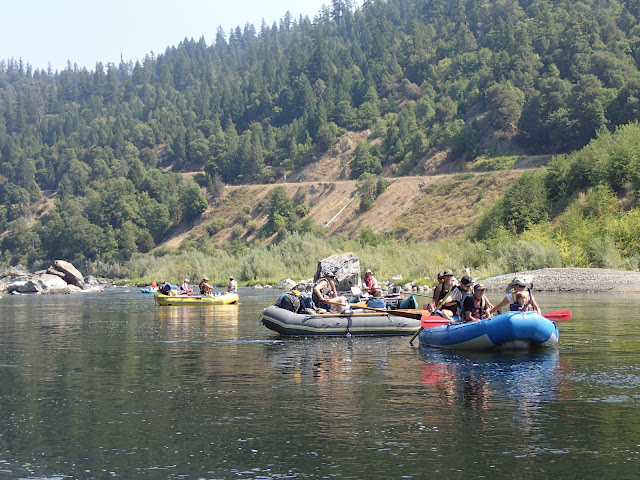
Despite our longtime enjoyment of the Klamath River, it's not a secret that today's River faces many problems.
But it's also one of the most restorable rivers in America. In fact, we're about to conduct one of the largest dam removals on the planet. Removal of four hydroelectric dams on the Klamath will change the landscape so significantly that we could easily see it from the moon.
This dam removal will reopen more than 300 miles of prime salmon and steelhead habitat and reduce toxic algae and fish disease in the river. In doing so, it will restore income to hundreds of commercial salmon fishermen, who have suffered closures due to declining salmon runs in recent years. And it will create at least 6,000 new jobs in economically struggling Siskiyou County, according to a recent environmental impact statement (EIS) by the federal government.
The EIS also states that a dam-free Klamath will produce 70,000 more fall run Chinook salmon. Klamath dam removal will save the power company that owns the dams, PacifiCorp, and its ratepayers more than $100 million. It will also save the American taxpayer hundreds of millions of dollars in disaster relief spending to bail out unemployed farmers and fishermen in any given drought year.
This dam removal agreement and its companion watershed restoration agreement took years of collaboration, listening and compromising to achieve. It's an answer created by the local people who came together in overcoming the conflicts and competing water needs from the upper and lower parts of the basin to build a plan to remove the dams by the year 2020. The result is the Klamath settlement that the Klamath Basin Economic Restoration Act (KBERA) introduced in Congress last fall, which now awaits a hearing in Washington, D.C.
Forty years ago, with the passage of the landmark Clean Water Act, Congress recognized our right to fishable, swimmable waters. The Klamath settlement transcends partisanship and breaks down barriers to help us realize this dream of clean, healthy streams in our watershed. Because, we know just how important it is to have a clean river flowing with huge fish.
Images courtesy of the author
Matt Rand: Fishing Continues to Top Deadliest Job List
But how the dams come down is important. The "agreements" Ms. Terence references are sweetheart deals for the 1% at the expense of taxpayers. We can get these dams down quicker and in a more equitable manner if we use the process that was designed for dam licensing, dam relicensing and dam removal; that process is FERC - the Federal Energy Regulatory Commission.
FERC ordered removal of PacifiCorp's Condit dam in Washington state and that is what should happen on the Klamath River too.
The "agreements" which Ms. Terence favors require congressional action; that is a recipe for delay and for mischief. Let's get these dams out through the normal FERC process; it will be quicker, better for salmon and cheaper for taxpayers.
Creating jobs, restoring salmon, protecting the natural world - interesting how knee jerk conservatives fight an issue simply on the basis that they perceive it as a 'win' for the other side.
We must begin to place Earth first because if there is any credibility to ecology, we are swiftly destroying the breath of life. Man is not an island apart, and his existence hinges on the natural laws that seeded life itself and are still the eco-nomy of all life or ecosystems and their biodiversity.
Set the rivers free!
This plan is a whole life plan. It involves the educational system, the energy market, the transportation system, the governmental system, the health care system, food production, and more. The plan is to restrict your choices, limit your funds, narrow your freedoms, and take away your voice. One of the ways is by using the Delphi Technique to 'manufacture consensus.' Another is to infiltrate community groups or actually start neighborhood associations with hand-picked 'leaders'. Another is to groom and train future candidates for local offices. Another is to sponsor non-governmental groups that go into schools and train children. Another is to offer federal and private grants and funding for city programs that further the agenda. Another is to educate a new generation of land use planners to require New Urbanism. Another is to convert factories to other uses, introduce energy measures that penalize manufacturing, and set energy consumption goals to pre-1985 levels. Another is to allow unregulated immigration in order to lower standards of living and drain local resources.
You will then discover that most of the land in your counties is now owned by 1) state or federal government, 2) land development companies, 3) land ‘trusts’ or ‘land funds, 4) environmental organizations, and 5) large corporations.
If you are lucky enough to have several Plat Books covering a 2, 3, 5, or 10 year period (Plat Books are published annually), you will see a connection between land trusts, land development companies, land funds, and corporations. You will discover that they buy and sell to each other, and that they change the names of their organizations, and also create spin – off organizations, on a regular basis.
Then, if you go to the websites of these organizations, you will discover that they are ‘partnered” with 1) each other, 2) with larger global corporations, and 3) with environmental organizations.
In other words, you will find that the buying and selling of land in your counties is a highly organized business bureaucracy that circulates perpetuates “profit and control” between revolving door “partnerships.”
But what are “partnerships?” In a word, “business” has changed in the United States. On TV commercials, I’m sure you’ve heard the term “partners’ – and certainly in your communities you’ve heard the lofty terminology of “public – private partnerships”. It sounds nice – like cooperative business ventures for the GOOD of the public. However – this is a lie, sorry.
http://www.freerepublic.com/focus/f-news/2351578/posts
FISH more important then humans ping.
How are we suppose to charge our electric cars?
BelegStrongbow
I guess they don’t want the water and the electricity. Who knew SF was self sufficient?
Each salmon will be caught as it enters the river and an empty rechargeable batter and a generator will be attached to it. As it swims upstream it will charge the battery. Then the batteries will be retrieved when they reach their mating ground and sent to San Francisco to run their city lights.
SmithL
Every day I get happier I left California. I used to miss the redwoods and mountains (as if there weren’t any others anywhere else). I only wish I could get my extended family to leave. Sad days for the west.