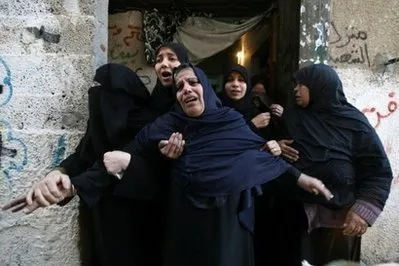
Gaza is recovering from Israel's latest assault, which ended in a cease-fire earlier this month. In the UK, the British Broadcasting Corporation has let down its worldwide viewership by refusing to broadcast this charity appeal to help Palestinian victims of the violence:
The appeal was produced by the Disaster Emergency Committee (DEC), a consortium of charities including the Red Cross, Oxfam and Save the Children. What is so inflammatory about this humanitarian plea, which doesn't blame Israel or any other party for the plight of Gaza?
Why did the BBC hide behind a statement that "the debate about who is responsible for causing (suffering and distress in Gaza) and what should be done about it...is contentious?"
The Corporation joined Rupert Murdoch's Sky News as the only two major UK broadcasters not to air the charity appeal, a decision which has caused a huge uproar in the UK and around the world.
Demonstrators march to BBC Headquarters in London
In years past, the BBC regularly aired similar charity appeals:
The BBC broadcast DEC appeals after the 1999 Kosovo war and 1990 Gulf conflict. In 1968 it broadcast an appeal for victims of the Vietnam war. Over the last two years it has broadcast appeals for aid for crises in Burma, Bangladesh, Sudan, Chad and the Congo. Neither has it previously shunned humanitarian appeals in the Middle East. The second DEC appeal ever to be broadcast on the BBC, in June 1967, was a film seeking help for Palestinian and Syrian refugees displaced by the Six Day War. In 1982, the BBC helped raise £1m by broadcasting a DEC appeal for victims of Israel's invasion of Lebanon.
But now, things have changed. Blame is being laid at the feet of the BBC's Director General, Mark Thompson.
Since his arrival at the BBC in 2004, according to senior sources within DEC charities, the BBC has grown cautious and worried about compromising its impartiality. In 2006, the BBC similarly rejected a DEC appeal for victims of Israel's month-long war against Hezbollah fighters in Lebanon.
This episode is revealing interesting things about the factors that guide the BBC's coverage of the endless Israeli-Palestinian conflict, coverage which helps shape worldwide opinion. These include a set of reporting rules that BBC journalists must follow in their dispatches:
"The 24 words and phrases from the reporting rules the BBC has agreed to make public appear innocuous enough, but even here some might discern a sense of paranoia. Journalists are instructed to avoid using 'assassination' in favour of 'killing' and in discussing Gaza, the word "occupation" is to be avoided in favour of 'permanent military presence'."
Palestinian children in Gaza
Ironically, the resulting controversy over the BBC's censorship has resulted in a doubling of donations to the DEC's emergency fund for Gaza, with over one million pounds raised since the appeal was aired by other UK broadcasters on Monday night. Shame on Mark Thompson, and shame on the BBC. It's a sad day if this once-venerable news organization can't be counted on to honestly and accurately inform the public.
Erik Ose is a veteran of Democratic campaigns in North Carolina and blogs at The Latest Outrage.