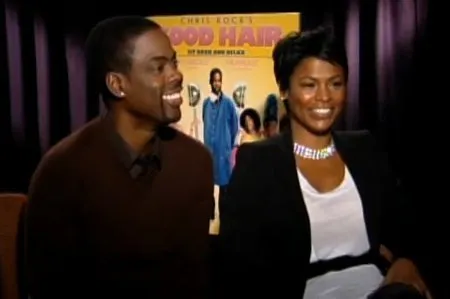
In his new film, Good Hair, Chris Rock approaches the subject of black women's hair--all at once--like a man, like a novice, like a voyeur, and like a comedian in his investigation of hair weaves and hair straightening relaxers. And the results are mixed. In his exploration, he all but ignores the existence of so many black women who don't choose to alter or cover the hair texture that grows naturally from their scalp.
When I asked Rock about these omissions/deletions during a recent interview in Washington, D.C., Rock joked with a good-natured assurance that those of us who are au naturale belong to a small set of the black population that goes to concerts featuring Common or Erykah Badu, as opposed to the masses following the likes of Lil Wayne. He reasoned further that a film, for example, about people with locs doing their hair "with shampoo and beeswax" couldn't compete with the footage, much of it a spectacle, that he and director Jeff Stilson have gathered for Good Hair.
I guess it depends on what world you are living in (but Rock is from Brooklyn!) and what you are trying to say. No doubt, another treatise on natural hair, such as the 1997 Middle Passage-N-Roots by Ada Marie Babino or the 1984 Hair Piece: A Film for Nappyheaded People, by Ayoka Chenzira, could not compare to the surreal scene in Good Hair of the annual Bronner Bros. International Hair and Beauty Show in Atlanta.
At the show, hair stylists compete -- in fishtanks, with near-naked models and
while hanging upside down -- to win first prize. But the show, with its dizzying statistics on the amount of money that black people spend on hair care, the fact that most vendors and manufacturers are Asian, and the emphasis on relaxers and weaves--also amounts to a testament to the opposite of black power. That testament about our lack of empowerment is delivered full blast while there is little acknowledgment of the African American resistance to a European beauty standard, or our embracing of our own curls, waves, naps, braids and locs.
So, even though Rock includes very briefly two women who have turned their back on chemicals (the "creamy crack" one woman calls it), and exposes the ridiculous expense of most weaves, as well as the toxicity of the sodium hydroxide found in most relaxers (including so-called "kiddie perms"), Rock glosses over the important history of our difficult and wonderful journey to reject straightened hair and embrace our natural selves.
In Good Hair, we are only left with ridicule and a joke. I screened this movie with a predominantly white group of critics and every time they laughed, I knew they were laughing at black people and not with black people. Again, I guess it depends on what world you are living in and what you are trying to say. It's obvious that Rock is choosing to make his case with a mixture of (literal) acid and humor.
Those who think they know everything on this subject will still find Rock's journey to India illuminating. Apparently, much of or most of the human hair used for weaves--and not just for black people -- comes from India, from a Hindu ceremony, wherein pilgrims are shaved bald in an act of humility and sacrifice. The temples, where these offerings are made, earn billions from the sale of hair, which is used for charity. The hair is sold to India's hair industry, where it is washed, sanitized and sewn into strips that are eventually placed onto the heads of women getting a "weave." These weaves are the norm in Hollywood. Actress Nia Long sat next to Rock during his D.C. interview and said point blank that if she wore her hair naturally that she wouldn't be considered for the role of a leading lady or "love interest" in movies. The charismatic Raven Symone is one of several actresses that come before the camera in Good Hair to detail their experiences with wearing hair from India, or wherever.
There are some obvious missing links (bald spots?) in Good Hair. Rock says that he began this hair journey when one of his daughters asked him why she didn't have "good hair." (She had been asked this by a child at her school.) But even though this question originated at home, Rock's wife, who would be the obvious person to oversee the hair maintenance of her daughters, is not included in the movie at all. By all appearances, it certainly looks as if Malaak Compton-Rock sports some combination of relaxed and/or weaved hair but we don't get to hear any comment from her on the subject. Her absence is conspicuous in Good Hair, even more so than the absence of natural hairdos.
Want to reply to a comment? Hint: Click "Reply" at the bottom of the comment; after being approved your comment will appear directly underneath the comment you replied to
Well, what else did you expect? John Henrik Clarke on Black hair?
Did ANYONE here think that a mainstream movie would be released that truly tackled the hair issue in a substantive, racially accurate and critical way?
Please.. Chris Rock is a COMIC. I expect this to be nothing more than an extended skit from the Chris Rock show with a few "shake my head" moments of hot ghetto messes advocating for their brainwashed Madame C.J. Walker perspective on Black beauty.
Wake me up when public intellectuals like Cornell West and Louis Gates get together and do a documentary on the subject.
I'm going to see this movie because as a Black woman, I've gone through many different paths just dealing with my hair! Not only is Chris Rock funny as hell but he's approaching a subject matter that really matters to women of color (or just folks obsessed with hair weave, color and relaxers). Besides, we need a little funny along with tough subjects in our lives and Chris can deliver -- no doubt about that.
I'm not black but find myself strangely fascinated by the sheer effort some black women put into their hair to make it straight - especially when black women who wear their hair "naturally" look fantastic.
The notion that "European" hair is somehow more attractive is utterly bizarre.
"The notion that "European" hair is somehow more attractive is utterly bizarre."
Yet it's been reinforced in the minds of everyone regardless of background to this day. It's part of the systematic put-downs and disparaging of black women that have been going on for centuries and still occur. For example, many workplaces, especially in the corporate world, would rather not see a black woman wear her hair "natural" because they see it as "wild" or "unseemly". Yes, it is extremely ridiculous, but too many people in our society- black, white, etc- believe straight hair is "the best" and have few positive things to say about curly hair, especially that of black women.
True, and yet totally depressing ...
They need to make a film about why blacks dye their hair blonde too, and asians doing the same, I think it's kinda bizarre.
I remember the era of 'perms' aka that Brady Bunch era, I had one done once, ugh the smell, never again, to think folks still put up with that regularly.
And some white folk don't have tame hair as well it's kinda wild (like mine), still fuzzes out at any opportunity.
I agree.
ere did that pride go? It's not for me to say, since I don't share the experience.
I am a white woman who has never been one to spend a lot of time on hairstyles, don't know much about products, never had a perm, etc. I don't even know about the things white women do to their hair, much less black women! And I have always refrained from asking my black friends about the subject because I didn't want to put them on the spot about a subject that I can tell has been the source of frustration. But I have watched the increasing number of women getting their hair straightened and wondered how much effort, time and chemicals are going into what I see as a trend. I remember when I was a kid, many black people wore afros with pride...wh
I personally admire the complicated hairstyles African women wear, although I can only imagine how much time goes into creating them. And I think Malia Obama's twists are so cute!
I don't think this is an easy target, low-hanging fruit subject at all. I'm a non-black female and am extremely curious about what goes on in Beauty Shops and the dedication some black women put towards their hair. We see it every day on Tyra's uber obviously fake mane and on other black females on the street. It's an important/ interestin g area that begs for some insight, and who better to do it than a tongue-in-cheek, black comedian. How else would you rather such a subject matter be deal with? In an earnest, sociologic al-magnify er type of way? That would be way more cringe-worthy. I cant wait to watch this movie not just because of Chris Rock who I happen to find hilarious but because I'm curious about the subject matter.
"How else would you rather such a subject matter be deal with? In an earnest, sociologic al-magnif yer type of way? That would be way more cringe-wor thy."
....But it's not like the origin of the subject matter is a pleasant issue to begin with. We shouldn't have to downplay these things just so non-black people can have a laugh or be able to understand the situation somehow with comedy as a factor. Sometimes it's good to give a blunt, honest assessment. I don't think many people understand just how pervasive the European standard of beauty has been, not just for black women, but for other non-white women as well. These issues start from as early as the childhood years, and children always internalize what they see repeatedly. Even when you're told to appreciate yourself for who you are, it's difficult because you have the blond straight hair and blue eyed look constantly thrown in your face as "true beauty". I don't think that should be made into a comical situation.
I was skeptical about this movie before, and now I'm definitely going to avoid it. Chris Rock's "documentary" really doesn't seem like anything more than a mockery/joke.
I generally like Chris Rock but there are times that he is just a little too shallow for me. He should have enough money by now that the selling the pain of black folks and offering it up for ridicule should not be needed to be successful.
Ben Okri, Nigerian writer, in A Way of Being Free, states: “To poison a nation, poison its stories. A demoralised nation tells demoralised stories to itself. Beware of the storytellers who are not fully conscious of their gifts, and who are irresponsible in the application of their art: they could unwittingly help along the psychic destruction of their people… Great leaders understand the power of the stories they project to their people.”
Rock is that unconscious storyteller.
Interesting point.
Thank you Ms. Iverem. His project and take seems like the low-hanging fruit for the very reason you point out (non-relaxers' and non-weavers' invisibility).
I guess the film might hold entertainment value, but there's a bigger elephant in the room--the root, if you'll pardon the pun. He knows that, and by far it's the more thought-provoking aspect of the black women's hair/aesthetic discussion.
OTOH, maybe the ridicule and joke at black women's expense that you point out will serve to challenge some of us.
Those who saw "Good Hair" should also see the trailblazer on the issue::
.youtube.c om/watch?v =7l2nvf-gD ug .youtube.c om/watch?v =U5ar_ulsp Uo .youtube.c om/watch?v =L-HcHoO_b Xc
"UnBeweavable: Woman! What Did You Do To Your Hair?" [1999]
PART ONE: http://www
PART TWO: http://www
PART THREE: http://www
Rated 5 Stars on YouTube with almost 100,00 viewers!
ENJOY and Share!
That was so much fun! Some of those brothers were such hypocrits! Especially the drag queens. I have seen them go for the long haired light skinned girl so many times - then when girls who don't fit that profile try to imitate that look, they get laughed at. A black woman can't win for losing. I just wish some of those brothers would look in the mirror. Thanks for the links. I'm leading a discussion next week on the topic of "Good Hair/Bad Hair" for our black student organization next week. I think Ms. Iverem critique of Chris Rock's documentary and these videos are valuable resources. Thanks so much.
You must be logged in to comment. Log in or connect with