- BIG NEWS:
- Terrorism
- |
- Barack Obama
- |
- Bill Clinton
- |
- Health Care
- |
Everyday during the school year, 2,500 students drop out of high school in the U.S. Are you aware of this alarming statistic?
We need to get our school principals hopping mad about this.
Summer is here and the last thing most people are probably thinking about is school and education, but while you are on vacation, 18,000 top educators are congregated in San Antonio, Texas presenting exceptional ideas to improve education. They are attending the largest educational technology conference in the world -- the National Education Computing Conference (NECC) that started yesterday and runs until July 2.
These educators are offering some realistic answers to how to make the curriculum more relevant and more effective and how to cut the 50% high school dropout rate in our fifty largest cities.
What is their answer, in brief? Make the curriculum more relevant to students and more effective by integrating what the students want -- technology in the curriculum.
This morning at 8:30 a.m.hundreds of dedicated teachers were in a ballroom waiting for the release of the new version of the National Educational Technology Standards for Teachers (NETS.T) released by ISTE (International Society for Technology in Education)
Now, I am sure you are asking how this can help your school or your children. One way is that it will give teachers a guide to change the way they teach, the way they work, and the way they learn in this increasingly connected global and digital society. CEO of ISTE, Dr.Don Knezek said that "teachers must be ready to perform at a world class level in order to have our students competing in this flat world."
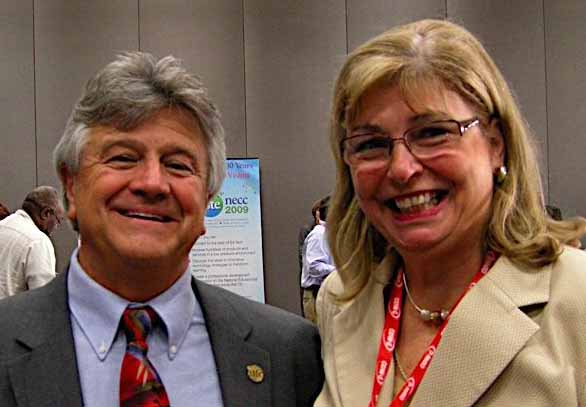
Former President of ISTE Jan Van Dam said "We need to light a fire under our school administrators to get them to see the importance of integrating technology in the curriculum."
"Schools are changing slowly because of the little people that walk in the doors. We need to change that so that the people who are in charge are the agents of change," she said.
We need models for teachers to follow in their classrooms and that is what the ISTE conference provides -- hundreds of successful models. Check out their website and show it to your principal and your child's teacher.
Why should you as parents and community members be pushing technology in education? One important reason is that the schools need to a better job preparing students for the 21st century job market. Not an insignificant reason.
A second but equally important reason is that it improves student performance in all areas of instruction. There are literally hundreds of papers that document the effectiveness of technology and many of them can be accessed on the ISTE website.
So now getting down to what you can do this summer to improve education this fall. Give the principal of your school a copy of the just released National Educational Technology Standards for Teachers (NETS.T). Let them read it over the summer.
And for your superintendent, you can give him/her a free booklet called Empowering the 21st Century Superintendent by going to this website and ordering it. Or you can simply go into the office and talk to them and give them the web address. Superintendents are open to community input. Don't be hesitant. You as a citizen have the right and responsibility to speak up.
ISTE even developed a free tool with the support of Hewlett-Packard to measure the level of technology integration in the classroom. Give this information to your principal and superintendent.
Schools respond to suggestions and pressure from the community and so you as a parent and community member have the power to make a difference.
Remember the world is hungry for tech savvy workers, and students are hungry for classes that effectively integrate technology and teach meaningful skills. Perhaps together communities can change our sad dropout statistics and help students lead more productive and satisfying lives.
Want to reply to a comment? Hint: Click "Reply" at the bottom of the comment; after being approved your comment will appear directly underneath the comment you replied to
Right ON, Esther. For those of you wondering about the utility and effectiveness of technology education on students today, take a look at the new technology standards for students at:
http://www.iste.org/Content/NavigationMenu/NETS/ForStudents/2007Standards/NETS_for_Students_2007.htm
Explicit technology instruction is only one part of a drive to help students develop the scholarly, social and technical skills to work WITH OTHERS to address challenges they face now and in their futures. Most states have already identified and adopted technology standards for students and they are embedded within the standards for each content area (English, History Social Studies, Math, Science, etc.) so that little instruction is tech for tech sake but in service of other goals. An emphasis on developing technology literacy is not just relevant in the sense of creating engaging learning experiences for kids (necessary for some kids to stay in school and graduate), but in preparing them to participate in an ever digitizing (and ever smaller) world.
Take a look at this: http://www.youtube.com/watch?v=pMcfrLYDm2U
Katie
Relevant to what? to whom? Relevant is often the buzzword used to mean the temporal, the faddish, or the immediate future. Whenever I read about the drive to increase technology in education I think, "Great, now maybe the younger people can develop technical solutions to the problems created by ... technology." It is a vicious circle. It is actually a Marxist concept that technological improvements will free mankind from wage labour and lead to an Utopian society. Such foolishness. Meanwhile, Shakespeare continues to be "relevant" because it deals with human experiences that everyone can understand.
HuffPost's Pick
Right here you have the problem with public education. Nobody cares. This comment area has been blank since the article was posted and I've been checking back all day.
I've been an educator my entire adult life, first multiply handicapped children and then, by choice, in the inner city. It gets very lonely during parent / teacher conferences, and its even worse at Home and School (PTA) meetings. And this is true of every kind of school setting. While the excuses may differ, the absence is the same.
The media doesn't care ( unless the teacher has been "bad" or the literature vaguely controversial), the public doesn't care unless the football team is winning (or losing), and the community only gets aroused when there is a threat of a tax increase. THEN, of course, the fur flies.
There are reasons why the American student has plummeted in comparison to students of MANY other countries... and this is one of the main ones. Nobody cares.
I am indeed torn. There is no intrinsic need for a kid to know anything about anything, as long as they can muddle their way through life. What then is the purpose of an education? Interested parties include parents, potential employers, and perhaps, the child themself. Each has a different, and conflicting agenda.
No one was designed to sit, basically motionless, for eight hours a day. The fact that many adults can do so, is by no means, a matter of pride, and almost invariably, a jiggling corset of flab is their graduation robe. On the other hand, to have no idea of the world you have been so inconsiderately conscipted into, just leaves you victim to those who see you as purely a commodity. We all know, that any knowledge which is "relevant" is soon to be superceded in this culture, so in any case, learning must continue, and desire to learn must be inculcated. There remain other verities which are equally relevant and which will not be communicated in a strictly utlilitarian curriculum. To teach only "relevance"is to be complicit in the commoditization of children. If GDP is your only measure, then perhaps this is what you want.
You must be logged in to comment. Log in or connect with