To a guy with a hammer, everything looks like a nail. But I can't help seeing this
moment of combined military and financial crisis as a validation of Dwight D. Eisenhower
and a repudiation of Ronald Reagan.
Eisenhower figures prominently both in my 2006 film Why We Fight and my
forthcoming book The American Way of War, so I've been basically living with the guy since 2003. The Ike I've come to know is a fiscal and military conservative with a
healthy skepticism toward the kind of unwarranted conflict in which we are engaged
abroad and the fiscal irresponsibility we are witnessing at home. As the nation
approaches November -- already beleaguered by war and now bracing itself for the
brunt of this banking tsunami -- Eisenhower has much to teach us about how we lost our
way and what we can do to get back.
Reagan, on the other hand, is long overdue for a rethink. At a time when we are mired
in a tragic foreign conflict invented by his latter-day acolytes and digging through the
wreckage of their corrupt and deregulated economy, the fullness of Reagan's vision is
upon us. But if there can be any silver lining to these combined crises, it may be to
inspire a shift away from America's blind obsession with Reaganism and a return to the
more sober polices that once kept America secure -- militarily and fiscally.
What a difference fifty years makes.
During his presidency, Eisenhower wasn't seen as a very bright light. But today, he
haunts us. First, the Iraq war fulfilled his now legendary 1961 farewell warning about the
"military-industrial complex." Back then, he was all but written off as a kook for
suggesting that a shadowy network of corporate and military actors could lead the
country to war for profit or ideology rather than principle or necessity. Now, as we try to
understand how we got into our domestic financial mess and to what extent it relates to
the military mess overseas, Eisenhower grows more prescient by the minute. Perhaps,
too, he can teach us something about how to respond.
As president, Eisenhower gave the lie to George Clemenceau's axiom "War is too
important to be left to the generals." As his granddaughter Susan recounted to me, he
was deeply shaken by his experience of World War II and sought to ensure that no such
thing could happen again. As president at the height of the Cold War, he initiated his
controversial "New Look" policy -- a far-reaching program of defense reduction that
pitted him against an entrenched bureaucracy of military-industrial interests. Fearing
not only the direct costs of war but the disfiguring indirect impact that foreign
entanglement can have on the nation's financial health, Eisenhower described America's
conflict with the Soviet Union as "an unbearable security burden leading to economic
disaster."
Ike's career holds so many such applicable pearls of wisdom, it's best to get them right
from the horse's mouth. In 1953, in one of his first addresses as President, he made the
now legendary Chance for Peace speech, in which he quantified in brutally simple terms
how money spent on defense is diverted from other areas of national need:
Every gun that is made, every warship launched, every rocket fired
signifies, in the final sense, a theft from those who hunger and are not
fed, those who are cold and are not clothed...
The cost of one modern heavy bomber is this: a modern brick school in
more than 30 cities.
It is two electric power plants, each serving a town of 60,000 population.
It is two fine, fully equipped hospitals.
It is some fifty miles of concrete pavement.
We pay for a single fighter plane with a half million bushels of wheat.
We pay for a single destroyer with new homes that could have housed
more than 8,000 people.
As president, Ike's advocacy for military and economic restraint put him at almost
constant loggerheads with the Pentagon over defense expenditures and pressure from
Congress for increased overseas military engagement. While during the Bush years it
has been the Republicans who critique their opponents as soft on terror, in Eisenhower's
time, the party lines were reversed. As Democratic senators Henry "Scoop" Jackson
and John F. Kennedy used the spurious "bomber gap" and "missile gap" charges to
impugn Eisenhower's stewardship of national security, he resisted pressure by members
of both parties to launch a preemptive nuclear strike against the Soviet Union.
"God help this country," the embattled President was overheard to say, "when someone
sits at this desk who doesn't know as much about the military as I do."
With 20/20 hindsight, the regrettable covert activities Eisenhower approved in Iran,
Guatemala, Indochina, and elsewhere, are part of the larger covert story of how Cold
War America came to violate the framers' resistance to foreign entanglement. It's a
tragic story of unintended consequences that leads uncomfortably to today's quagmire in
Iraq. Yet, beyond his role at the dawn of such covert mischief, Eisenhower did manage
to keep America largely out of conflict for eight years at the height of the Cold War
without bankrupting the country.
That was then. But today's Republicans are a different breed. This was confirmed
earlier this year when lifelong Republicans John and Susan Eisenhower -- Ike's son and
granddaughter -- opted to break ranks with their party, no longer able to brook its
abandonment of first principles. In this sense, the current combination of crises is the
culmination of a long process by which the commitment to small government and
isolationism that were once the hallmark of the Republican party have been replaced by
Reagan's free-market fundamentalism and runaway militarism, which have directly and
indirectly led to our current predicament.
Reagan's renaissance, which culminated in his near-monarchic state funeral four years
ago, coincided with the rise of the neoconservatives in Washington, all of whom laud him
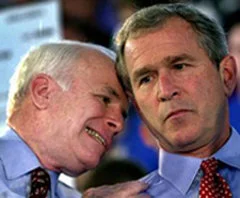
as their political hero. The ever-shifting candidate John McCain, who appeared in "Why
We Fight" and makes a characteristically fitful appearance in my book, describes
Reagan as "our icon, reversing the lesson of Vietnam in his policy of military strength
and support for freedom fighters around the world." Not surprisingly, McCain's straight
talk express is having a bumpy ride during the current array of crises. In Tuesday's
Washington Post, George Will described McCain as "behaving like a flustered rookie
playing in a league too high." It's a pretty sad day in Mudville when you're trying to win
the hearts of conservatives and George Will accuses you of being more socialist than
FDR. To be fair to John McCain, though, the current crisis doesn't only reveal a
disconnect in his thinking. It uncovers a basic dilemma over what it means today to be a
Republican more broadly.
The problem, of course, is that you can't really love Reagan and love Eisenhower at the
same time. Eisenhower was a fiscal conservative, military conservative, and
government-bureaucracy conservative. Conversely, Reagan had a proactive,
expansionist view of America's role abroad and a blank-check enthusiasm for military-industrial
corporatism at home. Taken to their logical extreme, these produce
entanglement abroad, economic instability at home, and now, the big-government
solutions that inevitably follow. Of course, it didn't start that way. Reagan's revolution
was sold on a ticket of "small government." But buyer beware. Now that Reaganomics'
warranty has run out, the party of anti-Communism and small government is proposing
to socialize our economy. It turns out -- and this is what Eisenhower saw so presciently
- that you can't have the neocons' Reaganesque fantasies of military adventurism
overseas and deregulated corporatism at home without paying a price in the long run.
Suddenly, with Joseph Stiglitz assessing the Iraq war's cost at over $3 trillion and all hell
breaking loose in the markets, one-time critics of big government are standing on Wall
Street handing out bailouts like party favors (no pun intended).
No wonder it's hard to be John McCain these days -- or any other acolyte of Reagan --
struggling, after supporting the Iraq war and fighting for Reaganesque deregulation, to
distance yourself from the inconvenient consequences of these policies. For like his
party, McCain bet on the wrong horse, hitching himself not to the soldierly restraint of
Eisenhower but to Reagan's radical fantasy that a society of foreign entanglement
abroad and deregulated trickle-down economics at home can long endure. So what to
do about it?
Well, I might encourage John McCain and, for that matter, anyone in Washington who's
drunk the Gipper's free-market fundamentalist and gun-toting expansionist Kool-Aid, to
spend a bit more time reading Eisenhower. In combination, a couple of striking phrases
in the farewell address and in an earlier speech Ike gave upon assuming the presidency
of Columbia University may hold a key to optimizing our reaction.
"Crises there will continue to be," Eisenhower declared in his farewell warning. "In
meeting them, whether foreign or domestic, great or small, there is a recurring
temptation to feel that some spectacular and costly action could become the miraculous
solution to all current difficulties."
It's impossible to read these words today and not see the Iraq war as a "spectacular and
costly" reaction to the crisis of 9/11 and Paulson's $700 billion blank check as a
"miraculous solution" to our "current difficulties."
It's too late, of course, to heed Eisenhower's warnings against militarism and avert the
ravages of the Iraq war. But perhaps it's not too late to seek his economic counsel.
Unlike today's profligate Republicans, under whom the deficit has increased from $6
trillion to over $9 trillion, Eisenhower achieved a balanced budget for three of his eight
years in office, a feat unmatched by any president in the years since. (Not surprisingly,
we saw a similar explosion of the deficit under Reagan.) Eisenhower's fiscal
conservatism, though, wasn't just a function of knee-jerk penny-pinching or callous,
laissez-faire free market fundamentalism. His was a deeply held vision of the precious
balance between government expenditure and republican liberties. At his inauguration
as President of Columbia University in 1948, he decried that "if carried to the logical
extreme, the final concentration of ownership in the hands of government gives to it, in
all practical effects, absolute power over our lives."
In his article critiquing McCain's response to the crisis, George Will asked a pointed
question not only about the candidate but about his party: "So, is not McCain's party now
conducting the most leftist administration in American history?" Will went on to question
Paulson's reasoning when he responded to charges that his bailout was socialist: " this
is not socialism, this is necessary." What Will to his credit is highlighting is the central
problem at this moment for Republicans: how to support the audacious efforts of the
White House to respond to a financial crisis born on its watch by taking over the banking
industry in a way FDR never dreamt of while on the other hand trying to cling to a
coherent Republican ideology. To its own horror, contemporary republicanism is in
danger of becoming the new socialism, and George W. Bush a modern-day New Dealer.
In Monday's New York Times, Paul Krugman referred to Paulson's bailout bill as the"Authorization for Use of Financial Force," a joking echo of the wording of the Joint
House Resolution that produced the Iraq war by conferring Congress' war-making power
on the president. Beyond Krugman's jibe, though, is a very real concern that
Eisenhower would overwhelmingly share - that just as the country did in the wake of
9/11 America might respond to the current crisis not with the prudence of improved
oversight but with a radical doctrine of government ownership, marked by the too familiar
stains of cronyism and corruption.
"We cannot mortgage the material assets of our grandchildren," Eisenhower hauntingly
remarked in his closing words, "without risking the loss also of their political and spiritual
heritage. We want democracy to survive for all generations to come, not to become the
insolvent phantom of tomorrow."
If, how, and when the current crisis will end is anyone's guess. Somehow it's always
easier to dig oneself into a hole than to claw one's way back out. And broadly speaking,
the question about the bailout does not seem to be whether to have it, but just what form
it should take. This is a complex question -- like that which faced America after 9/11 --
that requires the time for a textured consideration. Having ignored Eisenhower's
example of military restraint for the past eight years, perhaps we can cut our economic
losses by heeding his example of fiscal and small-government conservatism. As the
White House now demands the rubber-stamping of its sweeping blank-check bailout with
the same fervor it used to sell Congress on the need to invade Iraq (with the added new
twist that McCain is hinging his appearance at Friday night's debate on the achievement
of a signed bailout), we must remember that Eisenhower, at the height of the Cold War,
did not allow his policymaking to be bullied by those who would allow the public interest
to be "held captive" by private interests.
For ultimately, Eisenhower understood that misguided national priorities that place
military expansion and unchecked cronyism above other vital aspects of our national life
condemn us to "destroy from within what we are trying to protect from without." Instead,
he argued, crises must be met not by spectacular and costly exercises of radical
governance but through a consistent commitment to "balance in and among national
programs." This requires a holistic understanding of what makes a nation strong. For
Eisenhower understood that an uneducated country is an undefended country, that a
country without adequate health care is an undefended country, that a country that
bullies its friends in the international community is an undefended country; and, above
all, that a country in which corporate-political corruption has compromised its people's
faith in their leaders is a country they will not fight for. Ultimately, that country - and the
principles on which it was founded -- cannot long endure.
* * *
Eugene Jarecki's 2006 film Why We Fight won the Grand Jury Prize at the
Sundance Film Festival as well as a Peabody Award. His forthcoming book, The
American Way of War: Guided Missiles, Misguided Men, and a Republic in Peril
(Simon & Schuster/Free Press), will be released October 14th.