
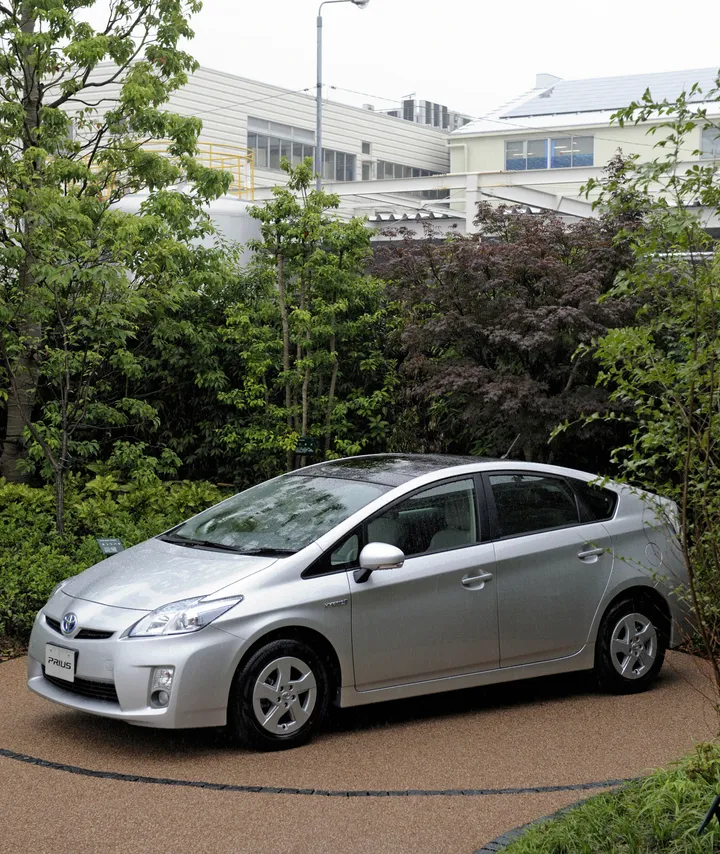
Fans of Larry David's hilariously cringeworthy hit comedy Curb Your Enthusiasm can't miss the Prius. It's in every episode, one way or another, and has been as long as the show has been on the air, I think. Replacing the bike hanging on the wall in David's iconic 1990s hit Seinfeld as a symbol of urban chic, Toyota's hybrid Prius became the uber-cool, eco-fashion statement of the 2000s. I'm not sure how many of my NRDC colleagues and board members bought one in the last decade, but you can bet it's well into the double digits.
But those of us who do own them, like David, may now have to yield our hipness credentials to the latest trend, which is owning no car at all. Almost unthinkable anywhere other than Manhattan for affluent professionals until recently, going car-free has now become a reasonable choice in many cities around the country, particularly those that are well-served by transit and have carsharing programs to accommodate occasional drivers. Whereas cars once ruled American youth culture (see my post from last year, "Little Red Corvette"), now the fastest-growing indicator of cool may be doing without.
Heck, in Ballard, Washington, you can now even obtain an "Undriver's License" from the organization Sustainable Ballard.
Martin Zimmerman reports in The Los Angeles Times that an eight-month study by J.D. Power of teens' and young adults' attitudes toward the automotive industry found that "[o]nline discussions by teens indicate shifts in perceptions regarding the necessity of and desire to have cars" and that "negative perceptions of the automotive industry that teens and early careerists hold could have implications on future vehicle sales," as they already have in Japan.
Similarly, Michilene Maynard writes in The New York Times that the question "which car do I want?" is now being replaced for many would-be purchasers with "do I need a car?":
"The recession and a growing awareness of the environment are causing many people to reassess their automobile ownership. After more than a century in which an automobile represented the American dream, car enthusiasm may no longer be a part of Americans' DNA . . .
"Whether because of cost, convenience or environmental awareness, a small but growing number of people are making individual decisions to get rid of their automobiles and rely on public transportation, car-sharing programs and rental cars.
"'There's a cultural change taking place,' said John Casesa, a veteran auto industry analyst and partner in the Casesa Shapiro Group. 'It's partly because of the severe economic contraction. But younger consumers are viewing an automobile with a jaundiced eye. They don't view the car the way their parents did, and they don't have the money that their parents did.'"
Maynard also reports that some empty nesters are choosing to go car-free, and that even suburban families are downsizing from, say, three cars to two. According to Jesse Toprak, vice president of industry trends and insights for TrueCar, a company that tracks car-buying habits, "People are questioning car purchases more than we've ever seen in recent history." Meanwhile, companies such as Honda and GM are investing in personal mini-vehicles, surmising that going car-free may not mean going transportation-free.
In that vein, not long ago, my wife and I were having dinner at a Japanese restaurant, when some motion caught my eye. In a matter of seconds, a well-dressed man on a Segway glided down the aisle from picking up his carry-out, out the front door, and up the sidewalk, maintaining a smooth pace the whole way.
Me? I'll keep my car, thanks; I really like it. (For the record, it's an Audi.) But I'm glad that, for me, driving it is mostly a matter of choice, not necessity. Sometimes I can go as long as a week without needing it. I want more and more people to have that choice, and to be able to do without altogether if that's their preference.
Kaid Benfield writes occasional "Village Green" commentary on Huffington Post and (almost) daily about community, development, and the environment on NRDC's Switchboard. For daily posts, see his Switchboard blog's home page.