
"Not even in 300 years" said Hezbollah's leader, Hassan Nasrallah, as he appeared on Lebanese television a few days ago bluntly declining to adhere to an indictment and arrest warrants issued by the United Nations Special Tribunal for Lebanon (STL) against four of his party's members.
Mr. Nasrallah also claimed that the four men were wrongfully accused by the investigation team examining the 2005 assassination of former Lebanese Prime Minister Rafiq Hariri. He added that the four suspects were victims of a corrupt and biased court aimed at tarnishing the image of "the anti-Israeli resistance."
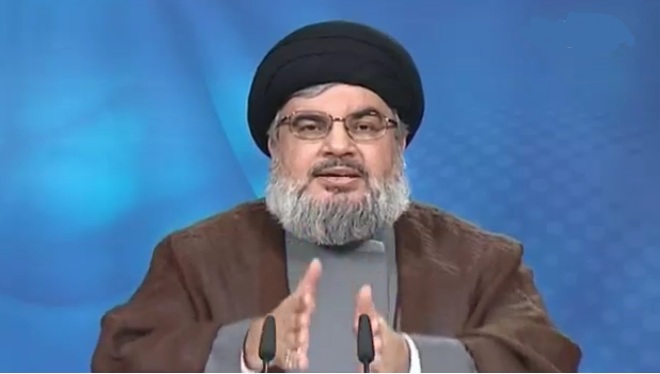 (a snap-shot of Hasan Nasrallah's live speech which aired on Hezbollah's channel, Al Manar on 2 July 2011)
The good news, however, is that he vowed that there "will not be a sectarian strife in Lebanon between Sunnis and Shiites" -- a statement intended to comfort those worried that another armed takeover by the predominantly Shia militant group of the predominantly Sunni areas of the Lebanese capital, Beirut, similar to what occurred in May 2008.
The bad news is in that particular statement itself: It implies that Mr. Nasrallah can, as he did before, indeed ignite a sectarian feud in Lebanon with the mere flick of a finger. It also implies that Mr. Nasrallah seems to believe that he speaks for all Shiites in Lebanon, which is not true.
In his same speech mentioned above, Mr. Nasrallah also said "don't ask of the government of (new Prime Minister) Najib Mikati to do something they are incapable of."
This is another indicator that the legitimate government of Lebanon will not be able to impose the handing over of the four suspects to the STL on Mr. Nasrallah or his party.
Come to think of it, who is to force Mr. Nasrallah to do anything, anyway? Over the years, all attempts to negotiate with Hezbollah have failed miserably when it came to convincing them to disarm and becoming an exclusively political party.
In fact, Hezbollah even decides when the country should go to war with Israel and when it shouldn't, as was evident five years ago when the kidnapping of two Israeli soldiers near a border checkpoint unleashed the disproportionate wrath of the Israeli Defence Force for 36 days.
In that war we all learned, including the Israelis, that Mr. Nasrallah just can't be stopped.
After all, we are talking about a man who had the audacity to declare himself victorious following a UN-brokered agreement that came after the IDF killed more than 1,000 people in Lebanon (mostly civilians) and caused grave destruction to the country's infrastructure and buildings.
Now, up until 2000, Hezbollah was considered by most people as a true example of an impeccable resistance movement, since it took the burden of fighting the Israeli forces occupying southern Lebanon and eventually managed to get them to withdraw.
However, like Israel's withdrawal from Gaza, which has contributed to the division between Fatah and Hamas, Hezbollah's guns eventually turned inward as it found itself without a real enemy for the first time since its creation in the early 1980s.
Throughout its existence, Hezbollah gained much popularity in the otherwise deprived areas of southern Lebanon, which were predominantly Shia, as it built schools, clinics, its own television station, and offered incentives for people to join.
One reason for the Shia deprivation was that, historically, the Lebanese elite were always the Sunni Muslims and the Christian Maronites. Another was that during the time Hezbollah was growing in influence and power, the rest of the country was engaged in a 16-year civil war.
Following the civil war, Saudi-backed Rafik Hariri emerged as a leader determined to rebuild and revive the country. It is worth mentioning here that until the Israeli withdrawal in 2000, Mr. Hariri was an avid supporter of Hezbollah's resistance efforts.
The problems began when Hezbollah declined to hand over their weapons, refused to serve as part of the country's formal army, and began appearing as more of an Iranian "playing card," used more to pressure the United States whenever needed as opposed to a party dedicated to serving Lebanese interests.
This leads us to the key question: If members Hezbollah did kill Rafik Hariri, how exactly do the STL and the Lebanese government intend to bring them to the justice?
This article was first published on Al-Arabiya's English website as "In Lebanon, Nasrallah just can't be stopped. Ask the Israelis!".