By Eleanor West
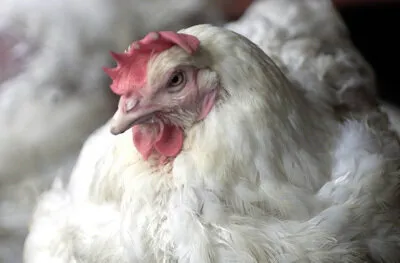
Can eating today's overweight and often deformed industrial chickens be contributing to our obesity epidemic? Is it possible that the white lean meat we've been told is better for us than heart attack-inducing red meat is actually full of fat? According to a 2009 British study -- yes.
The study, published in Public Health Nutrition and spearheaded by Dr. Yiqun Wang, shows that chickens have become obese at an alarming rate and, consequently, their nutritional value has plummeted. The explanations are many, but they can be summarized as a change in feed from grass to grain, a lack of movement due to confinement and gene selection for rapid weight gain starting in the 1970s.
Now, heritage poultry breeder Frank Reese Jr., consulting/advocacy group Farm Forward and Kansas State University have decided to conduct a similar study in the United States. (Read more about Frank Reese Jr. here.) But unlike the Wang study, which only focused on hybrid boilers, the KSU study will compare the nutritional value of Reese's heritage breed chickens (standard bred barred rocks) to that of store-bought chickens (hybrid boilers).
With heritage breeds, the focus is on genetics, which Reese feels is an element of poultry that is often overlooked by the media and consumers. "They may call them free range or organic but it is all the same animal. Organic makes no difference nutritionally. It's the same hybridized hen that is laying the egg," says Reese. To receive a heritage breed label, a chicken "must be from parent and grandparent stock of breeds recognized by the American Poultry Association (APA) prior to the mid-20th century." The chickens must also have genetic lines that can be traced back for multiple generations and they must mate naturally. Whereas Reese's chickens take 140 days to grow to fryer weight (3 to 3.5 pounds), industrial chickens take approximately 40 days. The rate for free-range chickens who are not aggressively overfed is marginally better, clocking in at around 60 days.
Reese and Farm Forward propose that heritage birds will prove nutritionally superior and uphold chicken's "lean" reputation. If they're succesful, their findings will be unwelcome news to the chicken industry -- both industrial and otherwsie. "It's common sense really," explains Steve Gross, Chairman of Farm Forward. "An animal that is healthy will be more nutritious and should taste better. But you can't just say that, you have to prove it."
Farm Forward and Reese have engaged Dr. Elizabeth Boyle, animal science professor at Kansas State University, to conduct the research for the study, which will be titled, "Comparison of protein and fat content between the meat from Standard Bred Barred Rocks and Hybrid Broilers." The heritage breed birds she will use in the study will all come from Reese's Good Shephard Poultry Ranch, where they have been raising the same breed of birds for over 50 years. Research began in February and the team expects that it will last for six to eight months.
Farm Forward and Reese don't anticipate that the results of this study will go over quietly, and they are already making plans for follow-up studies on heritage breeds of other animals like turkeys. Farm Forward's Gross says he is prepared to have the industry challenge whatever conclusions come out in the study. "We may not have their dollars, but we probably have more stamina," says Gross.
Regardless of how big agriculture might respond, Reese is confident that the modern chickens will prove nutritionally inferior to his heritage breed birds. "You'd be better off eating a hamburger than a hybrid chicken," says Reese.