Lord Kelvin's 100-year-old problem has been under attack this past week at the International Centre for Mathematical Sciences in Edinburgh, Scotland. In his attempts to understand space as an etherial foam of unit-volume bubbles, Kelvin sought the most stable, least-area such structure. Kelvin conjectured a structure based on a 14-sided building block called a truncated octahedron:
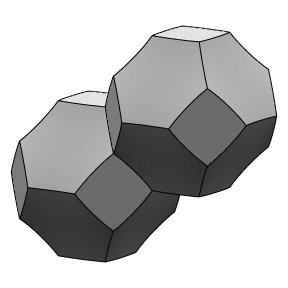
The Kelvin structure. Graphics by Ken Brakke in his Surface Evolver.
Kelvin loved this shape, constructed models, and exhibited stereoscopic images:
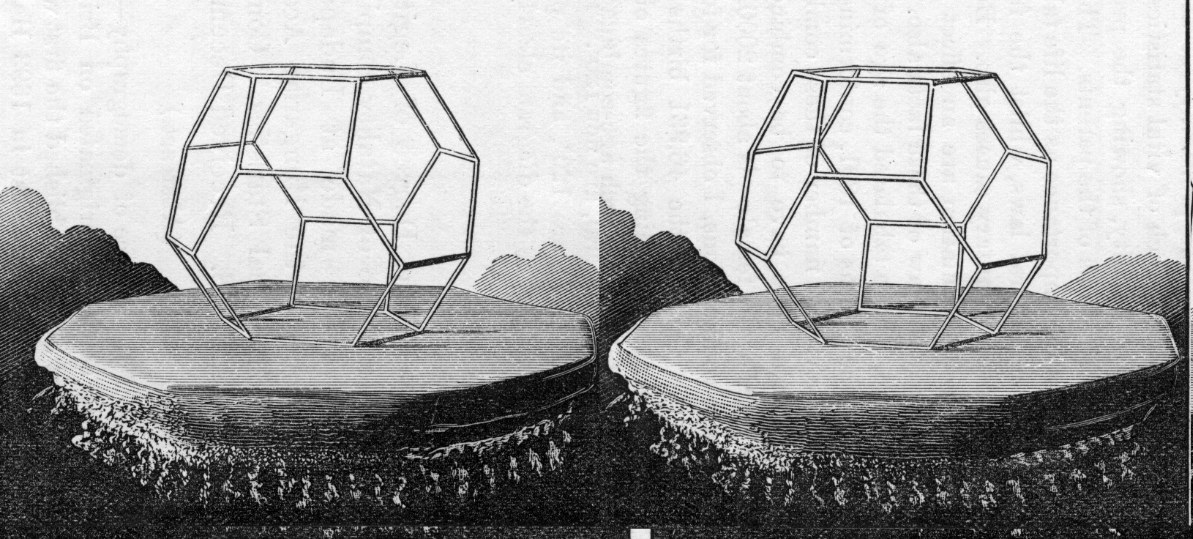
Cross your eyes to see a 3D image of Kelvin's 14-hedron.
One hundred years later, in 1992, another Irishman, Denis Weaire of Trinity College, Dublin, and his graduate student Robert Phelan beat Kelvin's conjecture by using two building blocks, one 14-sided as before, but this time with lots of pentagonal faces instead of hexagons and squares, and a 12-sided pyrite crystal ("fools' gold"):
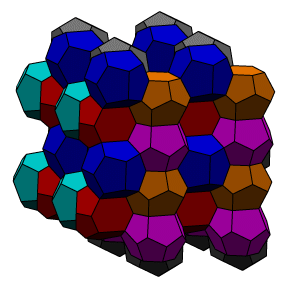
The better Weaire-Phelan structure of two building blocks. Graphics by Ken Brakke in his Surface Evolver.
Computation in the Brakke Evolver shows an improvement over Kelvin's conjecture of approximately 0.3%. That's a big margin in this business, "like winning by five lengths in a horse race" as Weaire put it in a public address at the Scotland conference this week. The rigorous proof, by Rob Kusner of UMass, Amherst and John M. Sullivan of TU Berlin, also in attendance, proves only approximately 0.01%.
Denis Weaire learns that his new structure beats Kelvin's.
Ironically, in the 1980s Brakke had spent hours by his great-grandfather's old desk seeking counterexamples. Had he reached up and pulled down his father's copy of Linus Pauling's classic, The Nature of the Chemical Bond, it would doubtless have fallen open to the illustration, in the clathrate compound section, of the chlorine hydrate crystal, essentially the Weaire-Phelan counterexample. Decades earlier, R. Williams, after spending years seeking a Kelvin counterexample, finally gave up and later published a well-illustrated The Geometrical Foundation of Natural Structure: A Source Book of Design. In his Figure 5.22, he pictured the Weaire-Phelan counterexample without realizing it.
Brakke said that as soon as he got the description of the new Weaire-Phelan candidate and saw all the pentagonal faces, he knew it was a winner. In a major address at the Edinburgh conference this week, Andy Kraynik of the University of Erlangen-Nürnberg reported on many other candidates, including one ("Friauf-Laves") with even more pentagonal faces. Does it beat Weaire-Phelan? No, the contortions required to get the extra pentagonal faces are too costly to be worthwhile.
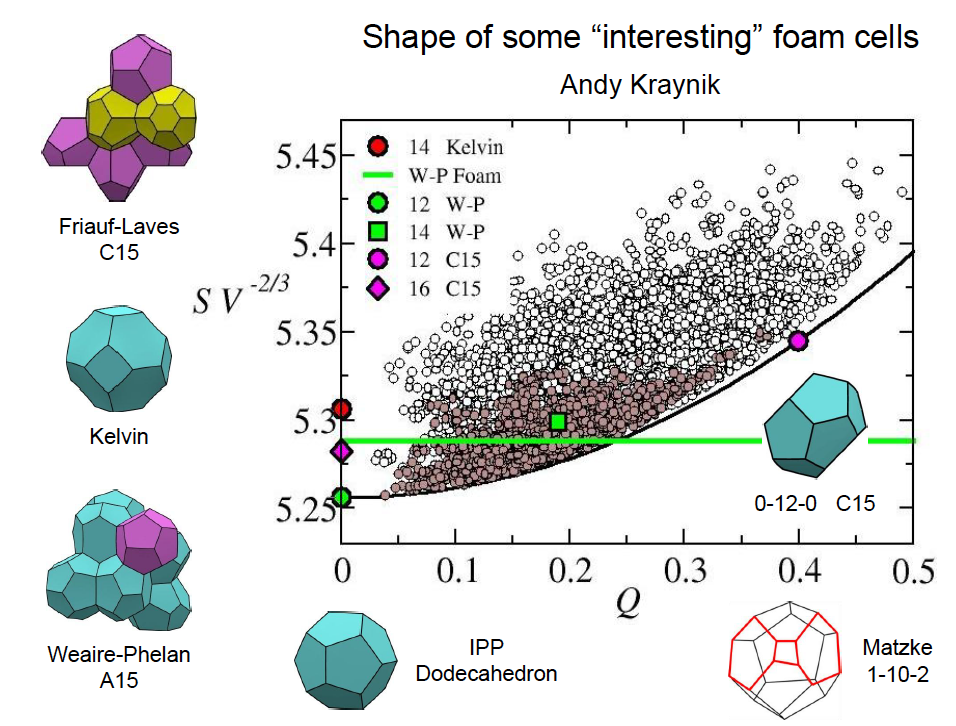
The two green Weaire-Phelan cells are both lower (cheaper) than the red Kelvin cell, even though the green square (14-hedron) is somewhat distorted (farther right). The purple Friauf-Laves diamond (16-hedron) with its many pentagonal faces lies below the Weaire-Phelan green square (14-hedron), but the Friauf-Laves purple circle (12-hedron) is very distorted and expensive (to the right and higher).
Andy Kraynik describes the analysis of foams he made his life work.
Mathematicians and scientists at this week's Edinburgh conference believe and would like to prove that the Weaire-Phelan structure is best. Discussions include Kraynik, Sullivan, and Thomas Hales, who proved the two-dimensional version about hexagonal honeycombs, as described in our previous post on "Can Math Survive Without the Bees?" I had previously suggested that the proof could take another century, but Hales and company are making some progress.
John Sullivan discusses the prospects of proving the Weaire-Phelan structure best.