When it comes to animal escapes, we often blame the enclosure or the zoo, but perhaps the culprit is human behavior. I am personally not against keeping animals at zoos, as they serve a huge educational purpose, but treating them well and with respect seems the least we could do, and with "we" I mean not just zoo staff, but most certainly also the public.
Consider this list:
•This year (2007), an 11-year-old gorilla male, Bokito, jumped over a water moat at Rotterdam Zoo, in the Netherlands, that had contained the gorillas for years. Bokito had been raised by humans. He attacked a female visitor, who came every day to "communicate" with her special friend, and had been warned repeatedly by zoo keepers that she was provoking him. The attack was not serious by gorilla standards, but left the woman in critical condition (which she survived). Bokito was darted and put back in an enforced enclosure. This year's most popular new word in the Dutch language has been declared Bokitoproof.
•Also this year, Franzl, a 12-year-old male chimpanzee at the Hellabrun Zoo, in Munich, Germany, jumped over the electric fence surrounding his enclosure and tried to get across the water moat. The zoo speculated that he may have been taunted by visitors. Franzl, too, had been raised by humans, and was attracted to people, and paid lots of attention to them. He was one of the most popular animals at the zoo, but drowned in the process.
•A few days ago, a 4-year-old 300 pound Siberian Tiger, named Tatiana, killed a young man, and attacked two others, following their blood trail until the police shot her. Tatiana had attacked a keeper one year earlier, chewing on her arm during feeding. The tiger had been tiger-reared. A shoe was found in the moat surrounding Tatiana's enclosure, causing speculation that one of the victims had dangled a leg over the 18-foot wall. This may have offered the tiger an escape route.
What struck me is the 18 feet. This is, if I remember well, exactly the walls we had around the tiger "pit" at a Dutch zoo where I worked long ago, from which no tiger had escaped for sixty-five years. That's an awfully long time, but one day a visitor was attacked nonetheless (21 September 1978, Burgers' Zoo, Arnhem). A 3-year-old 390 pound Bengal tiger jumped out and attacked a woman. The woman survived, the tiger did not. The story at the zoo at the time was that the tiger had jumped out in reaction to a different woman, a regular visitor, who often "chuffed" at the tigers to get replies (this is a soft friendly greeting, also known as "prusten").
I don't want to scare everyone, but it is my personal belief that animals at zoos - unless they are completely surrounded by glass, concrete, and metal - often can get out if they really want to. Their escapes are often called "amazing" (such as for Jabari, the gorilla, at the Dallas Zoo, in 2003), but happen nonetheless. For example, I have seen male chimpanzees get out of an enclosure they had been contained in for over a decade. They stacked up some tires, and climbed on top of each other, and voilà. We'd never thought they could do this. They did so after all females had been moved to a nearby area, hence had become inaccessible.
Motivation is key. Animals can be contained 99% of the time behind a moat of a certain width, or a wall of a certain height, but then if panic strikes, or if they respond to taunts, all of a sudden they manage to get out.
Most exotic animals are not particularly interested in people, which makes it hard to provoke them. Human-rearing gets them used to and sometimes imprinted on humans, which makes them potentially dangerous. Bokito was raised by hand at the Berlin Zoo, which is the same zoo now asking for trouble by hand-rearing a polar bear, the famous Knut.
There are ways to circumvent this. For example, we once had a baby chimpanzee, named Roosje, that needed care because of serious neglect by her natural mother. We trained another chimpanzee to feed Roosje by hand. The female adopted the baby and learned to let her drink from a milk bottle. By the end, the adoptive mother understood the process so well that she'd even remove the bottle from the baby's mouth if it needed to burp. Roosje grew up being an ape-oriented ape, as every ape ought to be.
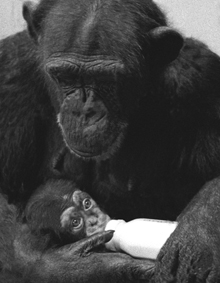
Roosje being bottle-fed by her adoptive mother.
The above may not work for all species, but human-rearing should be a solution of absolutely last resort. Both zoos and the public should think of ways to make animals feel at home. It may not be so much the enclosures that need changing, but our way of raising and treating animals, including the public's attitude. When I visit traditional ape houses, I often wonder which species is more intelligent. The public is constantly banging on the windows, yelling, and making obscene gestures, and the apes try to keep their calm through this din, and are no doubt relieved when closing time arrives.
Zoological gardens are based on a basic contract. The garden gets to display beautiful animals, teach the public about them, and raise awareness about conservation. And we, the public, have an obligation to act like the civilized animals we are, view these magnificent creatures with awe, and visit the zoo as a learning experience, not an amusement park with fatal attractions.