[Reported from the WISE Conference in Istanbul. All non-cited quotations or paraphrasings drawn from notes on the conference or interviews with WISE participants.]
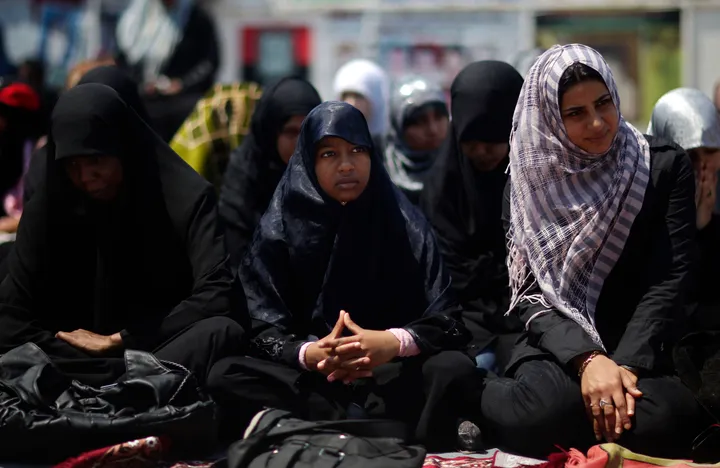
The "fearful fatalistic apathy", which a young Winston Churchill once noted amongst the "curses [of] Mohammedanism", (Churchill, River Wars, 1899) has found frequent repetition over the years as one base assumption behind explanations as to precisely why a political revolution, like the Arab Spring, could never come to pass in the Muslim Middle East. A similar logic has often been applied to the concept that women in Islamic societies might strive to become anything other than the "absolute property of some man" (another Churchillian gem). Such apathy was, however, on poor display October 14 as some 170 Muslim women leaders gathered at the Marriott Hotel in Istanbul to attend a four-day conference organized by the Women's Islamic Initiative in Spirituality and Equality (WISE) -- an offshoot of the American Society for Muslim Advancement (ASMA) dedicated to promoting women's rights in the Muslim world. Here, the word apathy does not spring easily to mind. As women from every far-flung province of Islam's reach stream into the empty conference hall, the air hums with voices raised in vigorous conversation. Flowery greetings and small talk segue swiftly into meatier discussion. Stories are told, tactics exchanged, politics debated, and by the end of each speaking event lines for questioning stretch towards the door. It quickly becomes clear that four days will not be nearly enough to contain the vitality of this group. African, Asian or European, bareheaded or modestly garbed in flowered hijab (traditional head scarf), these women brim not with resigned fatalism but with energy, conviction and, incredibly, an overriding sense of optimism.
There seems little evidence to support such confidence. Muslim women, especially those hailing from the countries of the Middle East and North Africa, remain notoriously underprivileged and underrepresented. A recent report released by Freedom House on women's rights in those nations did find marginal gains -- specifically in the fields of education, employment, and political participation. However, it remains the region where "the gap between the rights of men and those of women has been the most visible and severe." This is hardly news for the women of WISE, nor is such iniquity exclusive to Islam's heartland. Standing to speak before the conference, Sophia Abdi Noor -- a member of Kenya's 10th parliament- rattles off a list of offences. "I have been a victim myself," she admits, "who has gone through female genital mutilation at a very tender age, who has lost her two friends in the operation... who was forced to marriage." Later, when she ran for parliament, conservative Islamic leaders within the community convinced the president to disqualify Ms. Noor's bid, despite her victory at the polls. "But", she states to laughter from the crowd, "I did not stop at that!" She smiles triumphantly, "Now I am a member of parliament... and I am proud to tell you that I am one of the framers of the new constitution of Kenya!" This tone of dogged defiance in the face of adversity is one struck often and well here. From Suraya Pakzad, a fearless campaigner for women's rights in Afghanistan, to Santanina Rasul, who remains the only Muslim woman to win a senate seat in the Philippines, each participant pairs tales of hardship and bias with the casual assumption that no obstacle is insurmountable.
That mentality is one which seems to define this gathering but what is, perhaps, most striking about WISE is the religious framework within which it operates. This is a Muslim women's conference above all else and, in large part, it is this Islamic identity, which the organization seeks to empower. "Women are the glue that holds society together", states Daisy Khan -- WISE founder and executive director of ASMA -- their status in the Muslim world must change but, Daisy notes, "Islam can effect that change." That statement might seem antithetical to some, considering the frequency with which theological arguments are used to rationalize rights abuses in the Muslim world. However the women here maintain that, for the most part, these arguments represent only the manifestation of cultural and tribal mores in the guise of Islamic law. They argue that, contrary to popular perception, the six basic objectives which guide Sharia law -- the protection and promotion of religion (al-din), life (al-nafs), mind (al-aql), family (al-nasl), wealth (al-mal), and dignity (al-'ird) -- provide the same fundamental rights to both men and women.
The promotion of Sharia interpretations refocused upon these universal values is one of WISE's main objectives and the organization sponsors several programs aimed at balancing the narrative on woman's place within Islam. One such program, the NOOR Educational Center run by Jamila Afghani, has experienced marked success in educating Afghani Imams on the religious illegality of common cultural practices such as early and forced marriage. While the Shura Council, WISE's flagship project, brings together influential female leaders and scholars specializing in Islamic law to produce detailed and thoroughly sourced theological position statements on certain controversial elements of Sharia.
As Islamist parties stand poised to win a large share in government at upcoming elections in post-revolutionary Egypt and Tunisia, the promotion of an inclusive, non-restrictive approach to Sharia is particularly important. Efforts such as these, if spread successfully, have the potential to blunt the power of those who would use Islam as a weapon of repression, and inform those who would assert their intrinsic rights within the religion. However the tendency for Muslim women, bound by cultural and traditional norms, to censure themselves and prolong their own discrimination remains a major obstacle in efforts toward equality. Judge Kholoud al-Faqih -- Palestine's first Sharia court judge -- underlined this dilemma during a panel on spiritual leadership, recalling her disappointment at the reaction of many women who, upon seeing a female judge, clicked their tongues in admonishment and sought out male judges to try their case. "It is very sad to see this" she says with a shrug, "because this is cultural baggage and doesn't have anything to do with Islam." So, perhaps, Churchill's "fearful apathy" retains some of its power to convince the disenfranchised to stay that way. As long as it does, progress remains a distant prospect. Still, the events of the Arab spring should provide a lesson in the folly of underestimating the spark of individualism in the Islamic world. If the ladies of WISE 2011 are anything to go by, Muslim women may celebrate their own spring sooner than we think.