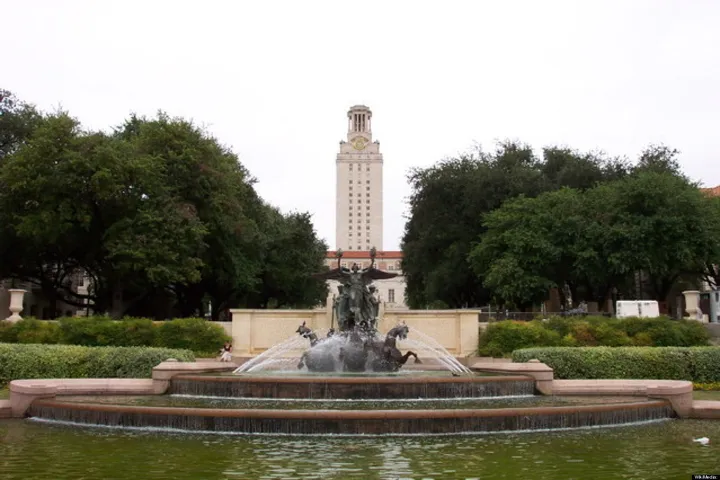
At least four students of color were recently attacked by other students with balloons filled with bleach while walking in West Campus, a student neighborhood near UT Austin. These attacks come at a time when the nation is debating whether UT Austin -- and the United States -- are "post-racial."
Tuesday, the U.S. Supreme Court will heard oral arguments in Fisher v. University of Texas at Austin, a case that challenges the use of race in the University's admissions policies.
Some proponents of race-conscious admissions argue that these policies are still necessary because of the historical exclusion of people of color from educational opportunities. Indeed, the only other time that a case involving UT Austin came before the U.S. Supreme Court was in 1950, when the University was sued by Heman Sweatt, a black man who was denied admission to the School of Law because of his race.
Meanwhile, opponents argue that UT Austin's race-conscious admissions policies are no longer necessary in our "post-racial" society. But anyone who believes that we live in a "post-racial" society only needs to walk around the campus of UT Austin and the surrounding neighborhoods to know that this is not true.
While I was disgusted like everyone else to hear about the "bleach-bombing" attacks, I was not surprised. I lived in West Campus for several years while I was an undergraduate student at UT and I regularly witnessed white students throw objects or shout racial slurs from high-rise balconies at people of color walking on the sidewalk below. I also regularly participated in protests against racially-themed fraternity parties and on-campus events held on Cinco de Mayo in which fraternity members dressed like Border Patrol agents ran around the campus capturing other fraternity members wearing sarapes, sombreros, and t-shirts that read, "Illegal alien."
The public -- and the Supreme Court -- must understand that these are not isolated incidents, and they are not merely tasteless pranks taken too far. These acts of racial violence -- let's call them what they are -- are symptomatic of a larger history and culture at UT Austin in which implicit and explicit racial hierarchies persist, even as the University strives to be recognized for diversity in its students, faculty, and scholarship.
In this way, UT Austin is a microcosm of the country, where progress on racial equality masks persistent racial hierarchies and racism.
While I was glad to witness the unveiling of the statue of Cesar Chavez in 2007, I was still surrounded by symbols of dominant historical narratives that silence the contributions made by women and people of color throughout the history of the United States. Although the University renamed a dormitory named after a law professor who was also the leader of the Florida Ku Klux Klan, there are still statues of Jefferson Davis (leader of the Confederacy) and Robert E. Lee (chief general of the Confederacy) displayed prominently on the South Mall.
The statue of Martin Luther King, Jr. -- where students recently gathered to discuss Fisher v. Texas and the racially-motivated "bleach-bombings" -- faces toward the east side of Austin, where gentrification, fueled in large part by the dominating presence of the University, continues to displace low-income black and Latino families that have historically lived there but cannot afford soaring house prices, rents and property taxes.
After college, I attended graduate school at the University's Center for Mexican American Studies, one of the first in the nation committed to cultivating scholarship about Mexican American and Chicano people, history, and culture. But I was shocked at the level of hypocrisy when, in 2010, administrators in the College of Liberal Arts proposed substantial budget cuts for African American Studies, Mexican American Studies, Asian American Studies, and Women and Gender Studies, while at the same time proposing a budget increase for the Center for European Studies.
While it is clear that UT Austin is trying to move beyond its history of racism and racial discrimination, the University still must do more. And while we should not dismiss these efforts, we must continue to demand an end to racism and racial violence at and around UT Austin. Increasing police presence in West Campus is not the answer; the struggle for racial equality at UT Austin has been, and will continue to be, achieved by student-led actions with support from faculty and members of the community.
If UT Austin wants to be internationally recognized for genuine diversity in its students, faculty, and scholarship it must do more than defend the constitutionality of its race-conscious admissions policies. The University must listen to the students when they protest proposed policies or budget cuts, and commit to building more equal and mutually beneficial relationships with communities of color that surround the institution.
Put simply, the only way for the University of Texas at Austin to move beyond its racist history is to use it as a mandate to become a symbol of racial justice.
Gabriel Daniel Solis is a Research Associate in the Justice Program at the Brennan Center for Justice at New York University School of Law. He attended the University of Texas at Austin from 2005 to 2011.