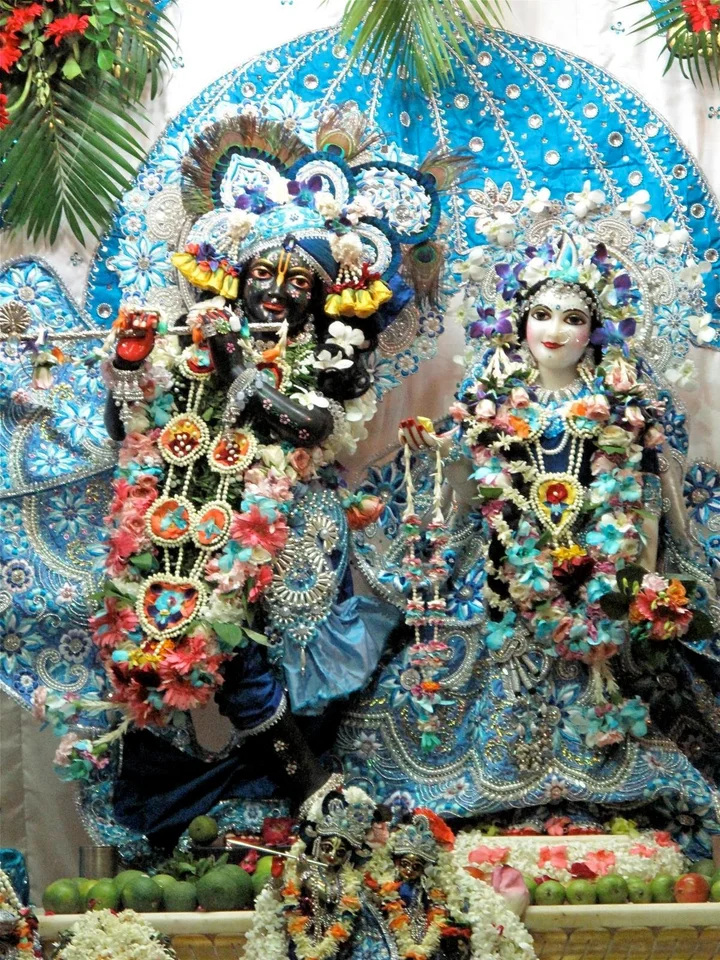
Millions will gather today, in India and around the world, to offer prayers, worship, and devotional songs glorifying the appearance of the Divine mother, Radha (Radharani). Radha descended from the spiritual realm shortly after Krishna, approximately 5,000 years ago. She took birth in the small village known as Barsana, which is about 28 miles from Mathura, the birth place of Krishna.
The word Radha comes from the Sanskrit verbal root radh, which means to worship, and the word rani, which means queen. Radharani can be literally translated to mean "the queen of worship." In some texts, she is described as "the supreme goddess who is worshipable by everyone. She is the protector of all, and she is the mother of the entire universe."
The answer to the question that has been on everyone's mind for millennia is, YES and NO. The question is: Is God a Man? God is not just male, and according to some Vedic scriptures, God has both masculine and feminine expansions. In the Bhagavad Gita, Krishna provides a sneak preview into these feminine traits.
"Among women I am fame, fortune, fine speech, memory, intelligence, steadfastness and patience."
However, in some of the more esoteric texts such as the Puranas and the Chaitanya-Caritamrita, it explains that the complete manifestation of God includes his feminine counterpart, Radha. They are inconceivably one and different, as Krishna expanded himself into two for the purpose of exchanging love. There's a beautiful description in the Chaitanya-Caritamrita which gives us a window into the connection between Radha and Krishna.
"Radha is the full power, and Lord Kṛṣṇa is the possessor of full power. The two are not different, as evidenced by the revealed scriptures. They are indeed the same, just as musk and its scent are inseparable, or as fire and its heat are non-different. Thus Rādhā and Kṛiṣhṇa are one, yet they have taken two forms to enjoy the mellows of pastimes."
This concept is not an easy one to grasp. If God is full and complete, why does he need to expand himself to exchange love? The next question we can ask is why does God need to do anything? God has a personality which indicates that he has preferences. Perhaps this need to expand for the purpose of exchanging love speaks of the importance love plays in the lives of all individuals.
Our desire to love and be loved comes from God. For the most part, no one wants to be alone, at least not permanently. The thing everyone is chasing after is love. We all want to know that there are people out there that love us. Simultaneously, we hanker to be able to give our love to others.
There is another passage in the Caitanya-Caritamrita that describes Radha's qualities and love for Krishna.
"Radharani's body, mind, and words are steeped in love for Krishna ... The body of Radharani is a veritable transformation of love of Godhead. Even Krishna can't understand the strength of Radha's love which overwhelms Him. Her transcendental body is complete with unparalleled spiritual qualities. Even Lord Kṛiṣhṇa Himself cannot reach the limit of the transcendental qualities of Radharani."
These are some of Radha's prominent qualities:
1. Radha is adolescent and always freshly youthful.
2. Radharani is very sweet and most charming to look at.
3. Radha's face is smiling and ever blissful.
4. Radharani is the most exceptional singer and veena player.
5. Radha's words are charming and pleasing.
6. Radha is exceptionally humble.
7. Radha is the embodiment of mercy and compassion.
8. Radha possesses Mahabhava, the highest sentiment of love.
9. Radha always keeps Krishna under Her control. Krishna submissively obeys Radha's command
These topics of divine and spiritual love between Radha and Krishna will always remain a mystery as long as we remain on the material platform. Love on the spiritual platform is devoid of selfishness. The needs and interests on the other take precedence over one's own needs. The kind of love that comes closest to spiritual love is the love exhibited by a mother towards her child. It's full of sacrifice and is completely selfless; it is without expectation.
The feeling of love is derived from the service itself. The child is limited in its capacity to reciprocate the mother's love. Even if it increases its demands, the mother keeps on giving. Most of us can only imagine a relationship where the reciprocation of love and service is completely selfless and without expectation. It's the kind of love our hearts hanker for.
The path of bhakti or devotional service prepares one's heart and consciousness -- by eradicating selfishness and incorporating selflessness -- to understand and experience that divine love which exists between Radha and Krishna.
This is a wonderful day to meditate and reflect on the beautiful selfless qualities of Radharani and pray that we can to some degree follow in her footsteps.
Follow Gadadhara Pandit Dasa on Twitter: www.twitter.com/nycpandit
Gadadhara Pandit Dasa: Karma: What Goes Around Comes Around
yhs, gourgivindsevak senan. 21.09.2011
It's the concept of God that looks rediculous.
I don't think Krishna would be very happy with the development of the repressive, misogynistic "Code of Manu" and subsequent subjugation of women, though.
Odds are that you are talking about Hindu mysticism in some form. But the idea that at maturity (ripe), life is struggle, pain and sadness, is one terribly depressing thought to the uninnitiated.
Why do the Indian people stay with that concept when more optimistic life affirming forms are now available? Perhaps it will remain until and if the economy and the rights of women changes.
Perhaps you haven't heard of mother's depression.
A discussion on spirituality should always be accompanied by science.
India is the land of suttee, where a widow is expected to throw herself on her deceased husband's funeral pyre and burn herself to death. It is a land of major sex trafficking, where ten-year-old girl children are for sale as prostitutes in every city, their haunted eyes peering out from doorways in sleazy brothels. It is a country where sex selection against females is resulting in many more boys being born than girls. "Eve teasing" is a male pasttime and everywhere in India, women are subjected to hoots, catcalls, derogatory remarks and sexist interference by men. Travel in India and it is obvious that the male is worshipped, women are openly considered inferior and women's role is to be a servant to the male.
What good is worshipping mythical goddesses when the real women of your land and time are treated worse than cattle?
But I did see the women doing back breaking work and certainly came away with "yeah, this is not where one wants to be a woman".
When I drove through the Indian country side I was reminded of Southern Italy, where the women did the hard work while the men were palavering in the village square. Only in India the women looked so beautiful in their colorful saris and covered with jewelry from head to toe. In genera even if they were poor they did not look unhappy.It is a fascinating country.
Your characterization of women being servants to male is too extreme as well. There are many sorts of communities in India, some more conservative than others, and one finds women in every sort of career from manual labour, clerical work to IT, medicine, teaching, enterpreneur, CEO and high political office. So its not so black/white as you're suggesting, and I am not suggesting that the social problems you speak of are imaginary.
BTW, this is TV advert against 'eve teasing', so its not the case that civil society isn't trying to change certain things (and recently, corruption)... http://youtu.be/Kk6Bi23Q7-E
This is a good book to understand India better: http://www.amazon.com/India-Wounded-Civilization-V-S-Naipaul/dp/1400030757
India is a great but wounded civilization, now once again on the move. Its many grand ideas have begun to shape other civilizations, just as India absorbs grand ideas from other civilizations, like the post 60's Western movement towards egalitarianism.
"That supreme Brahman is infinite, and this conditioned Brahman is infinite. The infinite proceeds from infinite. If you subtract the infinite from the infinite, the infinite remains alone."
Thus we create a model in which God, or the first cause, the unmoved mover exists apart from its creation. We thus posit that reality is really bifurcated - creator-creation (or natural-supernatural)... this is our first error. Reality is one.
Maps will never equal the territory. The knowledge which we seek is not of the analytical kind, but is a knowledge of being, within being, AS being. For this knowledge to be accessed, one must still the mind, quell the map-making analytical tendency and wait... until the subject which is asking the questions collapses into the object which is being asked about - because they are one and the same, always were... except that the analytic noise hid that fact.
Non-duality (a-dvaita) being how things are explains why there is no God flying down from the skies to save the planet.
It is more that there is no unverse for God to fly down to, rather than there not being a God to fly down.
And none of that negates anything said in the article or comments about Radharani - ultimately, all dynamic aspects of consciousness, including all form, are the Divine Mother, according to Hindu and other esoteric teachings. In Hinduism, the map-symbols can vary a bit without anyone being bothered.
I was just talking with a friend of mine who is Hindu, and I was asking her about the celebrations today, and she said, "Oh, today is when Ganesha's Mom appears" ... which elicited a bit of a discussion about Gauri, Parvati, and the Shaivite (Shiva-centric) traditon, in comparison to the Vaishnavite (Vishnu-centric) tradition, which is the source of today's Radharani celebrations (same goddess, different angle).
Anyway, just FYI for anyone who may find the continuity between today's celebrations of the Divine Feminine with the Ganesha Caturthi celebrations some of us were discussing, as well, to be interesting.
Namaste