Some people have skeletons in their closet. I have an enormous Barbie in mine.
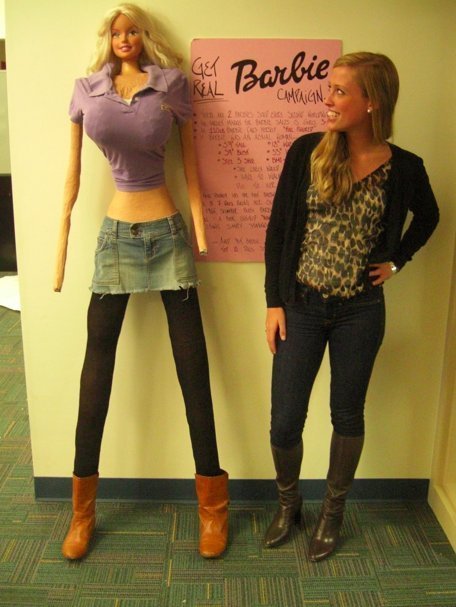
She stands about six feet tall with a 39" bust, 18" waist, and 33" hips. These are the supposed measurements of Barbie if she were a real person. I built her as a part of the first National Eating Disorder Awareness Week (NEDAW) at my high school, later introducing her to Hamilton College during its first NEDAW in 2011.
When I was a little girl, I played with my Barbie in her playhouse, sending her and Ken on dates that always ended with a goodnight kiss. I had fond times with my Barbie, and I admired her perfect blonde locks and slim figure. Barbie represented beauty, perfection and the ideal for young girls around the world. At least, as a seven-year-old, that is what she was to me.
In January 2007, I was looking for a way to make my peers realize the importance of eating disorders and body image issues. I was frustrated after quitting the cheerleading squad, frustrated with pressures to look and act a certain way and most of all frustrated with the eating disorder controlling my life. I wanted to do something that would turn others' apathy into action. That evening, my neighbor and I found two long pieces of wood and started measuring. With a little math, nails and hammering, we built a stick figure that stood about six feet tall.
The chicken wire came next. Surrounding her wooden frame, we created a body that wasn't much thicker than a stick figure, but had the womanly and unattainable curves and proportions that impressionable young girls idealize. We stuffed the chicken wire with newspaper and created a body that creepily leaned against the wall in my neighbor's basement. She now needed some skin, so I brought her back to my apartment and employed the masterful art of papier maché.
Taking stacks of newspaper, glue and water, I skipped my high school semi-formal dance to give my girl some skin. Oddly, I started to feel my fondness for Barbie return, now not as a plaything but as a tool to reveal the negative body image that she promotes. As I papier machéd, I couldn't forget Barbie's impressive bust and blew up balloons over and over again to achieve a perfect 39" measurement. Once her chest was secured, I spent hours dipping and smoothing the paper, and later mixed paints to replicate her seemingly perfect white skin tone. With a little hard work and a lot of time, a headless, footless and handless body soon stood in my apartment.
But it was then I became stumped. I couldn't figure out how to recreate the recognizable face of the Barbie we all know and love. With NEDAW just around the corner, I was panicked. On my way to get office supplies, I drove by a Toys 'R' Us, and that's when it hit me. Remember that Barbie with just shoulders and a head, meant for you to practice brushing her hair? I confidently walked into the toy store for the first time since I was a kid. I found the Barbie head, found a friend to assemble that head, and clothed Barbie for her first debut.
I dressed Barbie in my old clothes. The skirt she still has on today is a reminder of who I once was. That skirt, a size double zero, used to slip off my waist when I was struggling with anorexia. I put it on Barbie to serve as a reminder that the way Barbie looks, the way I once looked, is not healthy and is not "normal," whatever normal might mean. My Barbie's role is simple. She grabs the attention of apathetic onlookers and makes them think and talk about an issue that thrives in silence. In the last four years, Barbie has surpassed my expectations, attracting attention and sparking conversation among listeners and readers across the nation.
Once a year, at the end of February, Barbie comes out of the closet to meet my friends, strangers, and those apathetic onlookers. During NEDAW, she reminds people that eating disorders and body image issues are serious and prevalent. Holding an awareness week in high school or college is just one way to get students to discuss these important issues. However, constant discussion and education is key to dealing with and overcoming eating disorders.
Despite her bizarre appearance, Barbie provides something that many advocacy efforts lack. She reminds of something we once loved, while showing us the absurdity of our obsession with perfection.
More "Get Real, Barbie" statistics:*
•There are two Barbie dolls sold every second in the world.
•The target market for Barbie doll sales is young girls ages 3-12 years of age.
•A girl usually has her first Barbie by age 3, and collects a total of seven dolls during her childhood.
•Over a billion dollars worth of Barbie dolls and accessories were sold in 1993, making this doll big business and one of the top 10 toys sold.
•If Barbie were an actual women, she would be 5'9" tall, have a 39" bust, an 18" waist, 33" hips and a size 3 shoe.
•Barbie calls this a "full figure" and likes her weight at 110 lbs.
•At 5'9" tall and weighing 110 lbs, Barbie would have a BMI of 16.24 and fit the weight criteria for anorexia. She likely would not menstruate.
•If Barbie was a real woman, she'd have to walk on all fours due to her proportions.
•Slumber Party Barbie was introduced in 1965 and came with a bathroom scale permanently set at 110 lbs with a book entitled "How to Lose Weight" with directions inside stating simply "Don't eat."
For more information, call the South Shore Eating Disorders Collaborative at 508-230-1732 or visit the National Eating Disorders Association at www.nationaleatingdisorders.org.
* Source: Body Wars, Margo Maine, Ph.D., Gurze Books, 2000.