iPhone app iPad app Android phone app Android tablet app More

Featuring fresh takes and real-time analysis from HuffPost's signature lineup of contributors
Garrett Johnson

Garrett Johnson

Posted: July 24, 2009 10:28 AM

The Weird Have Turned Pro

What's Your Reaction:

"When the going gets weird, the weird turn pro."
- Hunter S. Thompson

When you live in interesting times it is sometimes hard to distinguish the real news from the fake news. For instance, I read this today.

WASHINGTON--A new report has revealed that when it comes to the important matter of owing large sums of money, Americans display a level of expertise and proficiency unrivaled throughout the world.

The same day I also read this.

The Treasury Department said Thursday that it will sell a record total of $115 billion in new notes next week, more than market participants had expected.

Both articles look like the could be real news, don't they?

The first article was from The Onion, and therefore should be considered "fake". The second article was from the Wall Street Journal, so it should be considered "real"...at least that's the way it should be.

But remember the wise words of Mr. Thompson. Only the Onion article was telling the whole story.

The WSJ mentioned the new debt that was being issued by the Treasury, but failed to mention the enormous mountain of existing debt that was scheduled to be rolled over just next week. Let's see if I can count this up....

70 day CMBs, $30 billion (tomorrow) 13 week Bills, $32 billion (July 27th) 26 week Bills, $31 billion (July 27th) 52 week Bills, $27 billion (July 28th) 2 year Notes, $42 billion (July 28th) 5 year Notes, $39 billion (July 29th) 7 year Notes, $28 billion (July 30th) 19 year, 6 month TIPS (reopened), $6 billion (July 27th)

Almost one quarter of a trillion in a single week.

We've been bombarded with lots of gigantic numbers over the past year, so maybe this number doesn't impress you. It needs to be put into perspective.

For example, this was your wage last year: $42,270

This is the average bonus that Goldman Sachs is giving their employees this year: $700,000

And this is the amount of money the Treasury needs in just one week: $235,000,000,000

Or to put this is another way:
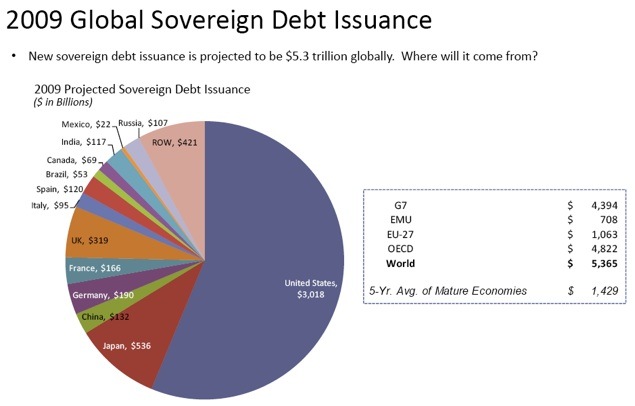

2009-07-24-debtissuance.jpg

Notice how America is borrowing far more money than the entire rest of the world combined. These aren't normal times. The weird have turned pro.

Here There Be Monsters

"The first panacea for a mismanaged nation is inflation of the currency; the second is war. Both bring a temporary prosperity; both bring a permanent ruin. But both are the refuge of political and economic opportunists."
- Ernest Hemingway, "Notes on the Next War: A Serious Topical Letter" , 1935

There are many dangers from borrowing so much money from foreign lenders. The first and most obvious danger is with interest rates.

In a 2003 paper, Thomas Laubach, the US Federal Reserve's senior economist, calculated the impact on long-term interest rates of rising fiscal deficits and soaring national debt. Applying his assumptions to the recent spike in the US fiscal deficit and national debt, long-term interests rates will double from their current 3.5pc.

Considering that this is the Federal Reserve's own prediction, this should be taken seriously. Consider what will happen to the already weak housing market if mortgage rates were to double in the next few years?

Even a single percentage point increase could cost the Treasury an additional $50 Billion a year, and with most of the nation's debt being short-term, it would be felt almost immediately.

It's simply a matter of supply and demand. The more debt that nations issue, without an increase in demand, means the price of that debt falls. In the bond market, price and interest rates are directly inversely related.

The governments of America, Britain, Japan, and elsewhere have tried to compensate for that dearth in demand by monetizing the debt. However, that caused the other supply and demand problem - more money printing without more goods means the value of the currency drops.

In 2009 and 2010, Washington will sell more than $5 trillion in new debt, according to Citigroup. A decade from now, according to the Congressional Budget office, Washington's outstanding debt could equal 82 percent of G.D.P., or just over $17 trillion. ... "It's an exaggeration of course, but it's a little like what happened to the subprime borrowers," Mr. Rogoff said. "People are just assuming the funding will always be there."

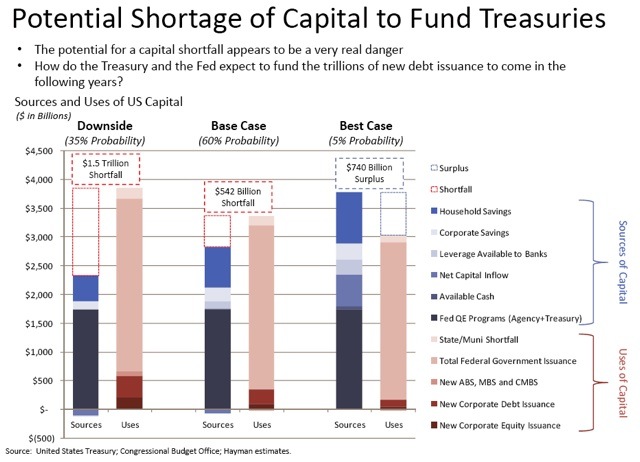
On the demand side of this issue is the simple lack of enough capital in the world. Bill Gross of Pimco had this to say on the matter.

The immediate question is who is going to buy all of this debt? Estimates suggest gross Treasury issuance of up to $3 trillion this calendar year and net offerings close to $2 trillion -- almost four times last year's supply. Prior to 2009, it was enough to count on the recycling of the U.S. trade/current account deficit to fund Treasury borrowing requirements. Now, however, with that amount approximating only $500 billion, it is obvious that the Chinese and other surplus nations cannot fund the deficit even if they were fully on board - which they are not. Someone else has got to write checks for up to $1.5 trillion additional Treasury notes and bonds.
2009-07-24-capitalshortage.jpg

Gross goes onto say that if the governments continue to try and spend our way out of the recession there are only two possible outcomes: 1) an immediate and enormous rise in interest rates, or 2) massive debt monetization by the central banks.

It appears that, because of a lack of clear vision and plan, we are seeing a combination of those two things. No one wants to make the tough choices, thus we will get a little bit of all the possible problems.

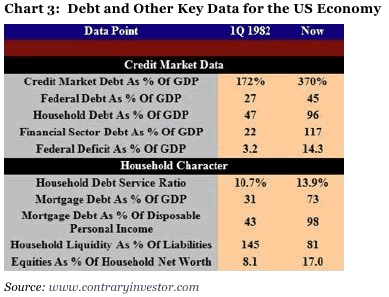
The country was more than 200 years old before America's public debt hit $1 Trillion. It hit $6 Trillion in early 2002, and then $10 Trillion in 2008.
2009-07-24-dollardemand.png

By the end of this year it will climb over $13 Trillion. The CBO estimates nearly $10 Trillion in new debt by 2019. In economics this trend is considered "parabolic", and all things that go parabolic are unsustainable.

2009-07-24-debt1.png

It begs the question - where will the money come from?

Sometimes people ask that question, which is a very good question, but stop there.

An even better question to ask is -- is there enough money?

The IMF, which has repeatedly underestimated the economic crisis, has produced some numbers which are scary in and of themselves.
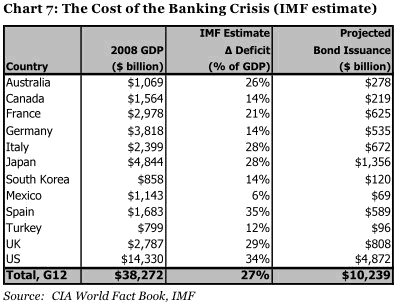
2009-07-24-imfcost.png

Fortunately, Carmen M. Reinhart and Kenneth S. Rogoff have studied dozens of historical examples since 1800 and tried to answer that question by basing it what that history teaches us.
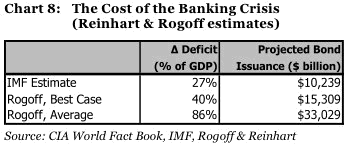
2009-07-24-truecost.png
If you are like me, $33 Trillion is so far above my ability to imagine that they may as well be using another language. That's why it is important to put things into perspective by comparing this number to other asset classes.
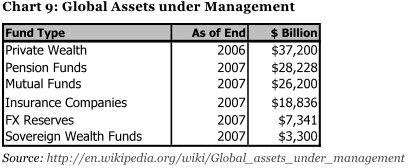
2009-07-24-perspective.png

If you understand the significance of these numbers you have arrived at the "Oh, shit" moment. The amount of money required to bail the world out of the current economic crisis, if this crisis plays out at a historical average, is nearly equal to all the private wealth currently in the world.

To repeat the obvious, this doesn't add up. What about the capital needed to fund the businesses of the world? What about the capital needed for private consumption?

Britain is trying to bail out their economy. The Euro nations are bailing out their economies. So is China and Japan. There isn't enough capital in the world for all these bailouts.

Kyle Bass from the US fund Hayman Advisors said the markets were choking on debt.

"There isn't enough capital in the world to buy the new sovereign issuance required to finance the giant fiscal deficits that countries are so intent on running. There is simply not enough money out there," he said. "If the US loses control of long rates, they will not be able to arrest asset price declines. If they print too much money, they will debase the dollar and cause stagflation.

"The bottom line is that there is no global 'get out of jail free' card for anyone", he said.

The numbers simply don't add up. Everyone can't borrow at the same time. Someone has to lend.

To argue otherwise is to tilt at windmills.

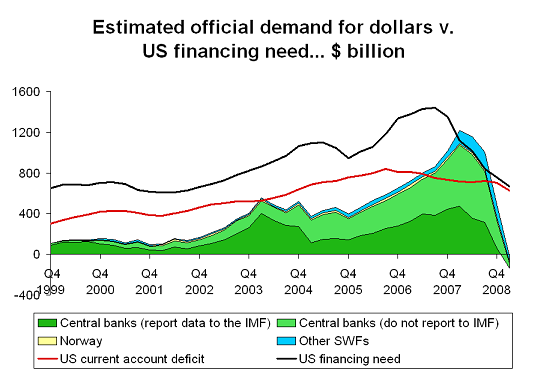
So then the assumption is that China will lend us the money, right?

China isn't happy with our management of their dollar-based assets. Because of that they are cutting back on their lending.
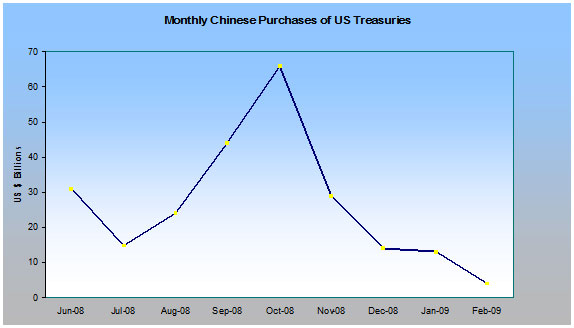

2009-07-24-chinaust.jpg

What about Japan, our second-largest creditor? They've been some of the world's greatest savers for over a generation.

Japan is no longer in a position to bail out America's overspending because Japan is getting old. Unlike young people who save, old people retire to live off their savings.
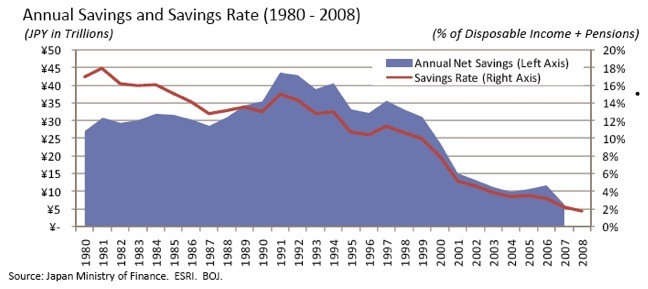
2009-07-24-japansavings.jpg

There is no "what if". The odds of all this deficit spending getting financed at an affordable rate is zero. It's simply not going to happen.

To put it another way, I will refer back to the Onion article.

"Their ability to consume well beyond their means, disregard all signs of approaching financial ruin, and then sit there like a fat duck waiting for solutions to appear is truly remarkable. Few nations achieve such excellence in one singular aspect of life. Bravo, America."

The report concluded that Americans are also second to none when it comes to defaulting on long-overdue loans, be they from individuals, banks, or great and powerful nations that have absolutely no qualms about making others regret their foolish mistakes for generations to come.


  • Comments
  • 22
  • Pending Comments
  • 0
  • View FAQ
Comments are closed for this entry
View All
Recency  | 
Popularity
04:09 PM on 07/27/2009
Money is debt. Of course it would take most of the world's wealth to retire most of the world's debt. That's the way money works. Wealth creation is just a byproduct of debt creation which, in turn, is a byproduct of interest.

The central paradox of financial capitalism is that money represents a promise to repay a debt that can never be repaid. Money promises inflation, and money promises that inflation eventually causes deflation. Money promises the "business cycle".

We need to prevent the need to pay interest on outstanding debt from creating demand for new debt. The government must create debt-free money out of nothing and spend it into the economy at the same rate as interest is owed on outstanding debt.

This doesn't cause inflation, because the banks would have otherwise created the same amount of debt-money to keep the Ponzi scheme humming along. We spend well over $1 trillion per year paying interest on outstanding debt. If this money were introduced as public spending rather than private lending, we wouldn't need taxes to fund the government.
HUFFPOST SUPER USER
Aaror
02:49 PM on 07/27/2009
Ultimatly, we forget what money is:
A means to allocate who gets which goods and services produced, and an incentive to produce goods and services (hopefully efficiently). We can and will print enough money to pay for these bonds, and use it to put people to work, so that we increase the real GDP (actual goods and services produced). Unfortunatly-paradoxically, it will increase the power of those who produce no goods, but get a tax upon our goods though their control of the apparatus we use to allocate goods. The US financial sector takes 20% of everything we make already, wanna bet they can't double it?
02:06 PM on 07/25/2009
CALVINIST CONSTIPATION AND WHAT NOTI


f goverment spending helps people get a job, or pay their rent, three cheers for government spending.
It`s time to throw good, old-fashioned Calvinist constipation out the window. The Soviets got rid of real socialism, Calvinist hypocrites with pockets overflowing with money should lear to get rid of Protestant constipation. Relax, enter the 21st century... finally! Please stop your anti-government scare campaigns. Writers like Garett Johnson are particularly tedious.
06:06 PM on 07/25/2009
I see you didn't understand the article.
This user has chosen to opt out of the Badges program
12:31 PM on 07/25/2009
When you look at these charts, Garrett, you can plainly see that this "money" has lost any and all connection with "reality."

Ultimately, though, "reality" must prevail. These numbers are but a mirror of a systemic problem that by now is rearing up its ugly head everywhere. Our question as a society (worldwide) is simply... how long will we wait to do what we all know must be done? How long will we continue to pray over spreadsheets and to sacrifice our life-blood and livelihood to them? Are we not, if we but determine to be, "wise men and women?" Then... let us be wise.
04:21 PM on 07/25/2009
Money has no intrinsic value, my friend. And neither has any other practically useful exchange agent. That's the whole point of using money... it frees you from having to deal with some physical value scale that has nothing to do with the exchange you are really interested in.
08:04 PM on 07/26/2009
Uh, no. Money had intrinsic value for thousands of years, and worked quite well at it. Intrinsic value was one of Aristotle's Qualities of Good Money.
Money will no intrinsic value is a new concept and has no withstood the test of time. every time it was tried in history it has failed.
photo
HUFFPOST SUPER USER
marinara
11:25 PM on 07/24/2009
"If a nation expects to be ignorant and free, it expects what never was and never will be."
-Thomas Jefferson

Who was also a victim of hyperinflation.
Read
http://books.google.com/books?id=w-IiCowd8_4C&pg=PA59&lpg=PA59&dq=hyperinflation+revolutionary+america&source=bl&ots=n3j1MFqGAz&sig=iJgxnCxnZYAcXIFCA8OYWJEfiBI&hl=en&ei=mnpqStrgE4mwtgelxo3HBQ&sa=X&oi=book_result&ct=result&resnum=1
07:46 PM on 07/24/2009
What the government is essentially demonstrating to us is that money is not real. Debt is not real either. The government is essentially running on debt right now, and if it wasn't there would be no government. In fact, if there was no debt at all there would be no money because there is always more debt than money due to the fact that we borrow money from the Fed instead of just printing it--or even, dare I say, backing our currency with a tangible resource. So while Bush and Cheney were running up the debt for two occupations, they were admitting to all of us that money isn't real, that debt doesn't have to be paid anytime soon if ever. We've been fooled into thinking that we have to work for things, when really, we are just making it up, and there's no end to it. We've been fooled into thinking that there's "not enough money" to cover everyone's heatlhcare when they get sck, that there's "not enough money" to keep people in their homes or to create a sustainable public transit infrastructure. "Not enough money" to make sure that no one goes hungry or homeless if they don't want to. Meanwhile we are arguing about whether the F-22 plane we've never used should still be produced. It's time to either bail out everyone in America or to scrap the whole system and start from zero.
photo
HUFFPOST SUPER USER
marinara
10:52 PM on 07/24/2009
wrong, as the dollar loses value, wages, pensions, and commodities become out of reach for consumers. Look at Zimbabwe. The plutocracy in Zimbabwe has SUV's and imported food, while the the masses are literally starving.
04:23 PM on 07/25/2009
Money is not real, debt, however, is. You need to take a class on basic economics.
06:45 PM on 07/24/2009
"Money, unlike gold or real estate, can be created from nothing."

That's the most important property that makes it useful as money... the other one is that it's incredibly cheap to make money.

Real estate can't move and gold is a mined mineral which you can only mine more of at higher levels of cost... but the cost to mine gold is a significant fraction of it's monetary value, already, which makes it expensive to "manufacture". Moreover, it is very easy to cheat with gold by adding metals of lesser value and nearly impossible to detect when its in circulation. It's a lot harder to do the same thing with money and it's a lot easier to detect the fakes.

:-)
07:34 PM on 07/24/2009
"Moreover, it is very easy to cheat with gold by adding metals of lesser value and nearly impossible to detect when its in circulation. It's a lot harder to do the same thing with money and it's a lot easier to detect the fakes."

I couldn't disagree more.
First of all, it isn't all that hard to detect a gold coin that has been debased - it'll be either lighter, larger, or have a different color. All you need is to have a good coin to compare it to.

Secondly, paper money is relatively easy to counterfeit on many levels. The stuff is everywhere. Just do a Google search.
Also, there is the other, more important problem of paper money - it is being legally debased all the time. It's store of value is being destroyed by official policy. And a currency that isn't a store of value is a very unstable sort of money.
04:18 PM on 07/25/2009
"First of all, it isn't all that hard to detect a gold coin that has been debased - it'll be either lighter, larger, or have a different color."

As a physics student I had a jeweler ask me once if he could measure the purity of his gold at the percent level with some cheap instrument... the only things I could come up with, at that time, would have cost him thousands of dollars. Today I could probably build a device for about $1k... cheaper in mass production. And that would only tell you that it's not pure. It wouldn't tell you what's in it.

You can Google this as much as you like, the quantitative answer is that it's hard to measure the chemical composition of alloys.
04:18 PM on 07/25/2009
"Secondly, paper money is relatively easy to counterfeit on many levels."

That's, at best, true for the US dollar. Try your hands at a Swiss Frank if you like and let us know how that went. The microprint on those is absolutely amazing.

"Also, there is the other, more important problem of paper money - it is being legally debased all the time. It's store of value is being destroyed by official policy. And a currency that isn't a store of value is a very unstable sort of money."

The value of gold can be whatever you want, all the way down to the mining cost, at which point it's utility value would be zero because we wouldn't have any economic activity left beyond the mining of gold. There are billions of tons of it in the oceans of the world and more than that in the Earth's crust. If you feel like wasting the world's energy reserves on extracting it, we can find as much of it as you like.
02:34 PM on 07/24/2009
+

Money, unlike gold or real estate, can be created from nothing.

If they want to keep up appearances, the FED prints it, loans it to the banks, the banks loan it to the Treasury.

If they care not about appearances, the FED just loans it to the Treasury.

There will never be a shortage of money.

Inflation is usually only a risk in nonrecessionary economies.

Therefore they can print all they want for the moment.

The real challenge is to fix the underlying pathologies that are gutting the middle class .

Once the economy starts to grow or inflation starts up, then the FED will not be inclined to print so much.

Until then, happiness is a warm printer.

Hunter S. Thompson was right too.

If you care about short term ways or long term ways to balance the budget:

short term: http://corporatestatesmen.org/images/FAST_2009_NATIONAL_DEBT_SOLUTION.pdf

long term: http://corporatestatesmen.org/images/AUTOBALANCE.pdf

+
photo
HUFFPOST SUPER USER
marinara
11:08 PM on 07/24/2009
The facts are at odds with you. Only a glut in the supply chain and a forced liquidation of small business are pushing prices lower.

If you would just read Garret Johnson's blog you would see that either we face a credit crisis or an inflationary crisis.

Quoting Damaskinos :"Inflation is usually only a risk in nonrecessionary economies.Therefore they can print all they want for the moment."

WE ARE TALKING ABOUT HYPERINFLATION HERE, BY DEFINITION YOU ARE WRONG.
If you look up HYPERINFLATION in the dictionary, you will see it has NOTHING to do with growing economies.

How about an example of 20 episodes of hyperinflation?
http://www.sjsu.edu/faculty/watkins/hyper.htm
11:59 AM on 07/25/2009
Man, that is a scary picture.

Are you that angry?

Hyperinflation is not the risk at the moment. Deflation is the risk.

The moment inflation rears its head, the FED will cut back big time on quantitative easing.

Is that a disney picture?