More

Featuring fresh takes and real-time analysis from HuffPost's signature lineup of contributors
Gary S. Chafetz

Gary S. Chafetz

GET UPDATES FROM Gary S. Chafetz
 

Mubarak's Turn

Posted: 01/30/11 09:44 PM ET

Today, the situation in Egypt is not so dissimilar to that of October 6, 1981 at 1 pm. And Hosni Mubarak, the current Egyptian president (who many view as a U.S.-supported dictator), was literally in the thick of it. Only back then, Mubarak was vice president and Anwar Sadat was president. And back then, Egypt was also teetering on the brink.

At that time, Sadat was the most hated man in the Middle East because he had recently made peace with the "hated, infidel Jews," in return for which Egypt was receiving more than $1 billion in U.S. aid. (Revered by the West, Sadat had just appeared on the cover of Time as "Person of the Year," and had just won the Nobel Peace Prize for signing the Egyptian-Israeli peace treaty, called the Camp David Accords.)

As a result of this reviled peace agreement, Sadat's own prime minister had resigned in protest. All Arab countries had severed diplomatic relations with Egypt. The country had suffered massive food riots. Sadat had jailed about 1,300 opposition politicians. Tourism, an important source of the country's income, was anemic. The standard of living was plummeting. The fundamentalists were ascendant.

And, at that same time, Israel was acting its usual defiant and assertive self. Thanks to the peace deal with Egypt, Israel decided to annex east Jerusalem, seized in the 1967 Six-Day War. Israel was also furiously building settlements in the West Bank, also seized in that war. And finally, it had just bombed Iraq's nuclear facilities.

And like today, the United States, Israel, and Egypt's power elite were having trouble sleeping. They were literally terrified that the catastrophe that had just taken place in Iran might very well take place in Egypt. Two years earlier, Ayatollah Khomeini, an Islamic radical cleric, had toppled the Shah of Iran, a U.S.-supported dictator. Khomeini established a fundamentalist regime, seized the American embassy in Tehran, and held hostage 52 American diplomats for 444 days. By the way, this is the very same regime that today appears hellbent on building nuclear bombs as a deterrent to those held by Israel.

And where did Hosni Mubarak happen to be sitting at 1 p.m. on October 6, 1981? He was seated shoulder-to-shoulder to Anwar Sadat's right at a military parade, celebrating Egypt's "victory" over Israel in the 1973 Yom-Kippur War. (Egypt actually lost the war badly.) Abu Ghazala, the Egyptian defense minister, was seated immediately to Sadat's left. By some amazing coincidence, five ear-piercing Mirage jets just happened to be flying overhead, spewing out the five colors of the Egyptian flag, when four blue-bereted soldiers leapt from a truck pulling a piece of artillery. They immediately started running toward the exact spot where Sadat, Mubarak, and Abu Ghazala were sitting in the reviewing stands. With everyone looking skyward at the jets whose roar drowned out all other sounds, these four soldiers fired their automatic AK-47s and threw grenades and smoke bombs into the crowd, but specifically at Sadat. No one stopped them. The presidential security guard did not fire a single shot until well after one of the soldiers actually reached the five-foot-high granite wall that separated the front row -- where Sadat, Mubarak, and Abu Ghazala were seated a foot away -- from the dusty parade ground.

In this attack, Sadat was assassinated. 39 others were killed and wounded. By an "act of God," Mubarak and Abu Ghazala survived without a scratch. (Abu Ghazala later held up his supposed military cap with a bullet hole in it. Mubarak later proffered a bandaged thumb.)

Were Mubarak and Abu Ghazala co-conspirators -- along with Egyptian military intelligence, the CIA, and Mossad -- in this extraordinarily convenient and brilliantly planned and executed assassination?

Did Mubarak and Abu Ghazala pull Sadat out of harm's way or throw themselves in front of Sadat's body in an attempt to shield him? If they had, presumably they would have been killed or wounded.

But there is one thing we know for sure.

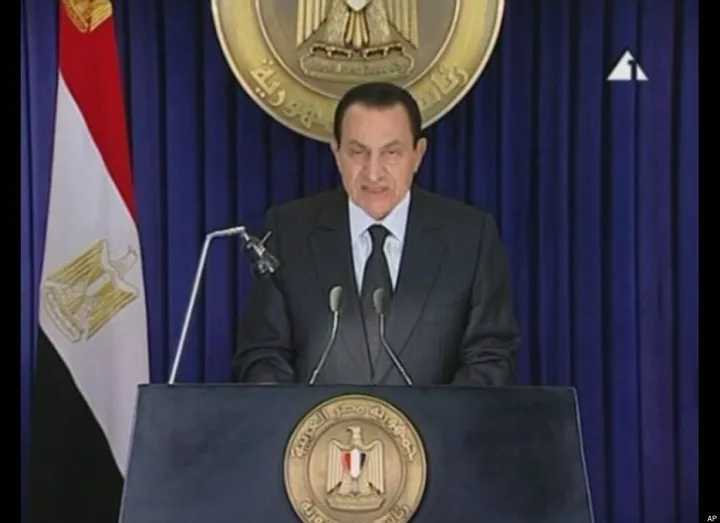
The status quo was saved. A few hours later, Mubarak, now presumptive president, gave a televised speech to the nation and the world, in which he declared that all "charters and treaties," including the Camp David Accords, would be honored.

In other words, Sadat -- the most hated man in the Middle East and the one who was held responsible for Egypt's precariousness, thanks to his having made peace with Israel -- had now been expediently sacrificed for the common good. Within a few years, all the Arab ambassadors were back in Cairo. The tourists were flocking to the Pyramids, the Sphinx, and the Valley of the Kings and Queens. The economy was improving. But most important for the CIA and Mossad, the peace treaty with Israel was still in place. More than $1 billion in annual U.S. aid was (and still is) pouring into Egypt. And the rich and powerful in Egypt were still rich and powerful.

Now, nearly 30 years later, it's Mubarak's turn. Egypt is back on the brink.

This time, however, the ruse of sacrificing the U.S.-supported dictator probably won't work. This time it may be impossible to save the status quo.

And so what happens if Egypt becomes another Iran?

What happens if the most populous nation in the Middle East with the largest army tears up the Camp David Accords? Israel's days may be numbered. If Israel finds itself attacked daily by a barrage of Qassam rockets and swarms of suicide bombers, it will deploy -- after the Holocaust, there is little doubt about this -- its nuclear arsenal.

And if that happens, God save the world, not to mention all the Middle East oil we waste driving alone in our big cars to work.

Gary S. Chafetz, the author of The Perfect Villain: John McCain and the Demonization of Lobbyist Jack Abramoff, led a six-month archaeological expedition, sponsored by Harvard University and the National Geographic Society, to Egypt's Western Desert from 1982-83, that searched for a 50,000-man Persian army -- known as the Lost Army of Cambyses -- destroyed in a sandstorm in 525 B.C.


Today, the situation in Egypt is not so dissimilar to that of October 6, 1981 at 1 pm. And Hosni Mubarak, the current Egyptian president (who many view as a U.S.-supported dictator), was literally in ...
 
 
  • Comments
  • 9
  • Pending Comments
  • 0
  • View FAQ
Comments are closed for this entry
View All
Favorites
Recency  | 
Popularity
09:10 AM on 01/31/2011
"If Israel finds itself attacked daily by a barrage of Qassam rockets and swarms of suicide bombers, it will deploy -- after the Holocaust, there is little doubt about this -- its nuclear arsenal."

...with all due respect, you really cannot expect to type something like that without clarifying quite a few pertinent issues. Such as - who exactly would Israel bomb? Egypt? The subject of the article is Egypt but Egypt and Israel went to war - the suicide bombers and Qassams generally come from militant Palestinians. Who cannot have a nuclear bomb used upon them without the bomb killing or maiming quite a few Israelis as well. This isn't exactly a large area we're discussing. And even if one could (I'm not as up to date as nuclear weapons technology as some) it seems a bit farfetched to presume that Israeli leaders, nutty as one might find them at times, would risk using such dangerous weapons so near to their own people considering the potential long term environmental consequences. Or be deluded enough to believe that after showing themselves to be such dangerous loose cannons as to use nuclear weapons because they are dealing with terror when many other countries have abstained (justly) under much greater pressures and dealing with larger losses that they won't suffer international consequences. And why are you using such extreme doomsday scenarios when nothing has even happened yet? Mubarak was still in power as of your writing of this article!
photo
HUFFPOST BLOGGER
Gary S. Chafetz
11:33 AM on 01/31/2011
Thank you for your comment. First, even U.S. and Israeli government officials have expressed concern that Egypt could become another Iran. Second, Iran--which may be developing nuclear weapons--is not populated by Palestinians, and yet it has called for the destruction of Israel, claiming it does not have a right to exist. Israel's nuclear arsenal would certainly be deployed if Iran were about to launch a nuclear attack against Israel. Qassam rockets (or worse) could be supplied directly by a fundamentalist Egypt to the Palestinians--or Egyptian jihadists could be permitted to fire them directly from the Sinai into Israel. In either case, Israel could view this as justification to go to war. If the onslaught became so unbearable with massive civilian deaths, Israel might have no choice but to flatten Cairo. It is the reason Israel developed nuclear weapons in the first place--the ultimate deterrent. It is the reason--besides oil--that U.S. foreign policy is so invested in finding a peaceful solution in the Middle East. It's the worst-case scenario that American policy has worked so hard to avoid. People--and governments--do not necessarily behave rationally, especially a country like Iran. Finally, Mubarak is still in power, but he may not be much longer. A small militarist group took control of Iran; the same for Afghanistan with the Taliban. It could happen in Egypt. It's what everyone is so worried about. I hope you're right and I'm wrong.
02:53 PM on 01/31/2011
I believe Mubarak will fall. But it's a huge jump to go from Mubarak falling to a government being elected that is going to immediately turn around and start supplying Hamas with Qassams because that assumes a) that certain people will be elected or take power who wil support doing that and b) that even if the people who take power do support arming Hamas, arming Hamas will even be high on their agenda after taking power. Regimes and leaders don't always act rationally and they don't always act predictably. And then it's an even larger leap, to go from that to assuming Israel will suffer such enormous losses of human life that they will use a nuclear weapon or that the new leaders of Egypt will pursue nuclear weapons themselves. Maybe it WILL end up being a nuclear holocaust scenario ten years from now but you seem to be jumping the gun a bit. Using a nuclear weapon on Cairo would call forth such enormous problems for Israel (the pressure Pakistan would be under to respond in kind would be enormous, not to mention that if Saudi Arabia and other Arab and Muslim countries don't respond as devastatingly in response as possible they will almost ensure overthrow by their own populations) so enormous that it is difficult to fathom the kind of situation that would have to develop before any halfway rational Israeli leader would even consider using nuclear weaponry against Egypt.
08:49 PM on 01/31/2011
I am sorry, you are somewhat filled with hubris and that is getting infront of you. You can't have deterrence with undeclared weapons. To the best of my knowledge Israel hasn't announced their weapons. The only reason Israelis have nuclear weapon is to scare the US that in any war if they lose they will use nukes, unless US gives them 100% support in what they want to do, and US has been obliging. I call this a nuclear blackmail, pure and simple.
11:07 PM on 01/30/2011
Logic about Egypt might be like Iran in 1979 doesn't really make sense. Many comentators rightly point out to the fact that the Muslim Bros are not popular enough, the uprising in Egypt is very liberal, and most importantly there is no Khomeini-like figure in Egypt today to lead such a supposed "Islamic state." The idea that the CIA, Mossad and Mubarak conspired to assassinate Sadat while very intriguing, lacks any evidence. Maybe we need a CIA wikileaks to get a better idea about CIA activities.
photo
jwcmass
I dream of things that never were and ask Why not
06:52 AM on 01/31/2011
There was also no CIA sponsored coup which overthrew a democratic regime, as in Iran.
 
To understand the Revolution in Iran, one MUST begin with the 1953 coup.
 
The US may have kept this regime in power, but it didn't put it there.
 
But the last paragraph is a warning. We don't know what a new Egyptian government would do about the Treaty.
 
Certainly Netanyahu should be more concerned about Egypt than Iran.
This user has chosen to opt out of the Badges program
photo
10:47 PM on 01/30/2011
What an exciting read. Thanks.
08:59 AM on 01/31/2011
I agree. Terribly exciting. Somewhat illogical. But exciting.