
Here we go again. And this time it wasn't on purpose, unless you consider that we know it's a strong possibility every time we take in new puppies. We've got parvovirus again. The signs go up in the lobby, the low-cost vaccine clinics for the public get cancelled, and the shelter gets broken up into three levels of quarantine, like we're in the middle of the movie The Hot Zone.
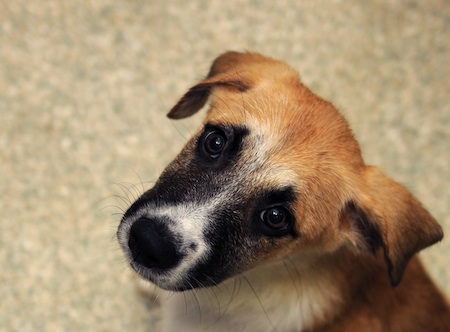
Clayton, one of the West Virginia puppies in isolation with parvo.
This is the hard part of bringing in animals who have "nowhere else to go." Which is more than our motto at the Washington Animal Rescue League; it's an everyday reality. And rescuing puppies. Puppies that act completely nuts (like puppies do) and who look perfectly healthy at the overwhelmed shelters we travel to every week to lend a hand and bring home the animals who have no time left. Truth is, the 42 healthy-looking, energetic puppies we brought back from two separate shelters in West Virginia last week, were already as much as dead at their shelters because the clock had run out. Not because those shelters were bad places and their staff didn't care. Quite the opposite. They were already doing all they could to save an ever-increasing number of animals whom the public has essentially discarded by overbreeding, under-spaying, never neutering, and rarely vaccinating.
And we don't have to go far to run into this. We open our doors to puppies who prance in with their owners from our own neighborhood, or we get them from our partner shelters who also want to save every last one. Unfortunately, it's a never-ending river of homeless, "throw-away" animals. The world -- at least the developed world -- has been well-educated in spaying and neutering and the tragedy of companion animal overpopulation. And vaccines have been around since the turn of the last century. So if it's not ignorance (which it's not), why is it that we still have too many puppies and kittens, and far too many discarded dogs and cats? And why such poor preventive medical practices when the most easily avoidable animal disease, parvovirus, is so rampant in our shelters?
I have a one-word answer: accessibility. Or lack of it. This country -- and the world, too, but let's stick with the U.S. for now -- is critically lacking in accessible veterinary care. And it's not the vets' fault. It costs a fortune to run a practice. And most new vets are in extreme debt to the tune of several hundred thousand by the time they get out of at least eight years of higher education. But if it costs you $100 to get a puppy examined and vaccinated or, heaven forbid, $600-800 if your dog starts vomiting in the middle of the night and you have to go to an emergency hospital, that's very hard -- if not impossible -- for many, many people. And never mind that spaying a dog can cost hundreds of dollars. Again, not your vet's fault. Try doing any of these things (well, not spaying) at a human hospital, and veterinary medicine will seem like the best bargain in the world.
We need accessible veterinary care in this country. Last week, I asked my medical director to come up with a list of veterinary hospitals in the U.S. who offer subsidized or reduced cost services to low-income populations. She found only four. And of those, none of them offered the kind of discounts that we offer here at our shelter. Because they can't. It simply costs too much. But when we look into the faces of our clients who are bringing in the one thing they haven't lost in this exhaustingly tenacious recession, it's clear they can't afford even the 80 percent reduced costs we offer. So how can people do it in rural West Virginia, or bayou Louisiana, or central Missouri? No wonder these shelters are so full. And it's the innocent who suffer -- the puppies and kittens no one ever had space or money for, with diseases that are wholly preventable, except they never got a vaccine. Life is already hard enough for people who are just making it as "working class," never mind the poor or the ill.
The result is all around me as I walk through the shelter, where we have forty pppies quarantined for at least ten days because they've tested positive for parvo. We lost one of them to the disease last week, but we hope we will save the rest, who will go on to wonderful new homes with families who want them and can take care of them. But who is going to save those thousands, ten thousands, millions, all across the country, who will never get that chance unless animal health care is supported, subsidized and prioritized, as it should be in a truly civilized society? For those of us trying to staunch the flow, that question is the toughest pill of all to swallow.