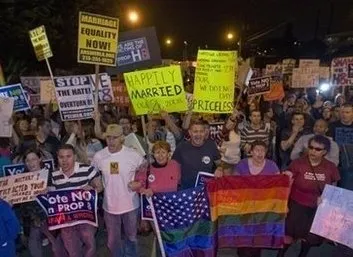
How can a free society reconcile the often competing values of democracy, religious liberty and the separation of church and state? This challenge was vividly illustrated by the recent controversy over California's Proposition 8, which forbade same-sex marriage.
In a democracy, the majority of citizens ordinarily may enact whatever laws they want. Some laws, however, are prohibited by the Constitution. For example, the majority of citizens may want a law denying African-Americans the right to vote or prohibiting Muslims from attending public schools, but such laws violate the Constitution.
Does Proposition 8 violate the Constitution? There are several arguments one might make for this position. One might argue that Proposition 8 discriminates against gays and lesbians in violation of the Equal Protection Clause. One might argue that Proposition 8 unconstitutionally limits the fundamental right to marry. One might argue that Proposition 8 violates the separation of church and state. It is this last argument that interests me.
Laws that violate the separation of church and state usually take one of two forms. Either they discriminate against certain religions ("Jews may not serve as jurors"), or they endorse particular religions ("school children must recite the Lord's Prayer"). Proposition 8 does not violate the principle of separation of church and state in either of these ways. It neither restricts religious freedom nor endorses religious expression.
What it does do, however, is to enact into law a particular religious belief. Indeed, despite invocations of tradition, morality and family values, it seems clear that the only honest explanation for Proposition 8 is religion. This is obvious not only from the extraordinary efforts undertaken by some religious groups to promote Proposition 8, but also from the very striking voting patterns revealed in the exit polls.
Proposition 8 was enacted by a vote of 52% to 48%. Those identifying themselves as Evangelicals, however, supported Proposition 8 by a margin of 81% to 19%, and those who say they attend church services weekly supported Proposition 8 by a vote of 84% to 16%. Non-Christians, by the way, opposed Proposition 8 by a margin 85% to 15% and those who do not attend church regularly opposed Proposition 8 by a vote of 83% to 17%.
What this tells us, quite strikingly, is that Proposition 8 was a highly successful effort of a particular religious group to conscript the power of the state to impose their religious beliefs on their fellow citizens, whether or not those citizens share those beliefs. This is a serious threat to a free society committed to the principle of separation of church and state.
The Framers of the American Constitution knew that throughout human history religious self-righteousness has caused intolerance, discrimination and injustice. They understood that religious self-righteousness is dangerous, divisive and destructive, and that it has led to untold ignorance and misery. It was for that reason that they embedded in our Constitution a fundamental commitment to the separation of church and state.
The Framers were not anti-religion. They understood that religion could help to nurture the public morality necessary to a self-governing society. But religion was to be fundamentally private. It was for the individual. It was not to intrude unduly into the political sphere.
But here's the rub: From a strictly legal perspective, it is next to impossible for courts to enforce the separation of church and state in the context of laws like Proposition 8. When a law does not directly restrict religious activity or expressly endorse religious expression, it is exceedingly difficult for courts to sort out the "real" motivations behind the law. As a consequence, courts are loath to invalidate laws on the ground that they enact a particular religious faith.
This does not end the inquiry, however. Courts also have difficulty in dealing with laws that do not expressly discriminate on the basis of race or religion or gender, but that were motivated by racial, religious or gender prejudice. But we know - as an essential part of our national character - that we as citizens should not support laws because they advance our discriminatory biases about race, religion, and gender. We know that it is un-American for us to enact laws because they implement our prejudices. We know that it is our responsibility to be tolerant, self-critical and introspective about our own values and beliefs and to strive to achieve our highest national aspirations.
The separation of church and state is one of those aspirations. Indeed, regardless of whether courts can intervene in this context, it is as un-American to violate the separation of church and state by using the power of the state to impose our religious beliefs on others as it is to use the power of the state to impose our discriminatory views of race, religion or gender on others.
This is the fundamental point that the religious advocates of Proposition 8 fail to comprehend. Like other citizens, they are free in our society to support laws because they believe those laws serve legitimate ends, including such values as tradition, general conceptions of morality, and family stability. But they are not free - not if they are to act as faithful American citizens - to impose their religious views on others. That is, quite simply, un-American.
This is not to say that individuals cannot attempt to persuade others freely to embrace and to act in accord with their religious beliefs. The First Amendment gives us virtually absolute protection to preach, proselytize and evangelize. But the fundamental point about religious liberty in the United States is that it is private. Christian Evangelicals have every right to try to persuade others to accept and abide by their beliefs. But they have no right - indeed, they violate the very spirit of the American Constitution - when they attempt to conscript the authority of the state to compel those who do not share their religious beliefs to act as if they do.
If a wife-beating, alcoholic, child-beating, mistress-keeping, God-hating, murdering heterosexual man can get married in the USA, then I think I deserve the SAME as him.
He may be pure scum, but he deserves marriage rights. I think I do too.
Just beautifully put. More than anything else, it's an issue of exclusion. You've nailed it.
It's amazing, the extent to which so many are okay with exclusion, so long as THEY aren't the excludees.
You do know you just agreed with gay marriage, right?
Is homosexuality behaviorly equivalent to heterosexuality? If the argument is for "marriage equality," are gay/lesbians also arguing that same sex relationships are equivalent to opposite sex relationships?
People are not equal. Their wants, desires, dreams, problems, abilities and challenges are not equal. Their rights are.
So, to the extent that it's an issue when a law "endorses" a religious view or value, it's not a First Amendment issue. The keep-religion-out-of-everything idea is a modern misreading.
"Only marriage between a man and a woman is valid or
recognized in California."' (Wikipedia)
Where's that religious endorsement exactly?
(As for me, I don't think a constitution should have such rules.)
The 14th amendment clearly states that people are to have "equal protection under the law regardless of race, religion, or creed."
And in case anyone is wondering, sexual orientation falls somewhere under "creed."
This is why Prop 8 is unconstitutional.
When you give people the vote, you can't dictate what can and cannot motivate them.
Having said that, there are some things that shouldn't be subject to whims of public opinion, and minority rights is one of them. That's what constitutions are for, and that's how this issue should be settled.
Exactly.
worked this problem out, that 'couples' are 'married' if they wish and also
'civilly united'. The former is optional (& religious) & the latter is mandatory,
if you want to be 'hitched'. Legal rights, etc., are connected to the civil union.
Anyone more informed care to comment?
definition of the term 'marriage', so a phrase like 'The right of marriage is a
civil issue, not a religious one' is deeply confusing at best. At some point
in US history (centuries before any now alive were married), American
civil authorities *naively* decided that marriage was a religious matter.
Europeans, having experienced a lot more religious strife than us, more
wisely decided otherwise.
The worldwide media attention surrounding the massive grassweb efforts
for g@y rights has been tremendous. Join the Impact was a HUGE success
and will continue to thrive because of your efforts.
NOW, it's time to show America and the world how g@ys love.
A day without g@ys would be tragic because it would be a day without love.
On December 10 the g@y community will take a historic stance against
hatred by donating love to a variety of different causes.
On December 10, you are encouraged not to call in sick to work. You
are encouraged to call in "g@y"-- and donate your time to service!
The Government was established to often enact unpopular laws, that regulate society, like the (55mph) speed limit, or who has the right of way at an intersection, what is driving under the influence. And, so it is with the term MARRIAGE! Since there can be no middle ground between, Straights and Gays, The Church and Gay, then the Goverment must step in and make it clear what the standard of society will in fact be, for the general good of an orderly society.
The Goverment must now DEFINE: What constitutes a marriage, One Man and One Women, Multiple Partnership Marriages One Women with multiple males, One Man with mulitiple Females, What age constitutes the age of legal concent, what is the mental limits to allow marriage. Can Religious Organizations be forced to preform marriages as defined by the STATE. DEFINE: Is there a Right to Marriage, and what is that Right in the respect of the Rites of Religions.
The Gay Community has asked for a Hard Line Answer, but now must be ready for an answer that fits the good of the society as a whole. There will be no middle ground, over MARRIAGE! State Civil Unions could have found middle ground.
People have a right--a duty, in fact--to stand up for their rights and interests. No matter how much you, or people like you, believe people should be punished for challenging the status quo. Our country wouldn't be here if a group of brave souls hadn't challenged the status quo of their day, would it?
This does violate the definition of "property" as it's been defined by the Supreme Court. Property includes the right go marry. (Look up Meyers v. Nebraska.) Therefore, this is the most obvious constitutional argument against Prop 8. And it's a legitimate one.
religion" or the free exercise of religion. 'Marriage' is essentially (if not exclusively) a religious
rite. We are stuck with something of a paradox. It seems that the 1st amendment could mean
that you can't even *define* marriage (because it's religious in nature), let alone 'regulate' it.
something strongly connected to religion. I say this as an atheist
who struggled with the moral 'impossibility' of getting married -
I did it *anyway*. We ought to figure out something else to call it.
POESSLQ, anyone?
We're not "establishing" religion by allowing it to exist within the framework of our culture. And, until the neo-lib movement started up, I'm not sure very many people would have even made such a weird connection.
Religion is part of our culture. So are a lot of other things. None of them threaten the state unless they do something threatening toward it. Such as, for instance, polluting the air for profit. Or using tax dollars to make illegal investments and/or give perks to CEOs. Or concocting bogus wars to put money in the pockets of corrupt contractors. Stuff like that.
While we're focusing on religion as The Big Threat to Democracy, the forces of business and war-for-profit continue to wash the ink from our Constitution.
a particular rule set down by a religion', in this case 'marriage is between
persons of opposite gender', which is prohibited. 'Free exercise' means
permission to enact such a rule, which cannot be prohibited (in effect).
So, therein lies the paradox.
The piece deliberately blurs the distinction between the enacting of a law and the act of voting on it. Two different animals, correct?
The author's weird suggestion that an improper vote can be invalidated re the establishment (or any other) clause ought to send cold, icy chills up and down our spines. What sort of society decides whether or not people voted for the correct reason? The Constitution provides a voting guide that, if violated, can result in the loss of our vote? Sorry, not in my democracy.
Paging George Orwell.
Our federal constitution forbids the making of laws which withhold equal rights.
Seriously, people never seem to want to ask why the state should be involved in marrying people. Figure out what marriage is for - in terms of public policy, not individual gratification - and it will be obvious whether heterosexuality and homosexuality matter. Marriage used to be a woman's career, but now men and women are equal. Marriage used to be about protecting children, but now the law typically says something like children have the same rights whether in or out of wedlock. If marriage is just about a reciprocal legal relationship between the adults, then it's a civil union.
And since when is marriage a right? And since when is an institution that requires *two* people an *individual* right?
The Equal Protection clause mandating that all be treated equally is in the 14th amendment of the Constitution.
Your point is sound, but your sources are off.
Gays and lesbians do have the right to marry--just not someone of the same sex. There are precedents for this restriction (e.g., a man cannot marry his sister). To my knowledge no one has argued that is a violation of civil rights.
Idiot.