
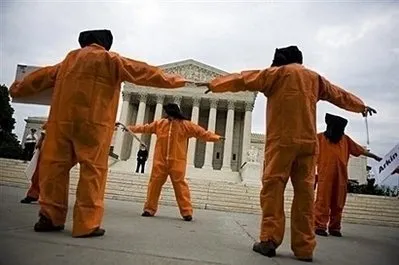
What is it that we Americans stand for? What is it about our nation that makes us most proud? What is it that makes other nations of the world respect and admire and emulate us? It is our unparalleled commitment to personal freedom and to the dignity of the individual. It is captured in our guarantee of freedom of speech, freedom of religion, due process of law, equal protection of the law, and freedom from unreasonable searches and seizures and cruel and unusual punishments. We are the beacon to the world because we aspire to be good and fair and just to one another. That is who we are and who we want to be.
We do not always live up to our aspirations. At times, we have embarrassed ourselves and tarnished our image. We have brutally persecuted dissenters, interned innocent persons, suspended habeas corpus, intrusively investigated innocent individuals and recklessly invaded reasonable expectations of privacy, we have even tortured our fellow human beings. We are a well-meaning but imperfect nation. We strive to be good, but we are only as good as our people, our leaders, and our institutions enable us to be.
Presidents have a wide range of official advisors, each with a designated portfolio. There is a Secretary of Defense, a Secretary of Labor, a Secretary of Energy, a National Security Advisor, and a Domestic Policy Advisor, to name just a few. The next president should create a brand new position, which should become a permanent part of the Executive Branch in the future: a Civil Liberties Advisor.
Certainly, matters of defense, national security, transportation, energy, labor, domestic policy, interior, agriculture, commerce, education, veterans' affairs, the environment, and management and budget are important presidential concerns. But so too is the preservation of our civil liberties. It is past time for the Executive Branch forthrightly to acknowledge this responsibility by ensuring that every administration shall henceforth have within its highest councils a respected public official whose charge it is to ardently and credibly defend our civil liberties against all comers.
Many presidential administrations have included high-level officials who have been strong advocates for civil liberties, even though this was not their explicit job description. Throughout our history, such officials have made a real difference. During World War I, for example, the administration of Woodrow Wilson launched a devastating campaign to squelch dissent. Although the Department of Justice vigorously supported this campaign - prosecuting some two thousand individuals for criticizing Wilson's war policies, several key figures in the Department -- most notably John Lord O'Brian and Alfred Bettman -- effectively moderated the government's campaign of repression.
Some years later, Francis Biddle, who served as Franklin Roosevelt's Attorney General, eloquently championed respect for individual liberties from within the White House. At the outset of World War II, Biddle declared that "every man . . . who cares about freedom must fight" to protect it "for the other man" as well for himself, and pledged that the nation would "not again fall into the disgraceful series of witch hunts which were such a dark chapter in our record of the last war." Biddle vigorously opposed the prosecution of dissenters, the mass detention of enemy aliens, J. Edgar Hoover's effort to authorize unbridled loyalty investigations of American citizens, and the internment of Japanese-Americans. Biddle did not always prevail -- he failed most notably on the issue of internment -- but he made a critical difference in our nation's policies.
A quarter-century later, in the wake of the demonstrations at the 1968 Chicago Democratic Convention, great pressure was brought to bear on President Lyndon Johnson's Attorney General, Ramsey Clark, to prosecute the leaders of the demonstration. Clark refused, concluding that they had done nothing unlawful. A year later, after Richard Nixon appointed John Mitchell as Clark's successor, the government filed conspiracy charges against those who had allegedly planned the protests. Reflecting the change in leadership, Will Wilson, Mitchell's assistant attorney general, observed that the "trouble" with Ramsey Clark was that he was "concerned with the rights of the individual."
There are many other examples. In 1947, President Harry Truman caved to public pressure and political self-interest when he promulgated the federal loyalty program. Three years later, after his inner circle began to include voices more sympathetic to civil liberties, he vetoed the McCarran Internal Security Act of 1950, explaining that the legislation was the product of public hysteria and would lead to "Gestapo witch hunts." (The act was passed over his veto). Thereafter, he boldly confronted Senator Joseph McCarthy, warning that all Americans were in peril "when even one American -- who had done nothing wrong -- is forced by fear to shut his mind and close his mouth."
Too often in our history, presidents have excluded voices supporting civil liberties from their highest councils. In some sense, this is predictable. The preservation of civil liberties usually involves protecting the rights of dissenters, minorities, and outsiders. It is generally politically expedient to look the other way when the liberties of such persons are denied. But as Francis Biddle astutely observed, "every man . . . who cares about freedom must fight" to protect it "for the other man" as well for himself. This is true even of presidents, or at least the good ones.
Administrations that marginalize or silence such voices are bound to err, often grievously. It is a common phenomenon that when like-minded people deliberate among themselves, they are likely to gravitate toward extreme positions. This has been clearly -- and quite painfully -- demonstrated by the Bush administration, which did its best to exclude any trace of support for civil liberties in its march to its secret NSA surveillance program, denying habeas corpus to those detained at Guantanamo, secretly authorizing torture and the use of secret prisons, and the abuses of the Patriot Act. Would all this have happened if some respected senior official within the White House could credibly have said, "No. This is not right. This is not what we Americans do."?
Some may object to the idea of an official Civil Liberties Advisor (or a Council of Civil Liberties Advisors analogous to the Council of Economic Advisors) on the ground that we already have an Attorney General, a Legal Counselor to the President, an Office of Legal Counsel, and a host of other lawyers in the Executive Branch. Moreover, the president himself is often a lawyer, and as with Woodrow Wilson and perhaps Barack Obama, sometimes even an expert in constitutional law. But all of these officials, presidents included, have mixed and often conflicting agendas and responsibilities. None is assigned the specific responsibility of articulating and advancing the cause of civil liberties. As history teaches, this state of affairs has too often failed our nation.
Of course, Civil Liberties Advisors may often lose the debate, or even be shunted aside. But sometimes they will win, and sometimes they will raise consciousness and help frame the discussion. Moreover, an administration without such a voice is much more likely to short-change civil liberties than one with such an advocate. The stakes for our nation are simply too high for us to continue to muddle along without someone in this critical position. Indeed, this idea this might well give rise to a whole new meaning to the notion of Homeland Security.
An abbreviated version on this post appeared as an op-ed in the June 30, 2008 New York Times under the title "How to Put Civil Liberties in the White House."