

The news from the south Pacific is horrific this morning. A major earthquake has struck Indonesia, killing at least 13 people and injuring hundreds more. This news comes on the heels of reports that 111 people are confirmed killed in Samoa, neighboring American Samoa, and Tonga as the result of an earthquake on Tuesday which generated three separate tsunami waves, the largest measuring 5.1 feet from sea level height. Officials in the Pacific region have expressed fears the toll will rise as rescue workers struggle to reach outlying villages in both regions.
I am worried. In February 2008 I was fortunate to meet artists from these countries at a conference on natural disasters organized by the International PEN organization in Tokyo. Of course, it is impossible to communicate with anyone in this region now. So, we pray.
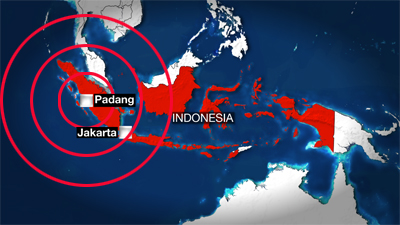
Sky News
The conference on Culture and Natural Disaster was named "Screamed, Survived, Start Anew," and sponsored writers and musicians from around the world. They spent five days presenting their work and discussing human responses to the fury of nature. Every participant at the conference had produced a body of work that speaks to the essence of humanity in the face of the unspeakable.
Novelist Khwaiyun Lukjan of Thailand narrated his description of the tsunami of December 26, 2004, when the Adaman Sea devoured the landscape of Thailand in Phang Nga Province on the island of Phuket. The tsunami surged numerous times as set after set of waves ebbed and flowed a distance of over two kilometers inland. Not a building, not a tree survived.
"When people meet with major catastrophe, we throw away the self-image that has been created to protect ourselves in our regular lives and lay bare the self essence residing in the deepest recesses of our hearts," Lukjan narrated.
"There was only one thing on my mind at the time. To live. No matter what happened I had to overcome it without fail. To survive was the only thing I was thinking about."
He described himself as "a small ant--drifting in a giant sea," and from this perspective the story of the "Stones of the Golden Women" was born.
The title of the work describes a devastated Moken Village, Hin Nang Thong, and the quest of a man (Lin) to find the body of his wife and mother of his child, so that he may put her spirit to rest.
The Moken are known as the "people of the sea, or sea gypsies." Their ancestors arrived in Thailand thousands of years ago from southeastern China, entering the ocean from Indochina. The Moken numbered only 3,000 in the American-dominated tourist areas of Thailand before the tsunami, and their history and culture was literally overrun and ignored. They were truly "an invisible people," in the words of Lukjan.
The Stones of the Golden Women is a place name that describes a wide stretch of coastline where rocks and stones littered the beach and shellfish were once bountiful in the coastal waters--shallow waters that by their very nature gave lift and power to the tsunami. Shellfish are an important food for the Moken, and Moken women inhabited the beach for this reason. No one standing there survived the 2004 tsunami.
Lin's wife, Sonporn, whose name means "wishes come true," left their home on the morning of December 26, 2004 to gather shellfish at the place of the Stones of the Golden Women and never returned. Lin was reduced to bitterness and alcoholism and his relationship with Sonporn's father was destroyed--"violent waves still battering their respective hearts."
Finally, Lin told the narrator that his wife appeared to him in a dream.
"I went to Khao Lak and got lost, and now I can't find my way home," she said.
Lin replied, "She was looking for me to help her. I want to look for my wife. I want to find her body. I want to bring home her bones."
Lin ultimately lost his emotions as well as his will to live. He became like the shellfish clinging to the shores and stones at Stones of the Golden Women. The shellfish were dislodged and upturned during the tsunami and left to die and burn under the South Seas sun--irradiated and demolished.
I came away believing that we are all Moka. The word means "human beings."
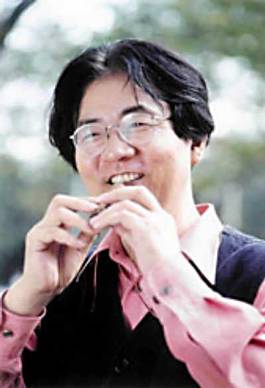
Kurotaro Kurosaka
During the recitation of this story, the pure tones of the "A-bomb hackberry tree" filled the auditorium. So did the heart and soul of the famed Japanese musician and flute-carver Kurotaro Kurosaka. Kurotaro played a kokarina (flute) he carved from the tree that survived the A-Bomb dropped by the United States at Hiroshima.
One kilometer from ground zero, a hackberry tree in the gardens of the Hiroshima Army Hospital was seared by radiation from the blast and half of the tree vaporized. The tree was a favorite of patients at the hospital, who would sit under its sheltering branches as they recovered from the wounds of war and life. The hackberry miraculously survived the vaporous hell and stood as a silent witness to the horror of Hiroshima until 1984, when it suffered a direct hit from a typhoon, produced a few leaves the following spring, and finally died in 1988.
The sound was clear, beautiful, indescribable, but filled with power. It shredded the heart and cut to the soul, and to hear it once is to never, ever, forget it. Bowing, smiling, Kurotaro Kurosaka put the wood of the ancient hackberry to his lips, his unruly shock of hair falling across eyes that were closed, absorbed in the beauty, the moment. His eyes filled with tears, because the release from the beauty, the power-- was required.
The soul of Kurotaro consumed every room he entered, and certainly the concert hall, known as "Space Zero," where the bulk of the P.E.N. presentations unfolded like beautiful, complicated origami.
How many of us have stood ancient and strong in spirit through incredible challenges, only to be felled by an unexpected typhoon of physical or emotional assaults or betrayal? The challenge comes when we pick ourselves up and whittle away to find the core of our existence, shape it, reform our lives and go on to make beautiful music that originates in our core--the soul. Sometimes we can accomplish this on our own, sometimes it takes an angel or two to salvage what is left.
Listen here to the sounds of Kurotaro,'s ancient hackberry, offered as requiem to the South Pacific.
And pray.