
iPhone app iPad app Android phone app Android tablet app More

Giles Slade

Giles Slade

Posted February 13, 2009 | 11:39 AM (EST)

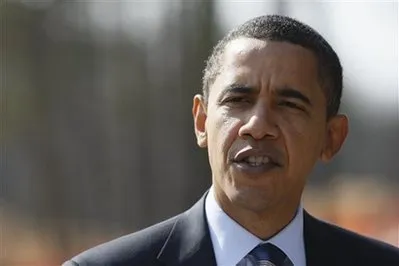
Obama Fends Off Neighbor-Lady's Advances


The President will visit America's largest trading partner on Feb. 19th, but for the five hours he's in Ottawa, he'll barely leave Air Force One.

This is an important diplomatic lesson that Canada had better understand. America's Canadian relationship is vitally important, but Canada's current Prime Minister needs to comprehend that America holds the best cards and will probably agree to very little until Canada's government stabilizes and America's economy is on more solid ground.

Central to these discussions will be the future of oil and gas from Alberta's Tar Sands mega-project which produces 1.3 million barrels of gas daily. Canada's economy depends heavily on supplying America with most of its oil and gas. During the economic downturn American demand has decreased by 1 million barrels per day.

In the New York Times recently, Andrew Nikiforuk, the author of a scathing expose,entitled Tar Sands claimed that declining demand has resulted in "the withdrawal of anywhere from $50 to $100 billion in capital".*

Gleefully sensing a long-awaited moment of weakness, environmental groups across North America are quickly uniting under the slogan 'Dirty Oil vs a Green Economy'. 14 groups including Sierra Club, Toronto's Environmental Defence, and Washington DC's Earthworks are working together in a coalition called Obama2Canada arguing that the moment has come to stop Alberta's environmental devastation which produces more ghg emissions than the whole of New Zealand. Man-made lakes of liquid toxic waste (the Equivalent of 300 Love Canals) now cover 130 sq kmsnear Fort McMurray, Alberta. Among the world's largest dams, these poisonous ponds can be seen from space.

But the author of Tar Sands wonders even if Obama listens to the environmentalists will he be able to refuse Canada's hardline Prime Minister Stephen Harper. Harper -- a George Bush crony, and, like Bush, the son of an oil executive -- rose to power with the support of his native, oil-rich Alberta. Harper needs American oil money to prop up his government. Still, what Harper thinks may no longer be very important. The country has tired of his manipulative brand of realpolitik, and many guess his term in office is finite.

These days, Harper sustains a rickety minority government by adopting liberal policies that are completely foreign to his political nature. An awkward man at the best of times, these painful efforts are like witnessing the public performance of a country musician trying to learn reggae.

The Canadian whose opinions are most likely to interest Barack Obama is Michael Ignatieff**, a former director of Harvard's School of Government, and a close personal friend of Obama insiders Lawrence Summers and Samantha Power. Ignatieff has taken up the reins of Canada's Liberal party. And it is Ignatieff who holds the future of Harper's embattled government in his hands. In addition to their pro-environmental stance, Ignatieff's party traditionally has very little sympathy with anything that makes one region of the country disproportionately rich and powerful to the disadvantage of the rest of Canada.

And yes, throughout North America the time is also right for radical environmental change. We no longer have to worry about losing our prosperity for the sake of the environment. Our prosperity is gone. Let the clean-up begin.

In a telephone interview with the HuffingtonPost.com, Andrew Nikiforuk says it's important to remember that Alberta's bitumen based oil is "dangerous, dirty and dwindling". Nikiforuk says now is the time to focus on a new approach to energy, one that includes smart grids and electric cars...Business as usual is just not going to work.

He may well be right. A good crisis is a terrible thing to waste...

PS a free .pdf download of the entire text of Andrew Nikiforuk's Tar Sands: Dirty Oil and the Future of a Continent will be available on this blog page on March 16th.

*The full NYT interview with Andrew Nikiforuk can be retrieved here.

** A NYT profile of Michael Ignatieff (who contributes regularly to the paper's Sunday Magazine) can be retrieved here

The President will visit America's largest trading partner on Feb. 19th, but for the five hours he's in Ottawa, he'll barely leave Air Force One. This is an important diplomatic lesson that Canada h...
 
 
  • Comments
  • 12
  • Pending Comments
  • 0
  • View FAQ
Comments are closed for this entry
View All
Favorites
Recency  | 
Popularity
03:57 PM on 02/19/2009
CBC.com has a really clear and informative feature about the five top environmental offenses of Alberta's tar sands entitled "Why It's Called Dirty Oil" at the following URL:

http://www.cbc.ca/edmonton/features/dirtyoil/dirtyoil.html

(Although funded by Canada's federal government, CBC news follows the BBC model in delivering objective, responsible journalism that does not tow a government line. Like the New York Times, once in a rare while they get it wrong, but they never intentionally mislead).
12:27 PM on 02/18/2009
Hello again,

I have a brand new blog out today (Feb 18th) in the Living Section of HuffPo entitled

WHY I BLOG

It's here

http://www.huffingtonpost.com/giles-slade/why-i-blog_b_167267.html

Giles
06:30 PM on 02/17/2009
Concerning Canada's Petro-dollar:

A CBC.com article today (Feb 17th) about the declining Canadian dollar entitled 'Loonie loses more than 1 cent' which can be retrieved at

http://www.cbc.ca/money/story/2009/02/17/dollarslip.html

describes the drop in Canadian currencies value in these words:

"The Canadian dollar's fall also coincided with a sharp drop in the price of oil. On the New York Mercantile Exchange, light sweet crude oil for March delivery ended down $2.58 at $34.93 US a barrel.

The Canadian dollar is often viewed as a "petrodollar," meaning its fortunes are closely tied to the prospects for oil."

The use of 'petrodollar' to describe the national currency is not hyperbole, although it is news to many Canadians who have lived in ignorance of Alberta's tar sand development for decades. The unfortunate truth is that recession is about to force Canadians to take their heads out of the sand. This is going to hurt and it will cause a major national political transformation.
01:57 PM on 02/16/2009
What's with the tone? I thought the arrogance of the Bush era was over and done with.
Obama might very well brush off our oily flirtations but the one thing he does need from Canada
is our water. And not just for drinking.
07:20 PM on 02/13/2009
If you are an American reading this article you probably do not understand our Canadian history and hence why this article is completely off-base so please help me explain where this article is wrong.

1) Harper's father was an accountant for Imperial Oil, not an executive.

2) Canada's economy is extremely diverse with a strong (previously) manufacturing sector in Ontario and Quebec, oil in Newfoundland (east) and Alberta (west), agricultural industries in Saskatchewan, forestry in British Columbia, and minerals/raw materials across the board.

3) America is far more dependent on Canadian oil than the author indicates, Canada is the number one foreign source of oil for the USA.

4) The recent instability arose when the opposition Liberals formed a 'coalition' with a separatist party (imagine that happening in the USA), which provoked such a horrible backlash from the public that the Liberal leader was forced to step down and was replaced by Ignatieff (who was widely seen as having disagreed with the coalition).

5) The Liberals have supported regional disparities when it serves their political purpose. The Liberals opposed moves to provide equal representation across the country which led the the weird situation where a 'seat' in PEI (a Liberal stronghold) represents perhaps 30 000 constituents but a 'seat' from Alberta (a Conservative stronghold) represents perhaps 100 000 constituents. It was the Conservatives that actually took measures to correct this. Moreover, the Liberals were largely seen as favouring Ontario, which spawned the western based 'Reform' party.
10:45 AM on 02/14/2009
Once again, at the risk of boring my American readership, let me just take issue with your point # 3.

Canada WAS America's major source of oil. However will it continue to be. America's demand for oil has decreased by 1 million barrels per day, so does it really need the 1.3 million barrels that the tar sands produce? That's the issue, here.

Furthermore, Canada's economy is based on the petrodollars that derive from Alberta's tar sands not from the 'strong manufacturing base' (in god's name what do they produce, American owned cars which noone is buying?) of Ontario and Quebec
02:14 PM on 02/17/2009
First of all, do you believe that US leadership would rather rely on Saudi and Venezuelan oil rather than Canadian oil? Do you think its even that practical to rely on those nations rather than Canada? If there is a decrease in demand for US oil it is more likely to cut back on sources of oil from nations outside of NAFTA rather than inside it. But go ahead and wait till the numbers come out for this year.

Secondly, yes, we produce US car parts, steel that's used in American cars and construction work, we also produce airplanes (the one that recently crashed was Canada-made), paper, etc..

Furthermore, your comment about the Canadian economy being based on Albertan petrodollars is hyperbole. Shall I also state that the US economy is based on the Texas oil? Of course not. If that were true then we'd see every province except Alberta being poor and begging Alberta for money. This hasn't been the case, it has only been in recent years with the decline of the US automotive industry that Ontario has experienced serious economic trouble. British Columbia, returned to fiscal sanity on the back of an economy strongly based on raw materials like wood. Saskatchewan has experienced a boom from other raw materials like potash.
02:49 PM on 02/17/2009
Just to emphasize my point, I look up some data from 2006. The two biggest general items were the following:

Petroleum products and plastics exports to the USA accounted for ~$70 billion.

Car parts, completed cars, car engines, and such accounted for ~$70 billion.

Other items accounted for the other ~$160 billion dollars worth of exports we made to the USA, including aluminum, nickel, copper, zinc, uranium, lumber, telecommunications, pharmaceuticals, etc..
HUFFPOST SUPER USER
Yticilef
04:07 PM on 02/13/2009
That's a great article. I think that the time is now for Canada and the US to work on becoming energy self-sufficient together - but not at the expense of the environment.
I've always felt that Harper is a sort of impostor who got into power because of the circumstances, and not because he was the man for the job. His juvenile, bullying style, the way that he treated Stephane Dion especially over Dion's "Green Budget", really turned me off. I live in Alberta, and I'll be happy to see him leave the PMO's office.

He's not native to Alberta though - he was born and grew up in Ontario, and his father I believe was an accountant for Imperial Oil, not an executive.
He moved to Alberta to work, and then continued on with studies that he had left in Ontario - eventually getting his Masters in Economics from the University of Calgary.
03:17 PM on 02/14/2009
Excellent comments, Yticlef. I tried to respond to you yesterday but somehow it didn't post.

You do very well to keep me honest. Stephen Harper's father was an account executive for an oil company, Standard Oil, I think. He worked for the same company and was born, as you have it in Ontario, not Alberta, but moved there later.

In addition, I like your characterization of his "juvenile, bullying style" and I've been waiting for the rest of Canada to tire of this too. I fits perfectly with a country weened on hockey, but is an unfortunate attribute in a politician. I think we pay our pols too little and so we rarely attract good talent.

Thanks again. Giles