
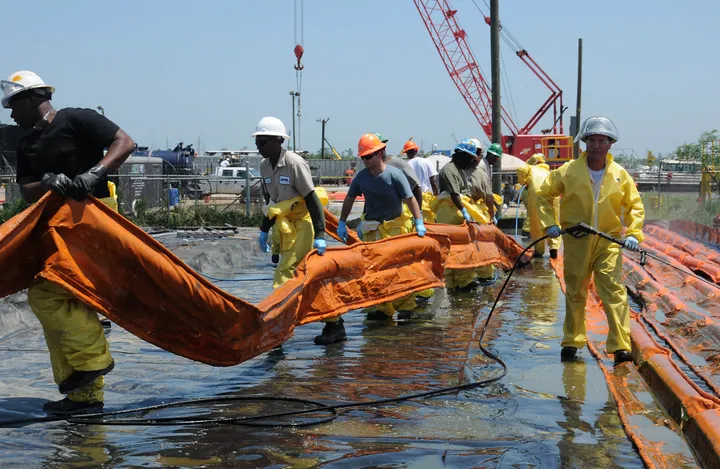

Oil spill clean-up brings workers and volunteers into close contact with chemicals that are known to be hazardous to human health. As we deal with the oil spill in the Gulf, it helps to brush up on history.
After the Exxon Valdez disaster, the National Institute for Occupational Safety and Health (NIOSH) reported an increase in respiratory symptoms, headaches, throat and eye irritation, rashes and other skin problems among the clean-up workers. More recently, a study of beach clean-up workers and volunteers in Spain after a 2002 oil spill found an increase in DNA damage. The long-term significance of this finding is not yet known. In Alaska, a mental health study of residents one year after the spill found that exposed individuals were more likely to suffer from anxiety, post traumatic stress disorder (PTSD) and depression.
Here's a summary of some of the scientific studies of the health effects to workers, volunteers, and local residents associated with five previous oil spills:
Exxon Valdez (1989)
- According to NIOSH there were 1,811 compenstation claims filed by people involved with the spill. Claims were related to cuts, sprains, contusions, respiratory problems, and dermatitis.
- 599 local residents were surveyed one year after the spill. They found that exposed individuals were 3.6 more likely to have anxiety disorder, 2.9 times more likely to have post-traumatic stress disorder, and 2.1 times more likely to be depressed.
The Braer oil spill (1993)
- People living in a 5 kilometer radius 1 to 2 weeks after the oil spill had a high prevalence of headache, throat irritation, dermatitis, and itchy eyes. One week after the accident, 97% of symptoms were resolved. No differences were found in the lung function, blood, or urine tests.
- Another study quantified DNA adducts and other genetic abnormalities in local residents after the accident. There was found to be no difference in the control and exposed group.
The Sea Empress oil spill (1996)
- There was an association between exposure to the spill and headaches, sore eyes, and sore throats.
- Environmental levels of hydrocarbons, suspended particles, and sulfur were below accepted occupational limits. Twenty days after the spill, 282 residents were interviewed about their work with the spill, exposure to fuel oil, and health; urine samples were also taken. Symptoms that were reported included back and leg pain, headache, itchy eyes, and irritated throat. There was a positive correlation between the number and duration of symptoms and the number of days worked on the accident.
The Erika oil spill (1999)
- Information was collected from 1465 people who participated in the cleanup activities. The most common symptoms that were reported were back pain, headache, and dermatitis.
The Prestige oil spill (2002)
- A study of paid and volunteer workers in a highly polluted area five days after the accident reported headache, back pain, dizziness, dermatitis, respiratory problems, irritated eyes and throat. This study also investigated genetic toxicity in volunteers, paid beach cleaners, and paid hose operators. There was an increase in DNA damage in all three groups; however, more was observed in the volunteers working on the beaches. The type of DNA damage that was observed can be repaired by the body.
- Toxic effects were observed more frequently among workers working more than 20 days in highly polluted areas, performing 3 or more tasks, having skin contact with oil, or eating while in contact with oil.
- Throat and respiratory problems were most frequent in seaman and workers who had worked more than 20 days in highly polluted areas.
These studies show that workers and local residents can suffer from health effects after oil spills. The main symptoms are acute headaches, dizziness, skin rashes, irritation of the eyes and throat, and breathing problems. Genetic abnormalities (which are potentially repairable) were also found in some studies but not others. One study reported mental health effects in local residents. These are the health issues we should be watching out for - and protecting against - in the Gulf Coast during the current oil disaster.
The review in this blog comes primarily from a study by Rodriguez-Trigo, et al. Arch Bronconeumology 2007; Vol 43(11): Pages 628-35.
This post originally appeared on NRDC's Switchboard blog.