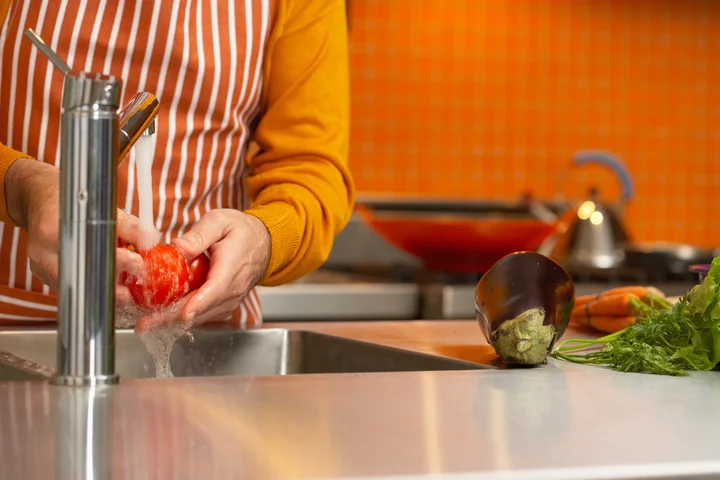
I am a practical vegetarian. In a world where vegetarians are already a marginalized, and fringe groups are further sub-categorized into vegans, pescatarians, raw foodies, lacto-ovo vegetarian, etc, I have invented a new category and introduced it into the urban dictionary.
A Practical Vegetarian is someone who almost always eats plant-based food when that choice is available. And when that choice is not available she is open to eating whatever food is indeed available and does so with gratitude. The difference between being a strict vegetarian versus a practical vegetarian is the world of difference between easily following a kind diet and struggling to stick to a strict regimen.
Strangely, when growing up in India, where it was easy to be a vegetarian, I was a meat eater; and now while living in the U.S. where it is easy not to be a vegetarian I have chosen to be a practical vegetarian. Part of the reason is that it took time and a shifting of consciousness to really understand the virtues of eating mostly plant-based food. And I must confess that Alicia Silverstone's talk at Google (where I work) on her book The Kind Diet was a tipping point. As Gabriel Garcia Marquez wrote in his book, One Hundred Years of Solitude, "Wisdom comes to us when it is of little use."
It was easy to embrace the virtues of vegetarianism. Some readers are part of the yoga, consciousness community and are all too familiar with it and do not need repetition. But the needs of being a global citizen, a professional in the tech industry with a passion for travel, a homeless, rootless, global nomad of sorts, has meant that I have had to adapt or die. The last few years have taken me to 44 different countries as far apart as Iceland, Mongolia and Bahrain. In Mongolia, outside of the capital Ulan Bator, boiled mutton was the only item on any menu in any restaurant. In Buenos Aires, my business school classmate laid out the most delicious food he had lovingly prepared to make up for the 10 years we had not seen each other -- Empanadas stuffed with minced beef. And on the long-haul United flight, returning from a day of meetings in New York, when the attendant came to the last row where I sat hungry and tired, all she could offer me was a Turkey sandwich.
And so it is that I have adapted to survive. I eat only plant-based food when I have the choice in front of me. And I gratefully eat whatever is in front of me when I don't have the choice. Here are my five tips for being a practical vegetarian:
Eat plant-based food as much as you can when you have the choice. And eat them as close to their natural state as possible. If you can point to something on your plate and see that it is a carrot or aubergine or a bean that is excellent. And if it is not cooked or processed in any way and even closer to its natural state you are in dietary heaven.
The more colorful your plate the better. Nature has done a pretty good job in building the right signals into us. A plate that is exploding in naturally occurring greens and red and pink and purple is visually appealing. But it is also likely a healthy plate with a balanced set of nutrients you need.
Choose and eat mindfully, consciously. Put things on your plate mindfully. Be conscious of what plants, fruits and vegetables you are putting on your plate. Be conscious of how much or how little you need to feed you body and your taste buds. And eat mindfully too. Be aware of the taste, texture, smells of the food you eat. Be conscious of the natural goodness and life energy that is packed into the crunchy lettuce, juicy carrot and sweet grape you are eating.
Eat with an attitude of gratitude. The simple truth is that for each plate of food in front of me there were about 60 people involved that I will never meet. The person who planted the crop, fertilized the field, picked the crop, transported it, chopped it, cooked it. And most of the them were toiling away in jobs less comfortable than mine and doing jobs I am incapable of. I don't know about you, but without these people and their skills I may actually starve to death, unable to grow my own food. I try to remember this and eat with a sense of gratitude.
Be practical. Don't beat yourself up. Having said all this I also recognize the fact that the dietary choice of others in this world may be different and that is where the practical aspect comes in. If I don't have a choice of plant-based food then I am OK with eating animal products. In my book being vegetarian 96 percent of the time is good enough. It makes my life easier. It make my host's life easier. And it makes it easy to travel to Arusha, Papete, Liberia, Koh Samui, Banjul, Tiruchirapalli, Gdansk, Karahnjukar ...
During the day, Gopi Kallayil works as a marketer at Google where the chefs in Google's famed cafes lovingly lay out a wonderful spread of plant-based food to choose from. These are carefully selected, organically grown, often from farms within 150 miles of the campus and sometimes even grown on the Google campus. He is grateful for their devotion to their craft. He teaches yoga, travels the world, speaks, writes, sings, lives freely and joyously. At other times he espouses radical ideas like eating plant-based food and can be a general threat to orderly, civil society. His blog, tweets and website live at www.kallayil.com.