
iPhone app iPad app Android phone app Android tablet app More

Featuring fresh takes and real-time analysis from HuffPost's signature lineup of contributors
Gordon Brown

GET UPDATES FROM Gordon Brown
 

Education Without Borders

Posted: 04/17/2012 7:00 pm

Every child has a right to an education. Yet millions of children are living in countries where that right is systematically violated as a result of armed conflict. It is time for the international community to stop this state of affairs by getting serious about its responsibility to protect education in all countries, irrespective of the barriers created by armed conflict.

Education seldom figures in media reporting from conflict zones. Yet the effects are devastating. In eastern Democratic Republic of Congo, where the education system has collapsed in the face of mass displacement and ongoing violence, over 1 million children are out of school. When the surge in refugees driven from Somalia by hunger and violence arrived in camps in northern Kenya last year there was no provision made for additional education. And the conflict in Yemen has pushed tens of thousands of children out of school.

Apart from violating the rights of children, failure to protect the right to education fuels the cycle of violence. One of the greatest fears of Somali mothers in the refugee camps of northern Kenya is that limited opportunities for schooling will draw their children into the ranks of al-Shabaab. You hear the same concerns among refugees from Darfur in the camps of eastern Chad.

Parents living in conflict zones make extraordinary efforts to keep alive the hope that comes with education. Sadly, the same cannot be said of the international community. Currently less than 2 per cent of humanitarian aid is dedicated to education. And it is not just a case of too little aid arriving too late. Agencies trying to provide education in conflict zones have to secure their funding through unpredictable annual appeals processes, where money tends to follow the most recent wave of media interest -- and where children living in long-running conflicts are seen as yesterday's news.
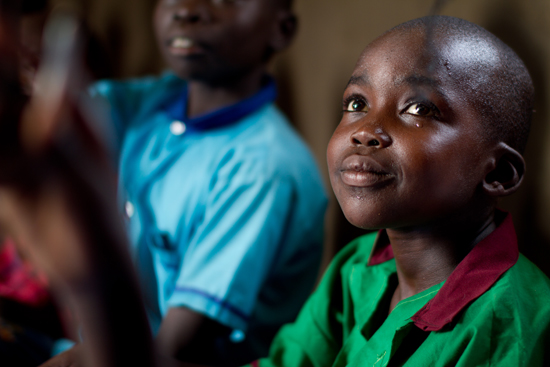
2012-04-17-juba25.jpg
A boy listens to his teacher during a lesson at the improvised Hai Kugi School on the outskirts of Juba, South Sudan. © UNESCO /M. Hofer (2011)


South Sudan is the latest country to demonstrate the inadequacy of the current aid architecture for education. In 2005, when a peace agreement ended a brutal 21-year civil war, hopes for a better future were running high. Seven years on, much has been achieved. More than half a million children have entered education for the first time. Child death rates have fallen by 20 per cent. There have also been improvements in immunization, nutrition and access to clean water.

Yet despite the progress that has been made, over 80 percent of South Sudan's population lives on less than $1.25 a day. The country has the highest maternal mortality rate in the world. Half of primary school age children are out of school, and just 400 girls make it through to the last grade of secondary school. In fact, girls are more likely to die in childbirth than they are to make it through primary school.

With tensions running high, it is now critical that both sides in Sudan draw back from the brink of conflict and resolve their differences. But South Sudan also needs support for reconstruction. As an all-party committee of the United Kingdom's parliament noted in a report this week, if South Sudan is to develop as a prosperous peaceful nation "it will need to invest in health, education and infrastructure." Nowhere is this more evident than in schooling. South Sudan's parents have demonstrated extraordinary resolve, innovation and ambition in attempting to get their children into school. Their efforts are inspiring and humbling in equal measure. Schools for their children was the most important demand of parents crossing as refugees from the old Sudan into the new South Sudanese state. Unfortunately, the same cannot be said of the international aid community.

Since the peace agreement, aid for education has arrived in an uncoordinated trickle. The Global Partnership for Education, which operates under the financial auspices of the World Bank, has yet to put a program in place. Most bilateral donors are operating on a small scale. To make matters worse, there is now talk of cutting back on long-term development assistance and transferring aid into short-term humanitarian budgets.

This is the last thing that South Sudan needs -- and there is an alternative. In a report published today, I set out the case for an 'education catch-up' plan aimed at extending learning opportunities for 2.5 million children by the end of 2015. The cost: around $400m annually over the next four years. Around half of this amount could be co-financed by the World Bank and the Global Partnership for Education (GPE) -- and the IMF-World Bank Spring meeting in Washington DC this week-end provides an opportunity to set the wheels in motion.

Some people will doubtless argue that getting all of South Sudan's children into school in the current climate is 'unrealistic' and that we should wait until the threat of war has receded.

But where is the 'realism' in denying a whole generation of children the chance of an education that could transform their lives? And why waste an opportunity to build an education system that could spur growth, create jobs, and nurture the attitudes on which a peaceful future depends?

When it comes to education, there should be no borders -- only rights. Organisations like the Red Cross and Medicine Sans Frontieres do not recognise borders in the provision of health care. Yet when it comes to education, the international community's commitment to the rights of children is weakest in precisely those conflict-affected states where support is most urgently needed. That is why I have been calling for the creation of a new type of initiative -- Education without Borders -- that will work to support and deliver education for children trapped-in conflict zones, and for those forced to flee their homes as displaced people and refugees.

We need to stop viewing education as part of the collateral damage that comes with conflict. We know that education gives children their best hope of escaping poverty. And we know that education -- especially of young girls -- can act as a catalyst for progress in other areas, such as nutrition, child survival and combating infectious diseases. For children trapped in conflict, education can help to create a sense of normality and keep alive the hope of a better future.

Never again should the right of a child to education depend on boundaries set by geography or conflict.

These children need our help -- and they need it now.

To learn more about the campaign to get 1 million children in South Sudan in school, please visit The Office of Gordon and Sarah Brown.

 
FOLLOW EDUCATION
Every child has a right to an education. Yet millions of children are living in countries where that right is systematically violated as a result of armed conflict. It is time for the international co...
 
 
  • Comments
  • 84
  • Pending Comments
  • 0
  • View FAQ
Comments are closed for this entry
View All
Favorites
Recency  | 
Popularity
Page: 1 2 3 4  Next ›  Last »  (4 total)
01:32 AM on 04/22/2012
After stuffing up our education, now he wants to start on some other poor beggers.
11:46 AM on 04/20/2012
"Yet millions of children are living in countries where that right [education] is systematically violated as a result of armed conflict.":

Remove the word "armed" and replace it with "ideological" and you have America!
HUFFPOST SUPER USER
kathy smelser
12:14 PM on 04/19/2012
we have yet to solve the problem of school violence in this country .....so how is it we have so many answers for schools in other countries ?
photo
Gupdiver
We are in a period of Ineptocracy!
11:07 PM on 04/18/2012
He should have said all children deserve to be educated, having the right is dependent on numerous things with the first being a free democratic society and publicly elected government which in most of the countries he refers to these prnciples does not exist in.
06:41 AM on 04/19/2012
Yes indeed& indeed YES
10:21 PM on 04/18/2012
Gordon Brown,
What about the Madeleine the daughter of your friends the McCanns - didn't she have the right to an education? So why were you so insistent in helping her parents in their alleged cover up of her possible death in Portugal? Madeleine McCann deserves justice.
09:31 PM on 04/18/2012
Where was this bleeding heart concern for the children of war zones when Iraq was invaded in 2003? L. Paul Bremer III was anxious to dismantle the public school system there; were the children even offered private school vouchers, or simply illiteracy?
HUFFPOST SUPER USER
ftkl1234
05:30 PM on 04/18/2012
Oligarchic states will always keep their peoples uneducated because educated people can cause a lot of discontent. With basic human needs like homes, sanitary health conditions, and clean water not addressed, education will not be seen as a priority, would it? Poor folks need the kids to be working and earning, not studying, traditionallly.
07:29 PM on 04/18/2012
But at the same time, the only way to effectively break a poverty cycle is through education as it provides a society that is capable of developing things like homes, sanitary health conditions and clean water for their own people.
04:49 PM on 04/18/2012
Wrong. Nobody has a right to an education.
photo
HUFFPOST SUPER USER
Philip J Sparrow
When your work speaks for itself, keep quiet
05:06 PM on 04/18/2012
Then what does anyone have a right to? And how many of them could be fully exercised and realised without an education?
photo
HUFFPOST SUPER USER
E Fowler
Confusing Liberals with Facts and Logic
05:15 PM on 04/18/2012
Exactly. People confuse rights and privileges. Education is a privilege, not a right.
01:30 AM on 04/22/2012
No,it is a right.
photo
BigBearcatBill
This is the real Bearcat - a Binturong
04:15 PM on 04/18/2012
Well we should have enough people available to educate the world, our business guys and engineers have made the factories and mass production so much more efficient that we can make several more times the amount of products per worker employed in any factory than just a couple decades ago....so what is everyone going to do that got laid off by the robot/computer age? Just having them deliver pizzas and work in coffee shops is not the best option.
Ana4
neutrino alert, just passing through
03:40 PM on 04/18/2012
Indeed, these and millions of other children worldwide need safety, stability, food and shelter, and yes--educational opportunities. Better education eventually leads to a decrease in population which the entire planet needs to accomplish. These and all children need an end to our imperialistic culture of war and the collateral damage caused by displacement and poverty, ongoing for decades in Africa in particular. Only then can stability, health and education take root.
photo
JeanVA
Wolves - the mother of all dog-kind.
03:37 PM on 04/18/2012
Next thing you liberal elitists will be saying is that every child deserves clean water, enough food and - aghast - medical care!
This user has chosen to opt out of the Badges program
03:13 PM on 04/18/2012
Education is the key to freedom.
02:32 PM on 04/18/2012
Not one individual has any right than to fulfil our obligation to love our Creator with all our heart, soul, and body; and our neighbour as ourselves. However, central to be able to do this is through education. Education should be free of charge up to the moment an individual joins the workforce. For your information Google “The World Monetary Order”.
01:49 PM on 04/18/2012
It is such a coincidence that all of a sudden the entire Western World is so concerned with all the poor people in Africa. The African continent has been impoverished for thousands of years, when the West was doing well economically, we would simply send aid to the warlords and increase their power by making the people come to them for help. Now that more and more petroleum and mineral resources are being found in Africa, leaders in the West are suddenly calling for a more direct form of "help". The people in the media are educated people, can it really be believed that they do not see this? From the KONY fiasco, to committing special ops units to Africa under UN control, to gaining a foothold in Egypt and Libya, do they really expect us to believe that all this is coincidence or done out of the goodness of their hearts?
01:30 PM on 04/18/2012
Yes, and in the USA there are still too many children who go without a proper education, without proper healthcare, in abusive situations, or forced into prostitution in neighborhoods close to home. We pay so little attention to the rights of children suffering right under our noses, in our own countries; countries that supposedly promise equality of opportunity for all. In the USA children are treated as a possession of their parents and are only 'cared about' once things for them have gone terribly wrong. The parents rights are respected, but not those of the child until it is too late. Yes, Mr Brown, and in the UK as well.