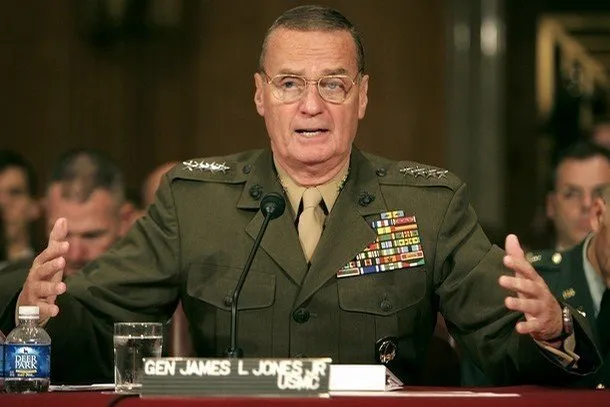
As we all saw on the morning of December 1, President-elect Barack Obama has clearly assembled a compelling national security team. As secretary of state, Hillary Clinton has the potential to be a highly effective and respected global diplomat. As secretary of defense, Robert Gates will provide excellent judgment and continuity, along with valuable political cover to a new Democratic commander-in-chief. But perhaps the most astute choice is General James L. Jones, the former commandant of the Marine Corps and Supreme Allied Commander of NATO forces in Europe, as national security adviser. It may prove to be one of the most critical decisions of his presidency.
Conceived first in the Eisenhower administration, the position of national security adviser was revolutionized by McGeorge Bundy, the brilliant forty-one-year-old dean of the Harvard faculty who was tapped by President John F. Kennedy to serve as the central coordinating agent for foreign and military policy in the White House. Following the disastrous Bay of Pigs invasion in April 1961, Kennedy mandated Bundy to centralize communications and decision making for national security in the West Wing, where the president (rather than any of his cabinet secretaries) would exercise ultimate authority for American global strategy and the crucially important decisions about intervention and the use of force. Acting as an independent counselor on behalf of the commander-in-chief, the national security adviser was conceived to be an honest broker of debates among the departments, an analyst of competing options and risks, and an adjudicator of proposed policies. Most essentially, Kennedy relied on his national security adviser to protect him from flawed military proposals that could trigger a superpower conflict at the most dangerous moment of the nuclear era.
With some variation over the decades, this remains the function of the national security adviser today. The counselor who holds that position must be an advocate -- not for any given policy or proposal but for the president's capacity to make informed, dispassionate, and rigorously analytical decisions, often in situations where there is dissent among different advisers and their bureaucracies. Over the years there have been two primary models for who should execute this responsibility. One is the academic and foreign policy intellectual with experience in the university and think tank world. The other is the military affairs expert, a former high-ranking officer from the armed services with direct experience preparing for and managing combat operations.
McGeorge Bundy was emblematic of the first model. He was a foreign policy intellectual -- a historian, conceptualizer, and grand strategist -- who upon assuming power discovered that his most daunting challenges involved military crises: the fiasco at the Bay of Pigs (Bundy supported the fanciful CIA plot to overthrow Fidel Castro with a clearly outmatched exile force of 1,300 soldiers); the threat of nuclear war in the Cuban missile crisis (Bundy's support for air strikes to remove the missiles was overruled by Kennedy in favor of a naval quarantine and negotiations); and intervention in South Vietnam (Bundy recommended the deployment of the first ground combat troops to Saigon in 1961, a proposal Kennedy rejected).
Of his successors, the most comparable to Bundy as a foreign policy intellectual is Condoleezza Rice, the former Stanford University professor and provost who served as a tutor to George W. Bush when he was a candidate and subsequently served as the president's first national security adviser. As had been the case with Bundy, the most complex challenges confronting Rice involved the concrete application of military force, first in Afghanistan and then in Iraq. Indeed, we will always wonder how history might have been different if Rice had played the role she was supposed to in the debate over the invasion of Iraq. The military, harnessed to the willful and myopic Secretary of Defense Donald Rumsfeld, presented a wildly unrealistic scenario for the occupation of Iraq in which the U.S. force posture would be slashed by 50,000 troops in a matter of months as part of a swift and clean extrication from the country. If Rice had exercised greater rigor in evaluating the flaws of the Rumsfeld plan, she might have chosen to present a case more skeptical of the war -- thus averting the greatest disaster in U.S. foreign policy since Vietnam.
The outstanding example of the second model, of a military affairs expert serving as national security adviser, is General Brent Scowcroft, who served President Gerald R. Ford from 1975 to 1977 and President George H. W. Bush from 1989 to 1993. For a brief period in the intervening years, another military man, General Colin Powell, served as national security adviser to President Ronald Reagan, helping to restore the position's integrity immediately following the scandals of the Iran-contra affair. But it was Scowcroft, a Columbia University Ph.D. in international relations who never allowed his counsel to be compromised by ideological conviction or theoretical abstraction, who fulfilled the true promise of the national security adviser and whose management of the president's options in the first Gulf war of 1991 was a brilliant success. Working in concert with Colin Powell, then the chairman of the Joint Chiefs of Staff, as well as Secretary of State James Baker and (remarkably) Secretary of Defense Dick Cheney, Scowcroft helped define a specific, plausible definition of victory (Iraqi expulsion from Kuwait). Scowcroft saw to it that the military means to achieve that goal were ensured (a massive coalition force of more than 500,000 troops). He immersed himself in the details of a near-flawless military strategy (a diversionary frontal assault and a lethal flanking attack). And he helped to secure global political legitimacy for American leadership of that multilateral force through the United Nations Security Council (the historic Resolution 678).
In selecting General Jones as his national security adviser, President-elect Obama has eschewed the model of the foreign policy intellectual and instead placed a true military-affairs expert as his side in the White House. If the country is fortunate, he will continue the paradigm of Powell and Scowcroft, counseling presidents on the possibilities and also the limitations of military power. Jones will be charged with advising the new commander-in-chief on how to withdraw our combat forces from Iraq without leaving a security vacuum that may pull the country under Iran's hegemony or push it into renewed sectarian warfare. In Afghanistan, Jones will counsel the president on how to revive a faltering allied counter-insurgency strategy and neutralize terrorist strongholds in Pakistan's tribal areas. These dual wars constitute an enormous challenge for the new president. But with his wise choice of General Jones, Barack Obama has made the right selection to serve as national security adviser.
Gordon M. Goldstein is author of Lessons In Disaster: McGeorge Bundy and the Path to War in Vietnam, recently published by Times Books.