
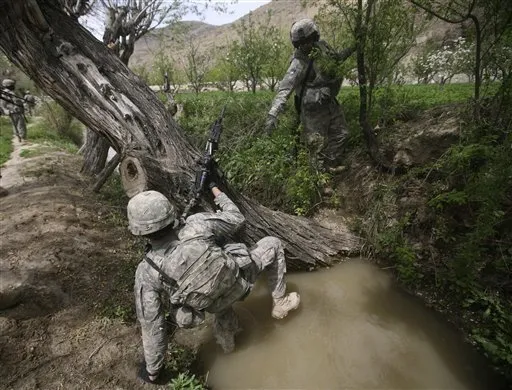
For all the talk of "smart power," President Obama is pressing down the same path of failure in Pakistan marked out by George Bush. The realities suggest need for drastic revision of U.S. strategic thinking.
-- Military force will not win the day in either Afghanistan or Pakistan; crises have only grown worse under the U.S. military footprint.
-- The Taliban represent zealous and largely ignorant mountain Islamists. They are also all ethnic Pashtuns. Most Pashtuns see the Taliban -- like them or not -- as the primary vehicle for restoration of Pashtun power in Afghanistan, lost in 2001. Pashtuns are also among the most fiercely nationalist, tribalized and xenophobic peoples of the world, united only against the foreign invader. In the end, the Taliban are probably more Pashtun than they are Islamist.
-- It is a fantasy to think of ever sealing the Pakistan-Afghanistan border. The "Durand Line" is an arbitrary imperial line drawn through Pashtun tribes on both sides of the border. And there are twice as many Pashtuns in Pakistan as there are in Afghanistan. The struggle of 13 million Afghan Pashtuns has already inflamed Pakistan's 28 million Pashtuns.
-- India is the primary geopolitical threat to Pakistan, not Afghanistan. Pakistan must therefore always maintain Afghanistan as a friendly state. India furthermore is intent upon gaining a serious foothold in Afghanistan -- in the intelligence, economic and political arenas -- that chills Islamabad.
-- Pakistan will therefore never rupture ties or abandon the Pashtuns, in either country, whether radical Islamist or not. Pakistan can never afford to have Pashtuns hostile to Islamabad in control of Kabul, or at home.
-- Occupation everywhere creates hatred, as the U.S. is learning. Yet Pashtuns remarkably have not been part of the jihadi movement at the international level, although many are indeed quick to ally themselves at home with al-Qaida against the U.S. military.
-- The U.S. had every reason to strike back at the al-Qaida presence in Afghanistan after the outrage of 9/11. The Taliban were furthermore poster children for an incompetent and harsh regime. But the Taliban retreated from, rather than lost, the war in 2001, in order to fight another day. Indeed, one can debate whether it might have been possible -- with sustained pressure from Pakistan, Iran, Saudi Arabia and almost all other Muslim countries that viewed the Taliban as primitives -- to force the Taliban to yield up al-Qaida over time without war. That debate is in any case now moot. But the consequences of that war are baleful, debilitating and still spreading.
-- The situation in Pakistan has gone from bad to worse as a direct consequence of the U.S. war raging on the Afghan border. U.S. policy has now carried the Afghan war over the border into Pakistan with its incursions, drone bombings and assassinations -- the classic response to a failure to deal with insurgency in one country. Remember the invasion of Cambodia to save Vietnam?
-- The deeply entrenched Islamic and tribal character of Pashtun rule in the Northwest Frontier Province in Pakistan will not be transformed by invasion or war. The task requires probably several generations to start to change the deeply embedded social and psychological character of the area. War induces visceral and atavistic response.
-- Pakistan is indeed now beginning to crack under the relentless pressure directly exerted by the U.S. Anti-American impulses in Pakistan are at high pitch, strengthening Islamic radicalism and forcing reluctant acquiescence to it even by non-Islamists.
Only the withdrawal of American and NATO boots on the ground will begin to allow the process of near-frantic emotions to subside within Pakistan, and for the region to start to cool down. Pakistan is experienced in governance and is well able to deal with its own Islamists and tribalists under normal circumstances; until recently, Pakistani Islamists had one of the lowest rates of electoral success in the Muslim world.
But U.S. policies have now driven local nationalism, xenophobia and Islamism to combined fever pitch. As Washington demands that Pakistan redeem failed American policies in Afghanistan, Islamabad can no longer manage its domestic crisis.
The Pakistani army is more than capable of maintaining state power against tribal militias and to defend its own nukes. Only a convulsive nationalist revolutionary spirit could change that -- something most Pakistanis do not want. But Washington can still succeed in destabilizing Pakistan if it perpetuates its present hard-line strategies. A new chapter of military rule -- not what Pakistan needs -- will be the likely result, and even then Islamabad's basic policies will not change, except at the cosmetic level.
In the end, only moderate Islamists themselves can prevail over the radicals whose main source of legitimacy comes from inciting popular resistance against the external invader. Sadly, U.S. forces and Islamist radicals are now approaching a state of co-dependency.
It would be heartening to see a solid working democracy established in Afghanistan. Or widespread female rights and education -- areas where Soviet occupation ironically did rather well. But these changes are not going to happen even within one generation, given the history of social and economic devastation of the country over 30 years.
Al-Qaida's threat no longer emanates from the caves of the borderlands, but from its symbolism that has long since metastasized to other activists of the Muslim world. Meanwhile, the Pashtuns will fight on for a major national voice in Afghanistan. But few Pashtuns on either side of the border will long maintain a radical and international jihadi perspective once the incitement of the U.S. presence is gone. Nobody on either side of the border really wants it.
What can be done must be consonant with the political culture. Let non-military and neutral international organizations, free of geopolitical taint, take over the binding of Afghan wounds and the building of state structures.
If the past eight years had shown ongoing success, perhaps an alternative case for U.S. policies could be made. But the evidence on the ground demonstrates only continued deterioration and darkening of the prognosis. Will we have more of the same? Or will there be a U.S. recognition that the American presence has now become more the problem than the solution? We do not hear that debate.
(C) 2009 GLOBAL VIEWPOINT NETWORK; (TM) TRIBUNE MEDIA SERVICES, INC.
Graham E. Fuller is a former CIA station chief in Kabul and a former vice-chair of the CIA's National Intelligence Council. He is author of numerous books on the Middle East, including The Future of Political Islam.