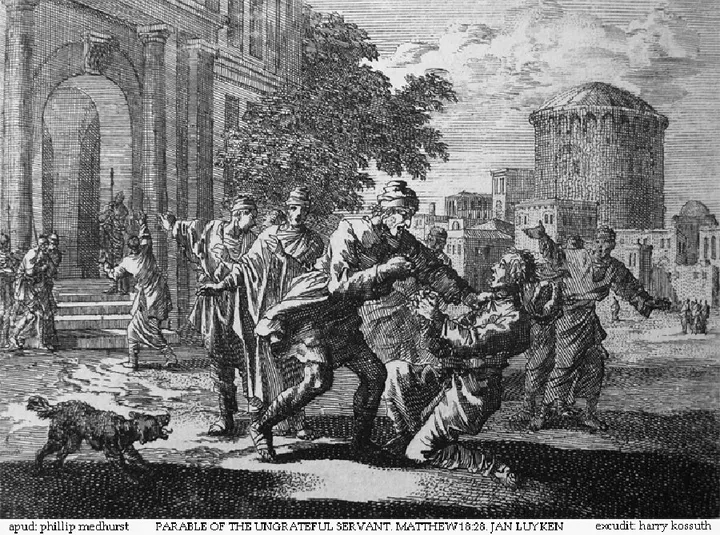
Slavery stands as the single most contested issue in the history of biblical interpretation in the United States. Not only did the nation fracture over slavery, denominations did too. Northern and Southern Baptists, Presbyterians, and Methodists remained divided until well into the twentieth century; in fact, Southern Baptists still represent the nation's largest Protestant denomination. What did slavery mean in the biblical world, and how did biblical authors respond to it?
Don't let anybody tell you that biblical slavery was somehow less brutal than slavery in the United States. Without exception, biblical societies were slaveholding societies. The Bible engages remarkably diverse cultures -- Ethiopian, Egyptian, Canaanite, Assyrian, Babylonian, Persian, Greek, and Roman -- but in every one of them some people owned the rights to others. Slaveowners possessed not only the slaves' labor but also their sexual and reproductive capacities. When the Bible refers to female slaves who do not "please" their masters, we're talking about the sexual use of slaves. Likewise when the Bible spells out the conditions for marrying a slave (see Exodus 21:7-11).
The occupations and experiences of slaves varied greatly. Many performed manual labor in horrid conditions, perhaps living only months after beginning their work. Some highly valued slaves attained wealth and status, a possibility reflected in Genesis' account of Joseph. Perhaps the story of the centurion who highly valued his slave connotes an erotic relationship, likely one-sided (Luke 7:1-10). In all cases the owners' right to use a slave as the owner sees fit, including the right to punish slaves severely, remain unquestioned.
How did people become slaves? Slavery did not accompany a particular racial status, as it eventually did in the United States, but the Hebrew Bible stipulates preferred treatment for Israelite slaves (see Exodus 21:1-11; 25:39-55; Deuteronomy 15:12-18). Crushing debt forced many into slavery, with some people selling themselves and others selling their children. Military conquest contributed greatly to the slave market as well.
The Bible does not attempt to hide the presence of slaves. Beware modern translations that use "servant" to cover up slave language. Slaves were ubiquitous in the ancient world. Imagine ancient Rome, where slaves made up between one-third and one-half of the inhabitants -- perhaps half a million people! The Senate once considered requiring slaves to wear identifying marks, but they stopped short in the face of a chilling realization: if slaves could recognize one another, what would prevent them from organizing and pillaging the entire city?
In the New Testament, Jesus frequently refers to slaves in his parables, the witty stories that marked his most distinctive teaching style. He never addresses slavery as an institution, though unfortunately one of the parables assumes that beating a slave is acceptable (Luke 12:47-48). More controversial is the apostle Paul, often blamed for promoting or condoning slavery. The great African-American theologian Howard Thurman recalled how his illiterate formerly enslaved grandmother would not allow him to read Paul to her. Slave owners, she said, constantly employed Paul's letters to promote docility among the slaves.
However, more recent scholarship suggests that Paul may have resisted -- or at least undermined -- slavery. Many scholars believe Paul did not compose six of the thirteen letters attributed to him in the New Testament. It so happens that the most restrictive passages regarding slaves occur in those six disputed letters (see Ephesians 6:5-8; Colossians 3:22-4:1; Titus 2:9-10), while the remaining seven letters leave open the possibility that Paul sided with slaves. One letter calls the slaveowner Philemon to welcome back a certain Onesimus "no longer as a slave but as more than a slave, a beloved brother ... both in the flesh and in the Lord" (Philemon 1:16). Is Paul calling for Onesimus to be set free, or simply for his master to receive him with love? Likewise, it strains the imagination that two modern translations of 1 Corinthians 7:21 could vary so greatly, but consider this example.
| English Standard Version | New Revised Standard Version |
|---|---|
| Were you a slave when called? Do not be concerned about it. But if you can gain your freedom, avail yourself of the opportunity. | Were you a slave when called? Do not be concerned about it. Even if you can gain your freedom, make use of your present condition now more than ever. |
Does Paul encourage slaves to embrace their captivity or to gain their freedom?
While we may debate whether Paul encouraged the manumission of Onesimus and other slaves (I think he did) one thing is certain. Some ancient Jews and Christians did resist the practice. The Essenes, likely responsible for our Dead Sea Scrolls, apparently forbade members from owning slaves. The book of Revelation lists slaves among the luxury items that Roman commerce generated by exploiting other societies (18:13). Most touchingly, very ancient documents indicate that some Christians literally sold themselves into slavery to purchase the freedom of others (1 Clement 54:4-5), while some churches collected money to buy slaves' freedom (Ignatius to Polycarp 4:8-10; Shepherd of Hermas 38.10; 50.8).
There's a simple explanation for nineteenth century debates on slavery and the Bible: the Bible isn't exactly clear on the subject. If anything, the Bible made it easier for slavery's advocates than for its opponents. On the other hand, Robert E. Putnam and David E. Campbell suggest that while religion contributed greatly in the motivation of abolitionists, their adversaries would have promoted slavery with or without religion.
Recommended reading:
Marcus J. Borg and John Dominic Crossan, The First Paul: Reclaiming the Radical Visionary Behind the Church's Conservative Icon.
Jennifer A. Glancy, Slavery in Early Christianity.
J. Albert Harrill, Slaves in the New Testament: Literary, Social, and Moral Dimensions.
Follow Greg Carey on Twitter @GregC666.
Follow Greg Carey on Twitter: www.twitter.com/GregC666
I HAVE, however, spent many of the intervening 5 decades studying works on the bible and on religions, including much study of what many consider "christianity" today.
It is common that those who profess belief in the bible, especially those who "believe every word" do not know much about it at all.
Many people have selected quotes that they feel support their ideas and/or prejudices, but few know wherof they speak.
Thanks again for this - it was not what I expected.
mark
The bible doesn't condone slavery, the Jews in the whole of the testament were under Roman rule were basically second class citizens. In Old testament the Jews half or most of the time were either going into slavery or been freed from slavery.
God created man and woman to be rulers of all things on earth except over over fellow humans.There is neither Jew or gentile in Gods eyes we all the same.
The bible is about fairness, children obeying your parents, and parents rising their kids what is right and not provoking their kids into anger. fathers loving their wives and wives doing the same
Jesus said treat all people with kindness and love
I'm surprised this article didn't mention this, but in the Old Testament, the so-called "Curse of Ham" was widely used to justify slavery by Southerners. And I'm not talking about a long time ago. I heard this as a child. God cursed the son of Noah (named Ham) who looked upon Noah's nakedness while Noah was passed out drunk. The curse involved Ham's sons having to serve the other two sons of Noah. If you will recall, the family of Noah was supposedly the only family left alive after a world-wide flood (and American Protestants read the Bible literally). So you basically have one-third of the upcoming population cursed to serve the other two-thirds, and what do you know? The Sons of Ham were determined by the listed Biblical geneologies to be those who settled in Africa . . . or so the early American Christians interpreted things.
Hmm..., another way to approach the Bible is to see it as reaction to existing conditions, i.e., how to make something new, make it opposite. Pantheism to monotheism, fertility rites become highly regulated or complete abstinence; now you have an "original doctrine" no?
Poloticians claim their polocies are to protect me (but their polocies only seem to restrict and bleed me..
Gross over spending by the government has made my little savings almost worthless and it is getting worst.
My employer says we as employee's must do more for less and with less.
Sexual harasment is all over the place.
on and on..... and all you say the bible condones slavery! LOL where is are freedom, We live in a time where slavery has (as you evolutionist say) evolved, Masters are so good at it... they have you believing your free! lol....
If someone was deeply in dept, he could sell himself as a slave. The maximum time that any Israelite would have to serve as a slave was six years (verse 2).
When setting a slave free, the master had to equip his former slave with provisions (Deut. 15:13, 14)
There is no basis for claiming that to 'please' one's master was meant in a sexual context. Those scriptures you refer to show that the woman was protected, to be treated as the master's own daughter.
That's not freedom. That's a guarantee that he will continue to be a slave forever.
The bible was written to serve the needs of kings and rulers, by oppressing the masses, forcing them to remain stupid.
Some people want to remain this way, I suppose. I don't see the benefit in being stupid.
Ah, but you neglect the part where the slave can voluntarily allow the master to take him before the Lord and pierce his ear with an awl signifying lifelong servitude...if he wants to stay with his family.
Assuming of course, the master hasn't beaten them to death already. So long as they take at least two days to die, he's in the clear.
"There is no basis for claiming that to 'please' one's master was meant in a sexual context."
Yeah, you might want to check the King James version instead of the frickin' Winnie the Pooh version. It makes it VERY CLEAR that we're about sexual slavery:
"If she please not her master, who hath betrothed her to himself, then shall he let her be redeemed: to sell her unto a strange nation he shall have no power, seeing he hath dealt deceitfully with her."
The verb here is "betrothed." To himself. Him being the master. Who bought the slave. Who he betrothed to himself. For the sexing.
But God said women were possessions, just like slaves, anyway. And he was always saying men could keep women as spoils of war.
That could never, ever be acceptable. There is nothing, no context, historical or otherwise, that justifies that.
This is the word of God, Amen.
1. there are different time periods, and the bible gives different snap shots of the times, and the institutions that existed, during Giddeon's time there were Judges in the land, not Kings (Judges 8:22,23) then a couple of hundred years later there are Kings in Davids time and now the best / proper roll was to obey the King, now a couple of hundred years and we have Presidents and Prime Ministers, because that is how it seemed best to protect individual liberty
Slavery or servants existed, and it is recorded in the bible, as well as what was reasonable, decent, fair and appropriate rules, the bible / God did not create slavery, when the collective consciousness of the people has risen, you have changes in laws, though Joseph and Daniel were slaves, when they became powerful rulers, they did not seek to outlaw slavery as an evil
2. The Slavery the bible wants us to understand is "slave to sin", in spiritual context, when somebody hurts our feelings, the "slave driver's shouts" (Job 3:18) inside tempts our soul to go to the dark side: pride, anger, hate and harm. If you obey the slave master's voice then your words and actions show it, God wants us to over come that temptation by being blind and deaf to their taunts, deflecting them with the shield of faith so they have no effect on us and we stay in: humility, forgiveness, love and peace.
the bible contains a physical message with a spiritual message hidden inside, like a box of Cracker Jack or the toy inside the kids cereal box (Proverbs 25:2 & Matthew 13:11-17)
spiritual development is a long difficult process, for a short answer, I would say there is an angle on one shoulder and the devil on the other and they are both wanting to be the guide of our life
prior to Moses, there weren't lots of physical rules, just names of people that successfully recognized the evil advice of the devil and relied on the angels suggestions for their words and actions (I did want to point out that they came into God's favor or likeness without the aid of the bible or any type of physical rules)
Moses was overwhelmed with people, that now need a governmental structure that provided communal needs (Exodus 17:3,4 & 18:14-16) it was forced on Moses and he relied on the inner voice of the angel to move beyond acting as a judge would
woven inside those physical laws was an ability to interpret it from the spiritual view (Psalm 51:16,17 & Isaiah 1:11-17) which gave a glimpse of how they overcame before, which brought them into communion with God
Governments change rules over time, slavery was legal and existed before the Constitution, and it had to addressed it, the same with the bible, Moses had to deal with it the best that the angle directed him at that time
Do you believe God said what the Old Testament said he did. Just in general. When it says in the Old Testament that God is speaking or that he said something, did he?
Did he really do the things it says he did? Like how he punished David (since you brought him up)?
I read your comments and am not far from where you are at, I am spiritual, which means I am not supportive of physical rules from the bible, there are religious folks advocating physical laws, I do not.
I replied to TonyQ above, and did not want to duplicate here, Government is separate and secular from ones freedom of worship (Matthew 22:15-22 & Romans 13) the important emphasis is character development (Romans 5:3,4 & 2 Peter 1:3,4) done internally, not externally
I am not sure how far along you are in your study of the scriptures, in order to form an opinion and comment on them, I provide a link to my article so you have an idea where I am coming from:
https://sites.google.com/site/thegoalofyourfaith/
You quickly went from slavery to homosexuality though it was not mentioned in the article, the spiritual folks that use the bible words "sexual immorality" are not referring to what we today know as homosexuality, it is somewhat advanced stuff, a small narrow interpretation sometimes difficult to put into words, I've given it some time and a try, you can review my efforts at:
https://sites.google.com/site/sexualimmorality/
Respect for others is the only way.
Hillary Clinton threw some money at the problem in a foreign country recently, Malaysia I think, but says nothing of the problem here in the states.
Paul clearly makes an appeal to nature in this verse. In his attempts at conversion he also appeals to the baser nature of men, ie. their stomachs, and penis. He makes appeals to their aggression/baser animal natures by subjugating women to men.
Paul, like the Jews before him sanctioned slavery as approved of God, in the verse below. Slavery then spread horrifically throughout the known world, as God sanctioned.
Deism is the idea that God doesn't intervene in the matter of men, and can be seen in the above verse as approval by God of slavery, first established in the Old Testament. It should be no surprise that the founders of the constitution were slave owners.
Therefore, god is a slave of man.