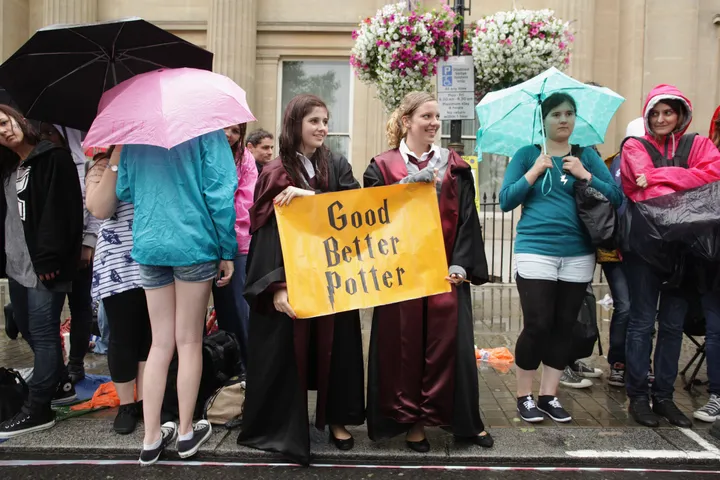
Thousands of people are gathering right now in London's Trafalgar Square, just down the road from me, for the gala world premiere of "Harry Potter and the Deathly Hallows, Part 2," the final film in the most-popular film series of all time. This is, as the film's advertising slogan would have it, the end (or at least the beginning of the end) of a 14-year journey that a generation of kids have made with the most popular fictional story of all time, and so it is an appropriate place for all of us to stop and ask some spiritual questions. Why has Harry Potter been so important in the lives of both kids and adults? What does the series have to teach us about who we are and what we're supposed to be doing?
Everyone seems to be trying to figure this out. All the newspapers here in Britain have been running features and op-ed pieces for the past two weeks trying to assess the Potter phenomenon, and the media interest is worldwide and comes often from surprising places. Late last night, I did an interview with Metro, the free newspaper distributed to commuters in subways around the world, about what children may have learned from the Potter books and films. I'm doing an interview with Men's Health magazine (!) on Monday for a feature called "Ten Things Men Can Learn for Harry Potter." I haven't heard that Cosmo is doing a Potter article, but if it doesn't, it will be in the minority. (And perhaps doing a disservice to its female readers, who also may have 10 things they could learn!)
Now, although I too am fond of Top 10 lists, we can boil down spiritual lessons from Harry Potter to three major things. In "One Fine Potion: The Literary Magic of Harry Potter," I devoted chapters to the responsible use of power, the formative power of community and the nature of true heroism in the world of Harry Potter. And while there are many other spiritual and even religious lessons in the books and films, this strikes me still as a good division of major themes.
The use of power is a theme seen through the lives of many characters, although it is central to the conflict between Harry and his nemesis, Lord Voldemort (or He Who Must Not Be Named, if you are still feeling squeamish). Harry and Voldemort are similar in many ways, but not in the willingness to choose power at any cost. The titular Deathly Hallows that both characters are seeking in the two final films are supernatural artifacts that could make the bearer immortal and virtually unbeatable. But Harry at last realizes that this is not his path, that violence will not ultimately save the day. As students of Gandhi or Martin Luther King Jr. know, it takes the greatest courage not to use violence. And so it's instructive that while Voldemort's signature spell throughout the saga is the killing curse, Harry's is the disarming jinx. Harry is not a killer -- a powerful corrective to much of American popular culture, which revolves around the idea of the lone hero who takes justice into his own hands and destroys his enemy through the use of righteous violence.
Another corrective for Americans comes from the centrality of community in the Potter story. Harry would make a terrible American hero -- he is short, wears glasses, is not the smartest, meanest or most powerful character in the saga. He can't prevail alone or by superior firepower. But he benefits from the company he keeps. As a student at Hogwarts School of Witchcraft and Wizardry, he learns lessons from teachers, staff and other students. He is also part of a holy trinity without whom he would not survive his many tests. Hermione Granger, the brainy friend, and Ron Weasley, the steadfast friend, are at his side for almost every challenge he faces. Harry also is a member first of a student organization, Dumbledore's Army, that fights Voldemort's underlings, and then the Order of the Phoenix, which opposes Voldemort himself. This focus on community formation should remind us of the Christian concept of ecclesia, a gathering of people around a common message or purpose. I don't suppose it's unintentional that author J.K. Rowling chose the phoenix to designate her ecclesia, since the phoenix is an ancient symbol of Christianity. Certainly Harry's communities do what church is supposed to do: they form, inspire, challenge and support him.
Finally, Harry teaches us what in a celebrity culture we sometimes forget: Heroes are not people who run fast or look good or are willing to do anything for publicity, although our tabloids and airwaves seem to be filled with such people -- often behaving badly. Harry is born into celebrity and is one of the most famous people in the Wizarding World from his early childhood. But Rowling's books make clear the difference between celebrity (which is prominence, often unearned and rarely long-lasting) and heroism (which is self-sacrificial, courageous and never gives up). Harry is given a task it takes his whole first 17 years to understand. It is a task that he alone can do, and if he does not choose to do it, the world will be a vastly poorer place. But against all odds, he perseveres -- and (this shouldn't be a spoiler) achieves it. In this, we are like Harry, for while our tasks may not attain the cosmic level of Harry's, all of us are engaged to be a part of the world's healing, and if we choose the values of our culture instead, the world will be poorer for it.
Teens and young adults who talk about what Potter has meant to them often talk about the values they have learned from Harry, as in, "What Would Harry Do?" This middle-aged writer has had his own values reinforced and sometimes dramatically re-taught by the Potter books and films. Harry is a Christ-figure, as those who have read the books (and now are seeing the final film) know. And J.K. Rowling is a Christian who has said that the thematic core of the entire 4,100-page series comes from the two Bible verses found in Book Seven. So perhaps it's not so surprising to hear people talk of Harry Potter in spiritual and even religious terms. This most popular story of our lifetimes reminds us of, and can lead us back to, other stories that shape, form and inspire us.
Harry is not Jesus. But Harry can point the way.