
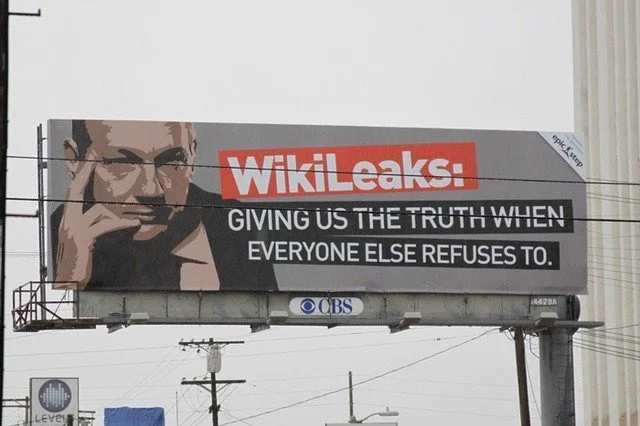
Exactly one year ago this week, Julian Assange and a crew of WikiLeaks volunteers -- including Birgitta Jonsdottir, who has since become a critic -- assembled in Reykjavik, Iceland, to edit and add subtitles to a video of a 2007 incident in Baghdad that Assange himself would title, "Collateral Murder."
At that point, WikiLeaks and Assange were far from household words in the U.S., despite three years of leaks that intermittently gained notice. Of course, everything has changed since.
A U.S. Army intelligence analyst, Pvc. Bradley Manning was arrested within weeks and eventually charged with leaking the video, and so much more that would put WikiLeaks in the headlines worldwide to this day: classified documents on the Iraq and Afghanistan wars, and then "Cablegate." Manning now is incarcerated in near-solitary conditions at the Quantico base in Virginia. He's the subject of my new book and e-book, Bradley Manning: Truth and Consequences, which also explores the "Collateral Murder" leak.
A little more than a year ago, intrigued by WikiLeaks' activities, New Yorker writer Raffi Khatchadourian e-mailed Assange, and then chatted with him on the the phone, establishing a certain level of trust. Assange mentioned the video, in somewhat vague terms. The writer knew it would make a splash if released. He'd wanted to write about WikiLeaks anyway and so, with an okay from his editor, he flew off to frigid Reykjavik, Iceland, in late March. Khatchadourian, author of The Kill Company (on Operation Iron Triangle in Iraq) and a profile of Adam Gadahn (an American who joined Al Qaeda), must have seemed to Assange like a good man for this job.
At a newly rented house soon dubbed the "bunker," Khatchadourian found a team of half a dozen volunteers had joined the tall, silver-haired Assange, and were readying the release of the thirty-eight-minute cockpit video from Iraq, which they labeled Project B. Assange had told the owner of the house they were journalists covering the volcanic eruption then disrupting air travel in Europe. He had chosen Iceland for his secret task after spending time there helping to draft a law with strong free-speech provisions. Some people involved in that fight, including a member of parliament, Birgitta Jonsdottir, now were engaged with Project B.
Also involved was Rop Gonggrijp, a well-known Dutch hacker and businessman, who knew Assange well. As Khatchadourian described it in his lengthy New Yorker report two months later, Gonggrijp "became the unofficial manager and treasurer of Project B, advancing about ten thousand euros to WikiLeaks to finance it."
The video, on a hard drive in the bunker, was still in the early stages of editing. Assange would not identify his source for the video, Khatchadourian later wrote, saying only that the person was unhappy about the helicopter attack in Iraq.
The writer captured Assange's describing to his colleagues what was on the video: "In the first phase, you will see an attack that is based upon a mistake, but certainly a very careless mistake. In the second part, the attack is clearly murder, according to the definition of the average man. And in the third part, you will see the killing of innocent civilians in the course of soldiers going after a legitimate target."
As days passed, Assange worked night and day, editing the footage and scrubbing any elements that might reveal the leaker, while trying to decide if he wanted to release the full video and/or a shorter version, with commentary, that would be more viewer-friendly. The video did not yet have a name. He considered "Permission to Engage" before choosing "Collateral Murder." The New Yorker writer quoted him telling Gonggrijp, "We want to knock out this 'collateral damage' euphemism, and so when anyone uses it they will think, 'collateral murder.' "
Much time was spent analyzing the video for evidence of Iraqi targets carrying rocket propelled grenades or AK-47s. Assange spotted what seemed to be weapons but in most cases it was not conclusive. He had declined to ask military experts for advice, since they were "not terribly cooperative" when he told them it was for a WikiLeaks release.
Breaking the code of secrecy, Assange dispatched two Icelandic reporters to Baghdad to notify the families of those killed or injured in the attack, including the mother of a boy and a girl who had been sitting in a van driven to the scene by their father. Assange wanted to prepare the families for publicity but also to gain some telling details on what happened that day.
Assange made a frank admission to Khatchadourian. Yes, he tried to foster "harm-minimization" to individuals in his work but WikiLeaks could not spend all of its time checking every detail. He was aware that some leaks risked harming the innocent -- "collateral damage, if you will" -- and that one day WikiLeaks members might get "blood on our hands."
Finally, Assange finished the edited version, at eighteen minutes, which covered the first two attacks. He also picked an opening quote, from Orwell: "Political language is designed to make lies sound truthful and murder respectable, and to give the appearance of solidity to pure wind." The intro would also include information on the deaths of the two Reuters staffers and the Army's investigation absolving crew members for that. It handled the delicate issue of guns on the ground by observing that "some of the men appear to have been armed [but] the behavior of nearly everyone was relaxed."
In the bunker, Assange predicted: "The video shows what modern warfare has become and, I think, after seeing it, whenever people hear about a certain number of casualties that resulted during fighting with close air support, they will understand what is going on. The video also makes clear that civilians are listed as insurgents automatically, unless they are children, and that bystanders who are killed are not even mentioned."
The following day, Assange, Gonggrijp and Khatchadourian (with the finished video in Assange's backpack) flew to New York, and then trained to Washington, D.C. Within hours, on April 5, 2010, Assange released the video at the National Press Club and posted it online, all hell broke loose, and nothing in the world of U.S. diplomacy, the media, the world or leaks, and the lives of Assange and Manning and so many others has been the same since.