
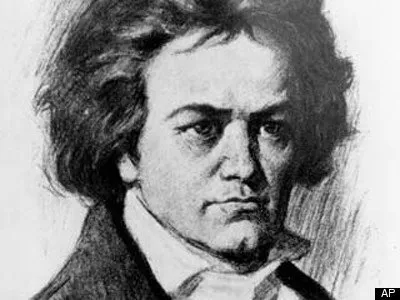
Last year, at this time, and in this space, I highlighted what I consider the greatest "thanks giving" music ever, the third movement of Beethoven's opus 132 string quartet, which he labeled a hymn of thanksgiving, or "Heiliger Dankgesang," on overcoming a serious illness. It proved very popular here, so I've posted it again at the very bottom of this page -- but now I'd like to offer for this day (also below) Beethoven's wish for universal brotherhood, at the close of his epic NInth Symphony.
The composer opened the earlier "Ode to Joy" section by offering advice that many of us political or media bloggers might want to heed today: "Oh friends, not these tones! / Rather, let us raise our voices in more pleasing / And more joyful sounds!" While much of the finale is based on Schiller's poem, those words are from Beethoven himself. He also added this crucial urging: "All men become brothers!" (Alle Menschen werden Brüder)
It's one reason that when Leonard Bernstein led the playing of The Ninth to commemorate the fall of the Berlin Wall the title was changed from "Ode to Joy" to "Ode to Freedom."
This Thanksgiving I'm thankful for many things -- including a new job, a new book, and a new (first) grandson named Jules -- but let me focus for now on my deep appreciation for Beethoven somehow entering, and staying, near the center of my life, starting about four years ago. How did the former executive editor of Crawdaddy end up as a Beethoven freak?
Yes, there is a bit of the political to it -- this is the man who always took the part of the average folk. But it is much more than that.
In fact, if you had told me four years ago that I would spend the morning of my 60th birthday -- and the evening of my 25th wedding anniversary -- with Beethoven, I would have laughed, or perhaps played a chord of "Wild Thing" on my guitar. After all, until that time, I did not know the difference between a cadenza and a concerto, an oboe and a bassoon.
Yet to my utter amazement in the past few years I have pursued all things Beethoven via recorded music, dozens of concerts, books, movies, lectures and the new electronic delivery systems, iTunes and YouTube. I returned to Avery Fisher Hall in New York for the first time in 30 years -- last there for Springsteen -- and this time no one was smoking pot. I scalped tickets outside Carnegie Hall, not for Dylan but for another brash international superstar, Gustavo Dudamel. It's a long way from my days in rock 'n roll in the 1970s when "longhair" music did not mean classical. Now I am suddenly debating, if only with myself, the relative merits of pianists Aimard, Gould and Denk, as I had once weighed the merits of Clapton, Hendrix and Harrison.
Goodbye Crosby, Stills and Nash -- hello Beaux Arts Trio!
One of the cultural highlights of the past year for me in New York was a performance of T.S. Eliot's "Quartets" by the actor Stephen Dillane--followed by the Miro Quartet playing the work that inspired those poems, Beethoven's opus 132 (with the "Heiliger Dankgesang"). A little later the Shanghai Quartet performed the "Heiliger Dankgesang" at the Rubin Museum, linked to an exhibit on death and after-life images in Tibetan art.
Of course, I am not alone in belatedly embracing classical music. Amid a steep falloff in CD sales of most kinds of music, sales of classical music are climbing. Many boomers have begun to put aside, or at least augment, some of the music they grew up and old with. Alex Ross -- author of the (surprising) bestseller The Rest is Noise -- wrote in the New Yorker that classical music is "thriving on the Internet in unexpected ways."
Why? Classical music from centuries ago may be a relief, an antidote -- even for some, a necessity -- as we boomers navigate the overwhelming be-here-now world of Blackberries, iPhones and the web, not to mention the global economic collapse. In any case, I have come to learn how exploring new passions can develop, almost overnight, as one enters a new stage of life, such as my own Aging of Aquarius.
All I know is that Beethoven's deeply emotional, powerful and meditative music (mainly in the lesser known, non-symphonic pieces) has enriched my own life in a profound way -- and all this with only occasional "lyrics." But younger people, as well, are getting into classical music, with popular "downtown" clubs opening in Berlin, New York and other cities. Maybe good old sex, drugs and baroque and roll is in our future.
I'm still not sure what led me on this path. One possibility: That scene in my favorite film of recent vintage, The Lives of Others, when Beethoven's "Appassionata" piano sonata took on mythic dimensions. The coming of iTunes, which makes musical dabbling fun and easy? Simply boredom with current rock 'n roll? The Beethoven back story of tragedy, lost love, deafness?
What Beethoven shared with the greatest rock stars -- and this explains part of the attraction for me, no doubt -- was his constant drive to top himself, to keep pushing the envelope, to finish epic pieces with a universe-cracking chord or sustained grace note. He was the first "heroic" composer, a mantle later worn by the likes of John Lennon. I've come to believe that, with Shakespeare, he is the greatest artist the West has produced--or the most "perfect," in Leonard Bernstein's formulation.
But there's another thing: After years of being among the oldest at rock concerts, it feels great to find myself a bit below the median age at most of the classical shows.
Here's the five-minute finale of the Ninth, conducted by Bernstein, with Part I of the "hymn of thanksgiving" below that (you can click there for part II). Plus, check this link for the "Benedictus" of the Missa Solemnis, which nearly tops everything else.
A new edition of Greg Mitchell's book "The Campaign of the Century," winner of the Goldsmith Book Prize, has just been published.