
I have lived in cloudy places, and in truth I love them best, so while Harry Potter and the Deathly Hallows: Part 1 may not suit all tastes (judging by the brash, hyper, migraine-inducing CG crapola in our press-screening's preceding trailers, assuredly there are other tastes), this franchise suits me very well -- this latest, penultimate installment included. Of course, what we're experiencing here is actually one half of a very long film which is in itself the seventh in a series; thus, at this point in this well-established storyline, whatever your opinions may be, you're right. Meanwhile, count me amongst the fans. I see a poignant paean to longing, loss and love, drenched in shadow and glistening with magic.
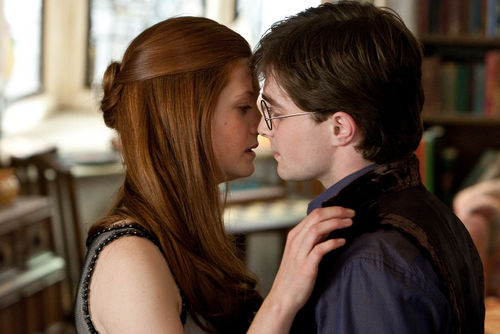
Chicks dig a vest.
photo: Warner Bros. Pictures
Faithful as it is to author-producer J.K. Rowling's 2007 mega-bestseller, this film of Deathly Hallows also comes saddled with the book's numerous challenges, foremost of which is the tying-up to reasonable satisfaction of a big fat jumble of characters, motivations, settings and themes. This series has been relentlessly repeating its motifs from the start (funny how its critics never accuse James Bond of same), and screenwriter Steve Kloves once again displays a steady hand in cherry-picking the book's vital bits to transcribe to the screen. Kloves has adapted all but one of the Potter novels -- the exception being Order of the Phoenix, the fifth and least-satisfying film, which got director David Yates off to a shaky start. Then, teaming both men with truly brilliant cinematographer Bruno Delbonnel (Amélie) yielded elegant, enthralling success with last year's Half-Blood Prince. This new film by Yates satisfies, but as with Rowling's series-capper it fragments rather jarringly, resulting in a mosaic of dark and intriguing puzzle-pieces.
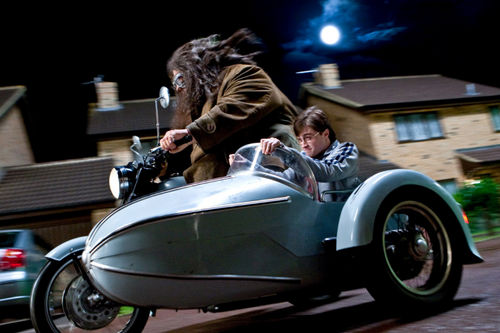
The magical sidecar: Combines the lack of mobility of an automobile
with the lack of safety of a motorcycle. (Fortunately, this one can fly.)
photo: Warner Bros. Pictures
The gist is that Harry (Daniel Radcliffe, approaching acting) is being aggressively hunted by symbiotic, slit-nostrilled and revoltingly-manicured wizard Lord Voldemort (Ralph Fiennes, onscreen too much to be scary), so the mannish boy daren't return to the beloved Hogwarts School of Witchcraft and Wizardry (until Part 2, anyway). Rather, assisted by a sortie of good wizards, he flees his "Muggle" (read: "suburban") family home to hide once again in the Weasley family's funky bucolic house -- which of course was visibly set ablaze by Voldemort's Death Eaters (read: "non-vegetarians") in the previous film (though not in the previous book), only now, voilà, there it is apparently unscathed, very much sans explanation. Must be magic.
Harry's narrow escape comes at a price, and the heavy body-count of Deathly Hallows begins -- then we suddenly indulge in a peculiarly flat wedding sequence chez-Weasley, which hastily and mercifully concludes via a violent attack of more swoopy-gruesome Death Eaters. Bedlam ensues, and Harry, self-proclaimed "highly logical" Hermione (Emma Watson in poetic form) and silly-no-more Ron (Rupert Grint, surprisingly gritty) narrowly escape to bedouin-wizard-on-the-lam status, haunting back-alleys and freezing forests and angsty acting workshops as they desperately search for more Horcruxes (preserved shards of Voldemort's soul which yield sexy nightmares which end too soon) to destroy.
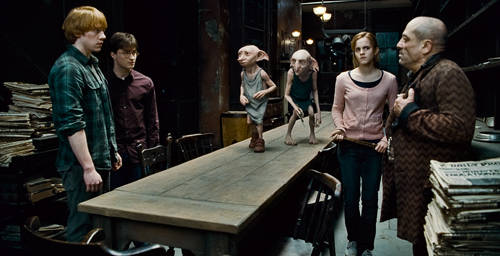
Dobby and Kreacher subject the humans to a Good-Elf/Bad-Elf shakedown.
photo: Warner Bros. Pictures
Although mentioning it will draw many fans' ire, my fave of these movies is the second one, Harry Potter and the Chamber of Secrets, which focuses all that is great about Rowling's fantasy pastiche (back story, romance, wit, whimsy, scary monsters, super creeps) into one production. However, contrasted to Deathly Hallows it's like juxtaposing Scooby-Doo and Se7en; it's really very fortunate that the principal cast have remained with Harry Potter from tip to tail, because otherwise the series has transformed so much, aesthetically and tonally, as to appear schizophrenic. Deathly Hallows is quite entertaining -- but in a bleak, dire and even vicious way. Fresh from viewing the movie I feel much as I did upon completing the book: Harry, Hermione and Ron are not only not kids anymore -- they're contending with feelings and inner conflicts which would be daunting to most people twice their age. Rowling's intense compression of all of life's dreadful experiences into the teen set is not a bad fit -- but it is an odd, noteworthy and not entirely realistic one.
And here we enter into what I really like about the Harry Potter movies: They're not to be taken literally; rather (and this is extremely impressive for Big Studio Product), these stories are the stuff of dream and soul. Hotshot twenty-year-old screenwriters would step in and start doing all of that offensive explaining that they're wont to do (and it turns out Yates, like J.J. Abrams, still directs like a teenager: When in doubt, SHAKE THE CAMERA!) -- but Rowling's magical little world (cobbled together as it is of Roald Dahl, The Books of Magic, The Worst Witch, etc. and, incongruously, Orwell) beautifully fits the screen because it just is. Wizards and witches fly, wands shoot spells, "Muggle" contrivances are deemed curious or even hilarious, and the human experience, freed of stymying everyday expectation, pours forth -- albeit here with a heavy emphasis on mortality and woe: The animated eponymous shadow-play is at once touching and laced with doom; and when Harry and Hermione, alone in the wilderness, dance to a very unlikely yet perfectly appropriate Nick Cave song via transistor radio, many may not get it -- but I get it.
Its sense of soul (depressive-honky-mythic soul, but soul) well defined, alas, the structure of Deathly Hallows does not come up aces. Props again to Kloves for engaging the complicated gears, but for both the considerable affection engendered by the whole Harry Potter series and the audaciously moody nature of this film in particular, this script...well, you know what they say about stuffing a one-pound bag? Rowling's fans go to these movies expecting one familiar setpiece after another, but this time I actually pity audiences unfamiliar with the book -- who in their confusion are also being deprived of the book's many grace-notes: no "freshwater plimpies," Mr. Lovegood? While the characters "apparate" willy-nilly all over Britain, Kloves and Yates afford only barest attention to clarifying what the hell is going on, or even, in some cases, who people are. The super-quick cameos (Neville on the train; Ollivander in a dungeon; series star Snape barely in this movie) prove dizzying -- and then suddenly Dobby the house-elf (wonderfully voiced by Toby Jones) inexplicably returns from his four-film holiday -- hug him while you can.
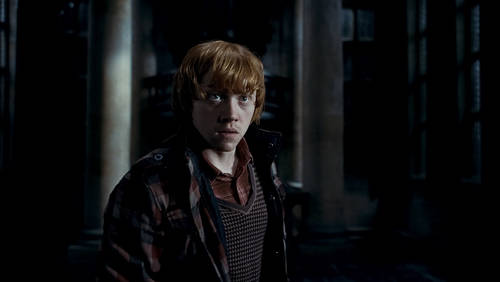
"You talkin' to me, mate?"
photo: Warner Bros. Pictures
Talent-wise, Deathly Hallows' best moments go to Rupert Grint, because although Ron's abrupt, violent shifts of character feel implausible (blame that and his mad muttering on The One Ring -- or the Horcrux pendant, whatever), Grint really gives this movie his crazed-and-nasty all: light-years from goofy-sweet Ron and evidently ready to shove Paul Bettany into brittle-old-man status -- perhaps Grint's surly new 'tude could make him Gangster No. 2? Meanwhile, Watson brings a touch of humanity to the horror ("This forest isn't how I remember it -- not the trees, not the river, not even me"), Radcliffe isn't bad, and all the supporting talent (Robbie Coltrane, Helena Bonham Carter, Tom Felton, Jason Isaacs, Bonnie Wright, Evanna Lynch) give us Potter-people what we want. In lieu of much in the way of Alan Rickman, Bill Nighy as Minister of Magic gets to borrow Snape's rock-star wig and deliver some memorably eerie close-ups. It's a scintillating showcase.
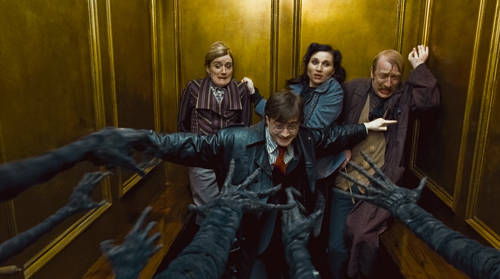
Autograph hounds!
photo: Warner Bros. Pictures
A great many youth/adventure series preceeded the Harry Potter phenomenon, and many more have followed in its wake with surely more to come. On the page and in moving pictures, I grew up with the Hardy Boys and Nancy Drew and Scooby-Doo and Narnia and many others. What makes Harry Potter special? That element -- relentless pathos -- has informed this series since its inception, and it fills nearly every single frame of Harry Potter and the Deathly Hallows: Part 1. As such, jollies are at a premium here. But if you like the way the series has been evolving, and dark dreams and grey skies please your cinématic palate, you'll find no more satisfying treatise at the commercial moviehouse this year.