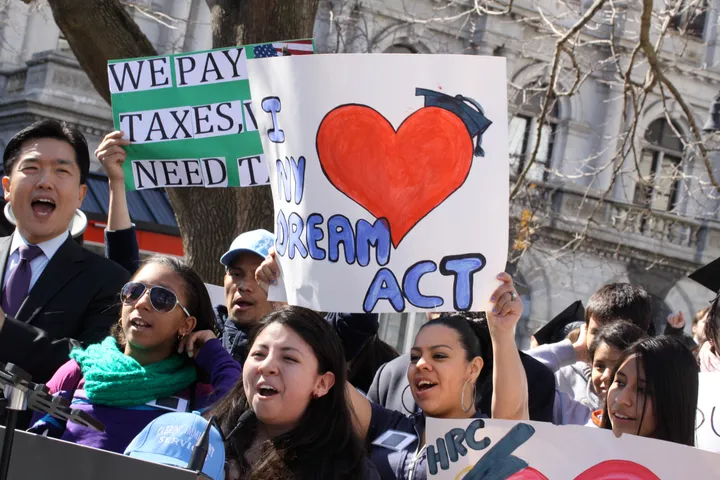
While North Miami high school valedictorian Daniela Pelaez was fighting deportation orders last month, Cuban soccer player Yosmel de Armas was planning to defect in Nashville, Tenn. Pelaez, who moved from Colombia when she was 4, received a two-year deportation reprieve and is fighting to stay. De Armas turned up in Miami seeking asylum and is expected to become a U.S. citizen.
Cubans landing on U.S. soil are typically granted asylum and can apply for legal residence in one year. Once they have green cards, they can apply for U.S. citizenship, which will be granted in five years' time. This is the only nationality that has an automatic pathway to citizenship upon entering the U.S.
This policy shares many characteristics with the proposed Dream Act, denounced by Republicans as an amnesty bill. Florida Senator Marco Rubio and senior Republicans are crafting an alternative proposal that will improve the GOP's dismal ratings among Hispanic voters. As they move forward, they should consider the parallels that exist between U.S.-Cuba migration policy, which the GOP fully supports, and the Dream Act, as well as the expectation that all immigrant groups be treated with parity.
U.S.-Cuba migration policy is based on the 1966 Cuban Adjustment Act (CAA) which granted permanent residence to roughly 300,000 Cuban refugees after Fidel Castro took over in 1959. This law ultimately enabled Cubans to become citizens.
The CAA was an appropriate Cold War response to the communist takeover of Cuba. It would have been inhumane and impractical to repatriate Cubans or to marginalize them socially and economically by suspending them in a legal limbo. The same rationale applies to Dream Act beneficiaries who have no ties to the countries they left behind.
The Dream Act would create a path to citizenship for non-Cubans like Pelaez who were brought illegally to the U.S. by their parents before the age of 16, if they attend college or serve in the military for two years. Individuals who meet the Act's requirements could attain citizenship in nine to 11 years.
Opponents of the Dream Act contend that it rewards criminal behavior and would argue that Cubans did not break U.S. laws. That is true, but neither did the beneficiaries of the Dream Act unless they are deemed accountable for the crimes of their parents.
Opponents claim that the Dream Act would incentivize migration because its beneficiaries would sponsor family members. This is correct, but it would be a protracted process. According to the National Foundation for American Policy, the wait time for a U.S. citizen to sponsor a Mexican sibling for permanent residency is 15 years.
If the CAA were being considered for passage today, critics of the Dream Act would oppose it as an immigration magnet. The lure of U.S. citizenship, along with the political freedom and economic opportunity it conveys, has spurred countless Cubans to migrate. The high points of this exodus were the 1980 Mariel Boatlift and the 1994 Balseros Crisis, when over 160,000 Cubans risked their lives crossing the Florida Straits. To preempt perilous mass migrations in the future, the U.S. government began in 1994 to return Cubans intercepted at sea back to Cuba or a third country.
Senator Marco Rubio's proposal (not yet public) is said to provide non-immigrant visas to young individuals so that they can complete their studies and work afterwards. They could apply for citizenship but would not receive preferential treatment.
Their wait would be long. About 60 percent of Dream Act beneficiaries are Mexican immigrants. Of all nationalities, Mexicans have the longest wait time for green cards because the demand greatly exceeds the country's quota.
Senator Marcos's unveiled plan would legalize the status of undocumented youth and enable them to gain an economic foothold. It is a step forward, but it is not enough, and as a Cuban-American, he should know.
The immigration system is broken, and the Dream Act is an important part of the solution. Given the proven contributions of the Cuban-American community to this country, it would be unwise and unfair to deny non-Cuban undocumented youth the same advantages and opportunities for success afforded to Cubans through their American citizenship.
Yoani Sanchez: Fidel Castro Promises "Inexhaustable Sources of Meat, Milk and Eggs" From Trees
"THE FAIR DREAM ACT"
1- Illegals have to acknowledge that they have broken the law and pay a penalty for no less then $15K..Payable in a five year term at 5% APR. Upon applying, they would be issued a temporary work permit for 5 years, if they fail to make payments for more than 90 days, the work permit would be cancelled and they will be subject to deportation.
2.- Pass a TOEFL exam with a satisfactory score.
3- Get a GED or high school diploma.
4.-Once the work permit is issued, neither they nor their family will be eligible for any type of public assistance. If they receive public assistance, they will be subject to deportation.
5.-Have no criminal record neither in the U.S. nor in their country of origin.
6.- If they have children born in the U.S., they must have paid at least 50% of the cost of maternity
7- At the end of the five year period, if they fulfilled all the above requirements, they can change their status to legal resident. If they do not meet the requirements, they will be subject to deportation.”
But here is what we are not supposed to notice. Per the Bureau of Labor Statistics Unemployment Report of April 6, 2012 the unemployment rate for American Men and Women less that 20 is 24.1%. For White Men and Women in this age group the unemployment rate is a mere 22.2%. For Hispanic Americans in this age group unemployment is 30.5%. For Black Americans this age unemployment is 37.9%. Why are these destitute Americans forgotten?
Where are the tears for poor American children who, because of competition from people living in the USA illegally, have no chance to build job skills for their future? One in four American youths have seen their opportunities disappear to those with no legal right to live and work in the USA. These are the forgotten people in the propaganda campaign to give amnesty to young Illegal Immigrants.
I would suggest this author review national laws around the world regarding the acquisition of that which is illegally obtained. In many countries of the world, including the USA, national law regards accepting possession of that which has been obtained illegally as a prosecutable offense, even if you are not responsible for illegal act which caused it to come into your possession. The individual is typically charged with a misdemeanor or felony, depending on the level of that which is obtained illegally. If the person receiving that which is illegal did not know that what they have received was obtained fraudulently, the person is usually allowed to renounce possession of that which was illegally obtained without prosecution. That is the true international legal precedent rather than the claim that children brought to the USA illegally should obtain legal status because coming to the USA was “not their fault”.
This sympathy ploy that people residing in the USA illegally should gain amnesty from the consequences of their illegal status and get benefits reserved of American Citizens because they were children and did not choose to come here ignores the plight of poor American children. In a world of limited resources Illegal Immgiration takes opportunity out of the hands of American children.
How do you then reconcile that the USA grants legal "vetted" immigrants into the USA at the rate of 1 each & every 38 seconds, since 2001.
Doesn't appear broken to me . . . . . . . . . . .
U.S., Sen. Marco Rubio, R-Fla., the Crown Prince of the tea party movement and possible vice presidential pick, along with other GOP senators, have added their two cents to the Dream Act controversy by offering what the New York Times so eloquently referred to as “a DREAM Act without the dream.”
Rubio’s endless nonimmigrant visas only leads down the path to a new class of nationless people.
Mike:
The Republicans should worry about the historic norm that 41% of eligible U.S. Citizens don't vote
240 million eligible U.S. Citizen voters in the USA ~ only 140 million chose to vote
who post in HP but don't vote. It's a shame. Take care.
Fanned & faved
Mike:
A solution is preventing something from happening again. The Dream Act does NOTHING in that regard. In fact, amnesties beget more amnesties and make the problem worse. That's the opposite of a solution.
This plan is being brought forth by someone who wants to deny others what his own family benefited from.